
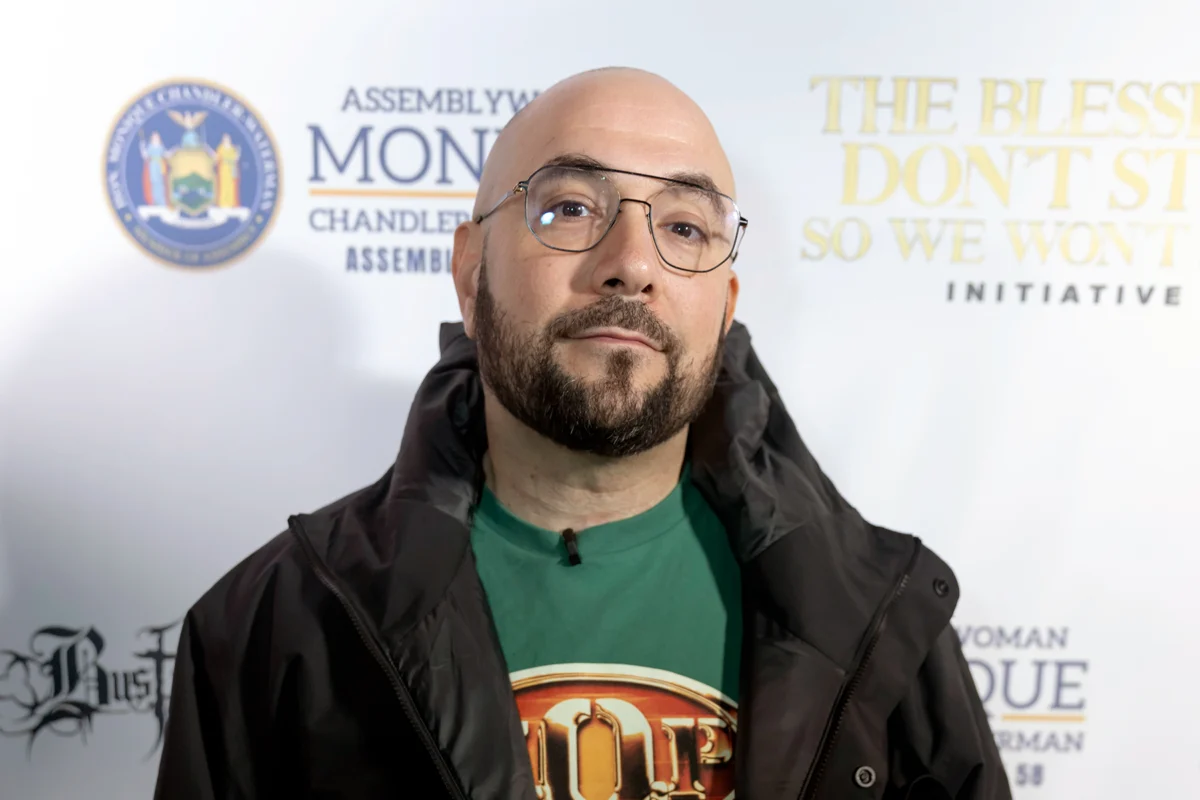
The modern entertainment industry has increasingly found itself at the epicenter of intense geopolitical friction, forcing figures known primarily for pop culture and music commentary to grapple with complex international crises. This dynamic was brought into sharp relief when long-standing media personality Peter Rosenberg—co-host of the Ebro Laura Rosenberg Show and a fixture of the New York radio landscape—sat down for a comprehensive discussion regarding his identity as a Jewish American in hip-hop, the fallout from recent events in the Middle East, and the shifting boundaries of public discourse.
The timing of this conversation coincided with escalating tensions across the North American leg of pop superstar Ed Sheeran’s Loop Tour. Sheeran found his tour’s logistical stability threatened following performances in New Jersey that featured opening act Macklemore. During the shows, Macklemore used the stage to voice support for the Free Palestine movement, drawing immediate and severe pushback from venue proprietors. Robert Kraft, owner of the New England Patriots and proprietor of Gillette Stadium, publicly condemned the remarks as hate speech, prompting Macklemore’s subsequent departure from the tour. The decision triggered a ripple effect, with supporting band members and fellow opening acts stepping down in solidarity, placing Sheeran in the middle of a high-stakes cultural and political controversy.
A Complex Chronology of Tensions and Public Discourse
To understand the current friction within the music business, industry analysts point to a gradual hardening of cultural lines that accelerated significantly following the October 7, 2023, attacks led by Hamas in Israel, and the subsequent military campaign in Gaza. However, public commentators like Rosenberg argue that the groundwork for this polarization was laid months earlier.
In late 2022, rapper Kanye West (Ye) embarked on a highly publicized series of antisemitic public statements, expressing admiration for Adolf Hitler and promoting conspiracies about Jewish influence. Rosenberg noted that this period marked a distinct, visceral shift in the tone of digital discourse, observing a marked increase in antisemitic vitriol directed at him and other Jewish public figures across social media platforms.

When the October 7 attacks occurred, resulting in the mass casualty and kidnapping of civilians at the Nova music festival and surrounding kibbutzim, the global response fractured almost immediately along ideological lines. Rather than yielding a unified period of mourning for civilian casualties, the tragedy sparked immediate counter-outrage over Israel’s subsequent military strategy. For many within the Jewish community, the lack of immediate, widespread empathy for the victims of October 7 felt isolating. Conversely, critics of Israeli policy argue that the immense scale of Palestinian casualties in Gaza has overshadowed prior atrocities, creating an environment where nuanced discussions are frequently drowned out by extreme rhetoric.
The Evolution of Jewish Identity and Hip-Hop Culture
Rosenberg’s path in the music industry offers a unique lens through which to examine these cultural shifts. Growing up in Chevy Chase, Maryland, in a politically progressive, Jewish household with roots tracing back to post-World War II displaced persons camps in Germany, Rosenberg developed an early affinity for foundational hip-hop radio.
Initially performing under the moniker PMD (Peter from Maryland) during his college years and early career in Washington, D.C., Rosenberg transitioned to New York’s Hot 97 in 2007. It was programmer Ebro Darden who encouraged him to use his given surname on air, recognizing the distinct marketing value of a multi-ethnic broadcasting lineup. Early promotional billboards for the station explicitly highlighted this diversity, featuring a Black host, a Puerto Rican host, and Rosenberg, labeled simply as the "Jew."
While Rosenberg initially viewed his distinct background as a point of novelty and connection within a predominantly Black art form, the broader sociopolitical climate has altered how such identities are perceived. Casual microaggressions once dismissed as background noise have been amplified by algorithmic polarization and high-profile celebrity controversies, transforming personal branding into a potential lightning rod for hostility.
Broader Industry Implications and the Crisis of Messaging

The Ed Sheeran tour controversy highlights a broader crisis of messaging within the entertainment sector. Industry observers note that traditional gatekeepers are no longer capable of easily containing or mitigating political fallout via corporate statements or standard public relations protocols.
In the case of Macklemore’s removal, critics from various political viewpoints pointed to what they perceived as contradictory standards: artists expressing solidarity with Palestinian civilians are frequently accused of crossing into hate speech, while performers with histories of overt antisemitism occasionally face fewer commercial repercussions depending on the nature of their current output. Rosenberg argued that the overarching messaging from institutional leaders often exacerbates tensions rather than alleviating them, creating a false binary where individuals are expected to pledge absolute allegiance to one side while entirely erasing the suffering of the other.
Furthermore, Rosenberg reflected on his family’s historical ties to Zionism, noting that his father, former AIPAC staffer and writer M.J. Rosenberg, experienced a ideological shift away from uncritical support following decades of witnessing political roadblocks to peace, culminating in the 1995 assassination of Israeli Prime Minister Yitzhak Rabin. This multi-generational critique of Israeli state policy, combined with a fierce defense of cultural Jewish identity, mirrors a growing internal debate among Jewish Americans seeking to separate their heritage from the actions of specific political administrations.
The Path Forward for Rational Discourse
As the shouting match between political extremes continues to dominate digital platforms, rational voices advocating for nuance, coexistence, and mutual recognition of trauma find themselves increasingly marginalized. Rosenberg’s critique underscores a central dilemma for modern cultural figures: the difficulty of holding two truths simultaneously—acknowledging the reality of rising global antisemitism while condemning state-sanctioned violence against Palestinian civilians.
Without institutional leadership willing to foster genuine dialogue rather than reactionary censorship, the entertainment industry is likely to face continued polarization. As the boundaries between art, commerce, and geopolitics continue to dissolve, the music world remains a volatile barometer of a deeply divided global society.

