
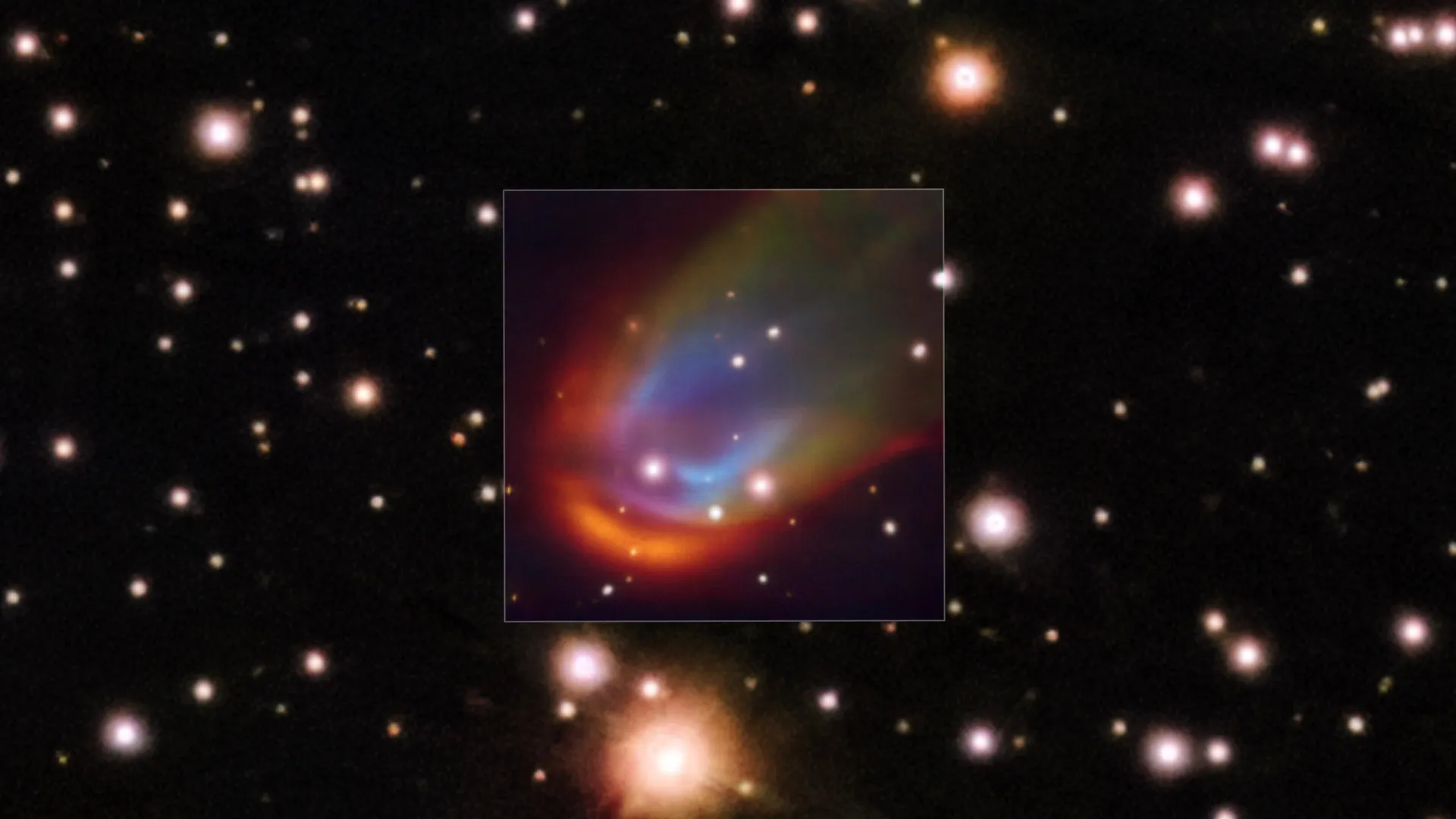
The deep reaches of the Milky Way have long been understood through the lens of predictable stellar evolution, yet a recent observation has shattered the prevailing models of how dead stars interact with their environments. Astronomers utilizing the European Southern Observatory’s (ESO) Very Large Telescope (VLT) have identified a colossal, energetic shock wave emanating from the white dwarf system RXJ0528+2838. This structure, a bow shock, typically marks the boundary where stellar winds collide with the interstellar medium. However, the presence of such a massive feature around this specific binary system—a system that lacks the standard mechanisms to fuel it—has left the scientific community searching for a "mystery engine" that currently eludes established astrophysical theory.
The discovery, detailed in a study published in the journal Nature Astronomy, presents a fundamental challenge to the standard model of binary star interactions. Under normal circumstances, a white dwarf—the inert, dense core of a low-mass star like our Sun—accretes material from a companion star. This process almost universally involves the formation of an accretion disc, a swirling ring of gas and dust that feeds the white dwarf and provides the energy for powerful outflows. RXJ0528+2838, located approximately 730 light-years from Earth, appears to be an outlier that functions without this vital component.
The Chronology of a Celestial Mystery
The path to this discovery began with wide-field survey data captured by the Isaac Newton Telescope (INT) located at the Roque de los Muchachos Observatory in the Canary Islands. During routine observations of the galactic plane, researchers noted an unusual, arc-like nebulosity surrounding the binary system. Initially, the nature of this structure was unclear; it could have been a chance alignment of an unrelated interstellar cloud or a relic of a previous supernova event.
To resolve these uncertainties, the international research team, led by Simone Scaringi of Durham University and Krystian Ilkiewicz of the Nicolaus Copernicus Astronomical Center, turned to the Multi-Unit Spectroscopic Explorer (MUSE) instrument on the VLT in Chile. The high-resolution capabilities of MUSE allowed the team to map the chemical composition and kinematics of the bow shock with unprecedented precision.
By analyzing the ionization states of the gases within the arc, the researchers confirmed that the material was physically linked to the binary system rather than being an incidental interstellar feature. Furthermore, the dimensions of the bow shock—which extends far into the surrounding space—suggest that the system has been actively expelling material for at least 1,000 years. This timeframe is significant, as it implies that the phenomenon is not a transient flicker but a persistent, long-term output of energy that the current structural model of the star cannot account for.
Analyzing the Binary Anomaly
The RXJ0528+2838 system consists of the white dwarf and a Sun-like companion star. In typical "cataclysmic variable" systems, the white dwarf’s gravity strips mass from the companion, creating an accretion disc that acts as a reservoir. The disc’s internal friction and magnetic interactions generate the high-energy environment necessary to launch polar jets or outflows.
However, spectroscopic data from the VLT confirm that RXJ0528+2838 lacks any discernible accretion disc. In the absence of this "feeding mechanism," the existence of an outflow capable of carving a bow shock into the interstellar medium is paradoxical. Noel Castro Segura of the University of Warwick, a collaborator on the study, noted that the structure acts much like the bow wave formed in front of a ship moving through water. For this "wave" to exist, the "ship"—the white dwarf—must be pushing material outward at significant velocities. Without a disc to facilitate this, the energy must be derived from an alternative source.
The Role of Magnetic Fields
One of the few remaining variables that the team could identify is the white dwarf’s intense magnetic field. The MUSE observations confirmed that RXJ0528+2838 possesses a magnetic field of considerable strength, which likely prevents the formation of a traditional disc by funneling captured matter directly onto the surface of the star along magnetic field lines.
While this explains why there is no disc, it introduces a deeper problem: the energy required to sustain a bow shock for over a millennium exceeds the energetic output that a magnetic accretion process of this scale should provide. "Our finding shows that even without a disc, these systems can drive powerful outflows," explains Krystian Ilkiewicz. "But the math does not currently balance. The present-day magnetic field strength would only be able to account for a few hundred years of such activity, leaving a gap of several centuries that remains unexplained."
This discrepancy has led researchers to propose the existence of a "mystery engine"—an unknown mechanism that may be storing or releasing energy in ways that current models of magnetic stellar physics have not yet predicted. Whether this involves complex magnetic reconnection events, internal structural oscillations of the white dwarf, or yet-to-be-identified plasma physics is a subject of ongoing debate.
Broader Implications for Stellar Evolution
The discovery of RXJ0528+2838 is more than an isolated curiosity; it serves as a "stress test" for the fundamental theories of binary evolution. If a significant population of white dwarf binaries exists that operates without accretion discs yet produces high-energy outflows, current models of how stars return matter and energy to the galaxy may be significantly underestimating the impact of these systems.
These outflows are essential to the life cycle of galaxies. By injecting heavy elements and kinetic energy into the interstellar medium, they influence the formation of subsequent generations of stars and planets. If the "standard picture" of accretion-driven outflow is only one part of the story, astronomers may be missing a major component of the chemical and kinetic feedback loops in the Milky Way.
Future Prospects with the ELT
The scientific community views this finding as a call for a systematic survey of binary systems across the galaxy. The current limitation is one of sensitivity; identifying faint bow shocks around distant white dwarfs requires the most advanced optical and infrared instruments available.
The European Southern Observatory is currently finalizing the construction of the Extremely Large Telescope (ELT), which is expected to begin operations later this decade. With a primary mirror nearly 40 meters in diameter, the ELT will provide the spatial resolution and light-gathering power necessary to study the surroundings of stars like RXJ0528+2838 in extreme detail.
"We are looking forward to using the ELT to map more of these systems, including much fainter candidates that we currently cannot resolve," says Simone Scaringi. By expanding the sample size, researchers hope to identify whether the "mystery engine" in RXJ0528+2838 is a unique anomaly or a common, albeit overlooked, feature of white dwarf binary evolution.
As the data from this study continues to be integrated into stellar models, the case of RXJ0528+2838 stands as a testament to the fact that the universe continues to hold surprises, even within the relatively well-understood classes of stellar remnants. The transition from the "known" to the "unexpected" in this system provides a roadmap for future research, highlighting that in the study of the cosmos, the most profound discoveries often lie in the phenomena that should not be there at all. For now, the "mystery engine" remains silent, but its footprint in the interstellar medium remains a clear, glowing marker of a process that humanity has yet to master.

