
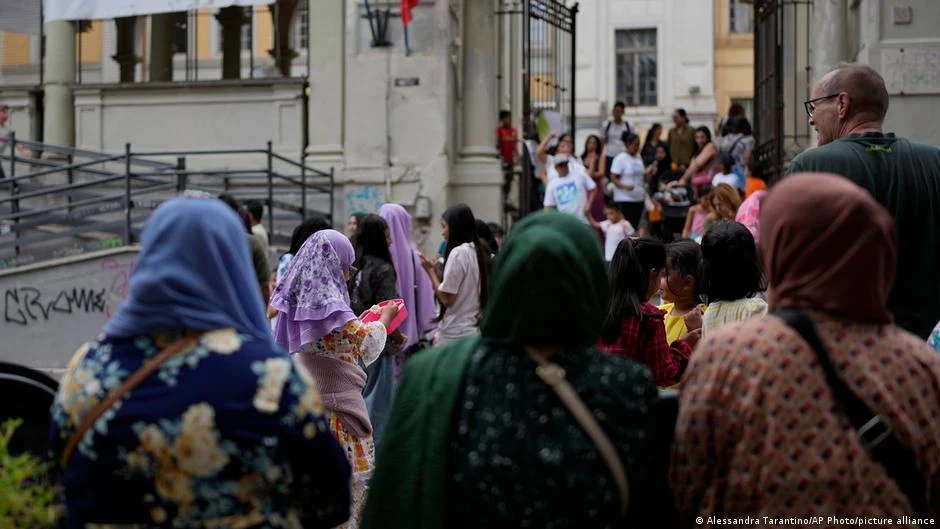
Italy’s right-wing coalition government, led by Prime Minister Giorgia Meloni, has taken a decisive step to reshape the nation’s educational landscape by approving a new decree that imposes significant restrictions on face-covering Islamic garments in schools and establishes caps on the number of non-native Italian speakers allowed in individual classrooms. The decree, which was passed by the Cabinet on Thursday, marks a controversial milestone in the administration’s broader agenda to preserve national cultural identity and accelerate the integration of migrant populations into the Italian public school system.
The policy, which takes effect immediately as an emergency measure, must still navigate the legislative process, requiring approval from the Italian Parliament within the next 60 days. Given the current parliamentary majority held by Meloni’s coalition, analysts expect the measures to be codified into law with relative ease, despite significant opposition from human rights advocates and political rivals.
A Chronology of Evolving Educational Policy
The current decree is the culmination of months of rhetoric from the Brothers of Italy party regarding the "dilution" of Italian heritage in public institutions. Since taking office, Prime Minister Meloni has consistently framed education policy as a battleground for social cohesion.
The seeds of this policy were planted early in the legislative session, with Education Minister Giuseppe Valditara frequently suggesting that the "excessive" concentration of non-Italian students in specific urban districts was detrimental to the learning outcomes of all pupils. The government’s narrative has consistently maintained that language barriers act as a hurdle to academic success and social assimilation.
The move to ban face-coverings in schools follows a long-standing European debate on secularism and public identity. While countries like France implemented broad bans on religious symbols in schools as early as 2004, Italy has historically maintained a more fragmented approach. The new decree seeks to standardize this, specifically targeting the burqa and niqab, while explicitly excluding the hijab—a distinction the government justifies based on the total visibility of the wearer’s face.
Statistical Context and Educational Demographics
The scope of the new regulation is, according to the Ministry of Education, targeted rather than universal. Education Minister Giuseppe Valditara noted that the restriction on the number of students with a poor command of Italian will impact approximately 1,000 classrooms across the country. In the context of Italy’s massive public education infrastructure, this represents roughly 0.3% of the nationwide total of classrooms.
Official data provided by the Ministry of Education and Research (MIUR) highlights the demographic shifts occurring within Italian schools. During the 2022–2023 academic year, students without Italian citizenship accounted for 11.2% of the total student population. While the national average remains relatively stable, the distribution is highly uneven. Approximately 7.6% of classrooms currently contain a foreign student population exceeding 30%.
The government argues that these "ghetto classes," as Prime Minister Meloni has characterized them, prevent the effective teaching of the Italian language and hinder the development of a shared civic identity. By capping these numbers, the government aims to force a more equitable distribution of students across different districts, though critics warn this could lead to the forced busing of students away from their local communities.
Official Rationales and Government Objectives
Prime Minister Meloni has defended the measures as "tools of common sense that do not divide," arguing that they are essential for ensuring that every child in Italy, regardless of their background, has access to the same opportunities. During her address to the Cabinet, Meloni emphasized that the primary goal of the language cap is to facilitate language acquisition, which she identifies as the fundamental prerequisite for inclusion.
Regarding the ban on the burqa and niqab, the government’s justification is rooted in security and the promotion of personal agency. Meloni stated in a recent television interview, "When a woman, or worse, a young girl, is forced to cover her face, she is being denied fundamental rights and the very integration that is so often loudly championed." The government maintains that the educational environment requires clear communication and identification, both of which are compromised by full-face veils.
Opposition and Civil Society Criticism
The announcement has sparked an immediate and sharp backlash from opposition parties and civil society organizations. Elly Schlein, leader of the Democratic Party, characterized the decree as a "new witch hunt at the expense of children," arguing that the government is utilizing education as a political football to appease its conservative base ahead of next year’s general election.
Human rights organizations have been particularly vocal in their dissent. Save the Children, an independent child rights group, issued a stern statement on Wednesday urging the government to reconsider the implications of the decree. The organization warned that the policy risks stigmatizing immigrant students, effectively labeling them as "second-class" citizens.
"Such a criterion creates a hierarchy of students," the statement read, emphasizing that segregating children based on their linguistic proficiency or cultural background undermines the inclusive mission of public education. There are also deep concerns among local school administrators regarding the logistical feasibility of the plan. In cities with high migrant density, such as Milan, Turin, and Rome, school authorities have questioned where the additional capacity will come from if students are to be redistributed to ensure lower concentrations of foreign-born pupils.
Analysis: Implications for the Italian Educational System
The implications of this decree extend far beyond the immediate classroom changes. For the Meloni administration, this is a consolidation of the "national sovereignty" platform that brought them to power. By prioritizing the Italian language as the primary vehicle for integration, the government is signaling a shift away from multiculturalism toward a model of assimilation.
However, the policy faces significant legal and practical challenges. Legal scholars in Italy have already begun to debate whether a national cap on foreign students violates the constitutional right to education for all, regardless of background. If the government’s attempt to redistribute students results in long commutes for children or the exclusion of students from their neighborhood schools, the policy could face challenges in the Constitutional Court.
Furthermore, the focus on the burqa and niqab—garments that are relatively rare in the Italian school system—is viewed by many analysts as a symbolic move designed to address the anxieties of the electorate rather than a response to a widespread pedagogical crisis. By tackling visible signs of religious difference, the government is successfully dominating the national discourse, though it risks alienating moderate voters and deepening the divide with the country’s growing migrant communities.
As the decree moves toward parliamentary review, the focus will shift to how the government intends to fund the necessary support systems. If the goal is truly to improve the language proficiency of students, critics argue that the investment should be in language labs, specialized teachers, and tutoring programs, rather than in caps and restrictions. Whether the Meloni government chooses to follow this path or remains committed to a strategy of restriction will determine the long-term success of this controversial educational reform. For now, the Italian school system finds itself at the center of a profound ideological struggle that reflects the broader tensions within European society regarding identity, integration, and the role of the state in personal expression.

