
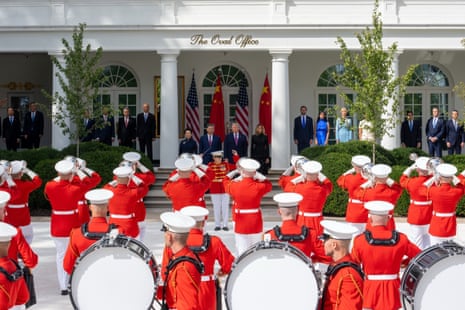
The White House press corps experienced an unprecedented day of logistical chaos and legal confrontation on Thursday, culminating in a bizarre public grievance from President Donald Trump. While awaiting a high-stakes state visit from Chinese President Xi Jinping, Trump took to his social media platform, Truth Social, to launch a scathing attack against two major news networks, CNN and MS Now. The president accused the broadcasters of intentionally boycotting his administration’s elaborate welcome ceremony for the Chinese leader out of partisan malice.
However, a closer examination of the timeline and mechanical operations of the White House press pool reveals a starkly different reality: the lack of live television coverage was a direct consequence of the administration’s own persistent efforts to bar those very news organizations from the premises, in apparent defiance of a federal court order.
The incident highlights a deepening constitutional crisis regarding press freedom, executive overreach, and the complex mechanisms that govern how the American public receives information about the presidency.

A Chronology of Conflict: From Bans to Courthouse Battles
The roots of Thursday’s broadcasting blackout stretch back to the previous week, when President Trump announced a surprise directive via social media banning journalists from CNN, Politico, and MS Now from accessing the White House grounds. Administration officials initially defended the move by asserting that the outlets posed an unspecified threat to national security, though critics and legal experts immediately characterized the ban as retaliation for critical reporting of the presidency.
In response, the targeted news organizations filed an emergency federal lawsuit arguing that the ban constituted a clear violation of the First Amendment rights of journalists and the public’s right to information.
The legal battle moved with remarkable speed. Late Wednesday night, US District Judge Timothy Kelly, a Trump appointee who had previously ruled in favor of press access during Trump’s first term, issued a temporary restraining order. The judge ordered the administration to immediately restore the press credentials of the banned outlets and halted the enforcement of the media ban for 14 days to preserve the legal status quo while litigation proceeded.
Despite the binding judicial directive, Thursday morning brought immediate defiance from executive branch security. Reporters and photojournalists from CNN, MS Now, and Politico attempting to enter the White House were turned away by Secret Service personnel. In several instances, security details confiscated the physical hard passes of journalists whose credentials had not yet been processed back into the system, claiming their passes were still registering as disabled.
Lawyers for the media coalition rushed back to federal court before dawn, requesting an emergency enforcement hearing. Judge Kelly subsequently ordered the administration to immediately explain its failure to comply. By Thursday afternoon, following hours of administrative delays and intense behind-the-scenes negotiations, the reporters were finally granted physical entry to the complex.
The Broadcast Pool Stand-off
While individual reporters eventually regained entry, the broader television infrastructure remained crippled due to collective action within the press corps.
Under long-standing operational protocols, the White House press office relies on a rotating pool system among five major networks—ABC, CBS, NBC, Fox News, and CNN—to supply video footage of presidential events to all other domestic and international broadcasters. Following the initial announcement of the CNN ban last week, the remaining four networks refused to provide pool video coverage in solidarity with their colleague.
As Thursday’s welcoming ceremony for President Xi approached, the broadcast pool requested official assurances from the White House press office that CNN crews would be fully integrated back into the rotation without operational restrictions. When those guarantees were not forthcoming, the networks held their ground, resulting in zero live video feeds of the historic arrival ceremony being distributed to the American public or global news agencies.
The President’s Truth Social Grievance
Unaware of—or choosing to ignore—the cascading operational failures engineered by his own staff and security apparatus, President Trump took to Truth Social during a two-hour break before hosting a state dinner for President Xi.
"The event was magnificent — Actually made for Television but, because they’re Fake News, and because they knew how good it would be, they didn’t want credit to be given to ‘TRUMP,’ they refused to be there," the president posted.
In subsequent posts, Trump expanded on his grievances, asserting that CNN and MS Now "only write badly about a man who won the Election IN A GIANT LANDSLIDE, winning all 7 Swing States, the Popular Vote, and 86% of the Counties, etc."
Legal and media analysts were quick to point out the ironies and potential legal pitfalls of the president’s public statements. By explicitly complaining that the networks failed to provide glowing coverage of his administration because of his electoral victory, the president appeared to offer a frank admission that the motivation behind the media ban was political retaliation rather than national security—a distinction crucial to the ongoing First Amendment lawsuit.

Statistical Context and Electoral Realities
Trump’s assertions regarding the magnitude of his electoral victory also drew immediate fact-checking scrutiny. While the president frequently characterizes his return to office as an overwhelming landslide, official election data compiled by political analysts tells a more nuanced story.
Trump’s popular vote victory over Democratic nominee Kamala Harris in the 2024 election was secured by a margin of just under 1.5% of total votes cast. His electoral college total exceeded that of Joe Biden’s 2020 victory by a narrow margin of six votes, while Biden’s 2020 popular vote margin stood at 4.4%.
While the administration frequently highlights that Trump won the majority of votes in approximately 85% of US counties, demographic analysis reveals that these statistics reflect geographic rather than population dominance. According to data tracked by organizations such as Ballotpedia and the Cook Political Report, roughly 48.1% of the American population—amounting to approximately 160 million citizens—resides in counties that voted consistently for Democratic nominees in the 2016, 2020, and 2024 cycles. Conversely, approximately 40.1% of the population resides in the more sparsely populated rural counties that consistently favored Trump across the same three elections.
Broader Implications for Executive Power and Press Freedom
The collision between the White House and the media pool on Thursday underscores a hardening battle line between the executive branch and independent journalism.
As the temporary restraining order remains in effect, the legal battle over White House press access is expected to proceed through the federal court system, potentially setting a monumental legal precedent regarding the limits of presidential authority over government property and press credentials.
Meanwhile, the episode has left lawmakers, international observers, and media watchdogs alarmed over the vulnerability of institutional norms. Whether the administration will fully normalize relations with the press corps or continue to test the boundaries of judicial oversight remains one of the most pressing questions in American politics as the current term unfolds.

