
Business leaders from Germany and China convened in Düsseldorf last week, an event intended to foster economic dialogue. Yet, beneath the veneer of trade cooperation and investment discourse, the pervasive shadow of the US-China strategic rivalry dominated every conversation. As the global economy faces a period of profound uncertainty, the meeting served as a microcosm of the geopolitical friction currently forcing nations to choose sides—or, in the case of a growing coalition of "middle powers," to forge a path of strategic autonomy.
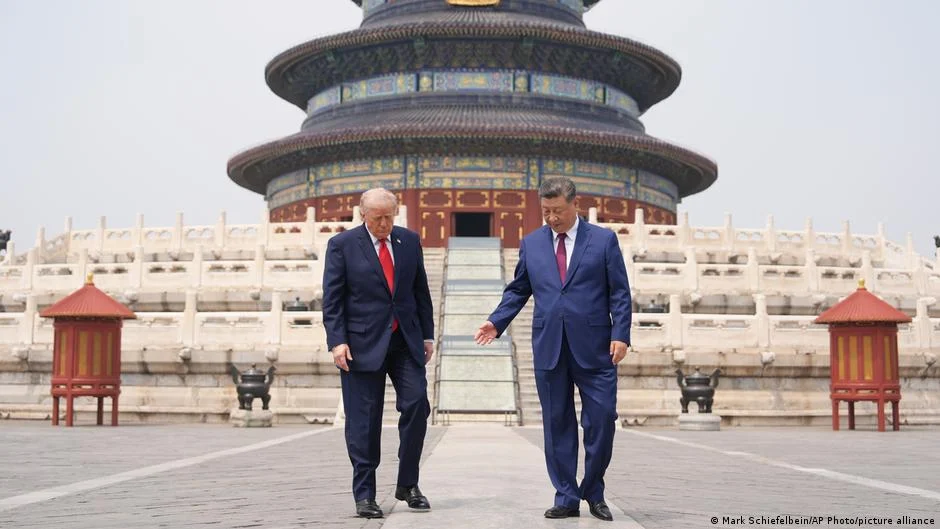
The immediate focus of the global diplomatic community is currently fixed on Washington, where Chinese President Xi Jinping and US President Donald Trump are set for a high-stakes summit. With the US-China trade war intensifying, stakeholders are tempering expectations. The previous encounter between the two leaders at a Beijing summit in May resulted in a diplomatic stalemate, leaving observers skeptical that a breakthrough is imminent.
A State of Strategic Stalemate
"The assumption in Beijing, and the primary operating principle for the Chinese leadership, is that China and the US will effectively hold each other in check for the foreseeable future," explained Mikko Huotari, director of the Berlin-based China think tank MERICS, during a recent policy briefing.
This stalemate is arguably a deliberate strategy for both administrations. For President Xi, the priority is securing time to recalibrate the Chinese economy and stabilize domestic output. For President Trump, the focus remains on domestic political optics ahead of the crucial US midterm elections in November. While a deal could provide a much-needed political win for the Republican Party, both sides remain entrenched. As President Trump noted regarding the upcoming meeting, "We will discuss everything," though analysts caution that "everything" may not lead to anything substantive.
The Artificial Intelligence Frontier
The most volatile aspect of this rivalry is the race for technological supremacy, specifically in artificial intelligence (AI). The current landscape is defined by mutual economic strangulation: the United States has imposed strict prohibitions on the export of high-performance semiconductor chips to China, aiming to degrade Beijing’s AI capabilities. In response, China has weaponized its dominance in rare earth elements, which are essential for the global semiconductor supply chain.
Despite these escalations, there is a glimmer of cautious optimism regarding AI safety. Following discussions in New York with Chinese Vice Premier He Lifeng, US Treasury Secretary Scott Bessent indicated that both nations have begun exploring the creation of a "notification mechanism" to share information regarding AI-related security incidents. This move mirrors Cold War-era "hotlines," designed to prevent catastrophic accidents, though it does little to resolve the fundamental ideological divide. While Xi has publicly called for international cooperation on AI, the Trump administration remains wary, viewing stringent regulation as a direct threat to American leadership in the field.
Europe and the Second China Shock
Europe finds itself in an increasingly precarious position, caught between the protectionist impulses of the United States and the aggressive export strategies of China. European Commission President Ursula von der Leyen, in her 2026 State of the Union address, explicitly warned that a "second China shock" is underway.
The first shock, occurring two decades ago following China’s accession to the World Trade Organization, flooded global markets with inexpensive consumer goods. The current iteration is far more sophisticated, centered on China’s rapid technological leap in battery technology, renewable energy infrastructure, and electric mobility. "It shows in our communities and in factories across our Union," von der Leyen stated. "It leads to deindustrialization in the industrial heartlands of Europe. This is unsustainable."
Brussels is currently debating the implementation of punitive tariffs on low-cost Chinese electric vehicles to protect the European automotive industry. However, the proposal faces fierce internal opposition. Major German automakers, including Volkswagen and BMW, have lobbied against the move, fearing that a trade war with Beijing would result in retaliatory measures that could devastate their revenues in the vital Chinese market. A Chinese executive at the Düsseldorf summit, speaking on condition of anonymity, confirmed the urgency of the situation: "China’s domestic consumption cannot absorb its current manufacturing capacity. Companies are desperate to tap into foreign markets because the domestic economy is weak."
The Rise of Middle Power Diplomacy
Facing the twin pressures of US tariffs and the volatility of the transatlantic alliance, traditional US allies are increasingly seeking to hedge their bets. Canadian Prime Minister Mark Carney has become the most vocal proponent of a "variable geometry" approach to diplomacy—a strategy that eschews total reliance on the US in favor of diverse, issue-specific alliances.
"We know the old order is not coming back. We shouldn’t mourn it," Carney declared at the 2026 World Economic Forum in Davos. His rhetoric reflects a broader sentiment among middle powers that bilateral negotiations with a hegemon inevitably lead to a position of weakness. "If we’re not at the table, we’re on the menu," Carney famously warned.
Canada’s recent pivot includes a "new-era strategic partnership" with Beijing, which saw Ottawa lower import tariffs on Chinese electric vehicles from 100% to 6.1%, albeit within a strict quota of 49,000 units annually. This maneuver has not gone unnoticed in Washington. President Trump has publicly derided the idea of the European Union offering Canada "associate membership," threatening to impose "very serious tariffs" on Europe should the move be perceived as a hostile act against US interests.
Chronology of Escalation
- 2025 (Q4): US intensifies export bans on high-performance chips to China; China responds by restricting rare earth exports.
- May 2026: US-China summit in Beijing concludes without a joint communique or tangible trade policy shifts.
- September 2026: China attends the BRICS summit in India and the Shanghai Cooperation Organization (SCO) summit in Kyrgyzstan, bolstering ties with the Global South.
- September 2026: EU Commission President Ursula von der Leyen formally identifies the "second China shock" as a primary threat to European industrial stability.
- October 2026: US Treasury Secretary Scott Bessent and Chinese Vice Premier He Lifeng initiate talks on an AI safety notification mechanism in New York.
- November 2026: Upcoming APEC summit in Shenzhen and the G-20 summit hosted by China, where middle powers are expected to further solidify alternative diplomatic pathways.
The Implications for Global Stability
The shift toward "variable geometry" represents a fundamental change in the post-WWII international order. As the United States adopts a more isolationist, protectionist stance under the Trump administration, the traditional network of alliances that once stabilized the global economy is fraying.
The strategy employed by middle powers—such as Canada and, to a lesser extent, certain EU member states—is an attempt to maintain economic sovereignty in a world where the two largest economies are increasingly decoupling. However, this strategy is not without its risks. By attempting to maintain positive relations with both Beijing and Washington, these nations risk the ire of both, potentially finding themselves squeezed in the crossfire of the next phase of the trade war.
Furthermore, the lack of transparency in the US-China relationship creates a high probability of miscalculation. While officials on both sides speak of "guardrails," the absence of a comprehensive framework to manage competition ensures that the global economy will remain in a state of flux.
As the world looks toward the upcoming summits in Washington and Shenzhen, the consensus among economists is that the era of hyper-globalization is over. In its place is an emerging era of fragmented regionalism, where the ability to navigate competing spheres of influence will determine which nations survive the coming decade of transition. For the global business community, the message is clear: the era of stability has been replaced by an era of strategic agility, where alliances are fluid, and the only constant is the pressure to adapt.

