
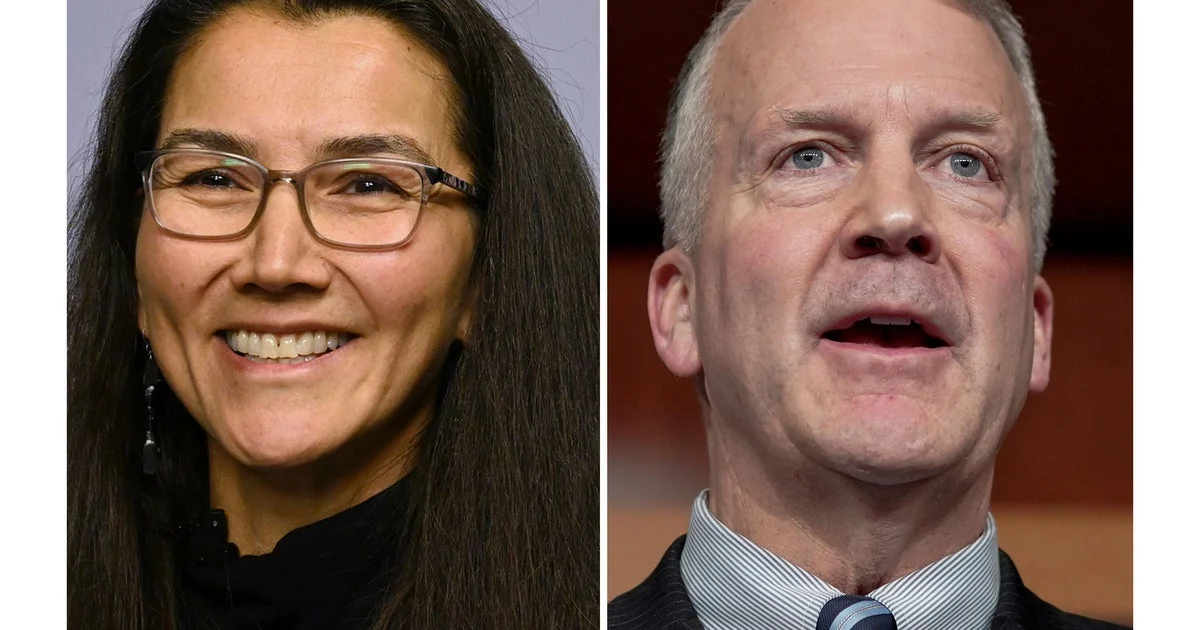
ANCHORAGE, Alaska — The federal prosecutor’s office in the District of Alaska has dramatically escalated its involvement in one of the most contentious political controversies of the 2026 midterm cycle, confirming that a surge of law enforcement assets has been deployed to the state following explosive new reporting regarding the origins of an independent candidate’s Senate campaign.
Speaking at a heavily attended press conference in Anchorage, U.S. Attorney Michael Heyman described recent investigative findings as "troubling," signaling a heightened level of federal scrutiny just days before voters head to the polls. The core of the controversy centers on Daniel J. Sullivan, an independent candidate whose identical name matches that of the Republican incumbent, Senator Dan Sullivan. The presence of the second candidate on the ballot has ignited a fierce partisan firestorm, with Republicans alleging a coordinated "sham" candidacy designed to siphon conservative votes and boost Democratic incumbent Mary Peltola in a race that could help determine control of the United States Senate.
While Heyman declined to specify the exact statutory violations under active investigation—noting that prosecutors are examining multiple legal theories and making no immediate assumptions of guilt—the Justice Department’s footprint in the state has expanded significantly. The investigation, which officials noted had been quietly progressing for several months, broke into public view following extensive investigative reporting that detailed alleged backroom recruitment efforts by operatives connected to the Peltola campaign and the Democratic Senatorial Campaign Committee (DSCC).
The Genesis of a Ballot Controversy
The controversy surrounding the 2026 Alaska Senate race dates back to the candidate filing period, when the appearance of a second Daniel J. Sullivan on the state’s ranked-choice ballot raised immediate red flags among state election officials. Recognizing the potential for widespread confusion among the electorate, the Alaska Division of Elections initially disqualified the independent candidate, determining that his entry was a deliberate attempt to mislead voters and disrupt the integrity of the electoral process.
However, that administrative decision was swiftly challenged in state court. A series of judicial rulings ultimately overturned the disqualification, with state courts concluding that election administrators lacked the statutory authority to bar a candidate based on subjective interpretations of "good faith" or voter confusion, provided the candidate met the basic constitutional and administrative requirements for ballot access.
The issue took a dramatic turn when investigative reporting published by The New York Times revealed internal communications and alleged connections between Democratic political operatives and the recruitment of the independent candidate. The reports suggested that individuals linked to the Peltola campaign and national Democratic campaign arms orchestrated a strategic effort to recruit and prop up the lesser-known Daniel J. Sullivan as a political spoiler.
The revelations prompted immediate local and federal fallout. Alaska Governor Mike Dunleavy swiftly ordered a state-level inquiry into the ballot dynamics, while federal investigators began issuing grand jury subpoenas targeting various political figures and operatives associated with the Democratic campaign apparatus.
Official Denials and Partisan Crossfire
The allegations have drawn sharp denials from Representative Mary Peltola and national Democratic organizations, who have forcefully rejected any wrongdoing or knowledge of an orchestrated conspiracy.
Speaking to reporters in the final stretch of the campaign, Peltola maintained her innocence, stating unequivocally that she had no prior knowledge of alternative candidates sharing the incumbent’s name and emphasized her commitment to a transparent campaign. "I am not interested in tricking voters," Peltola said. "I knew nothing about any other candidates on the ballot except for me and the incumbent."
Conversely, the Democratic Senatorial Campaign Committee has countered by accusing Republican aligned entities of engaging in systemic ballot manipulation and recruitment tactics in past and present election cycles. Democrats argue that the intense scrutiny directed at their campaign is a politically motivated effort by the incumbent party to deflect attention from broader structural debates over electoral fairness and the use of third-party candidates in competitive races.
Federal Escalation and Civil Litigation
The federal government’s intervention extends beyond criminal investigative queries into civil courtrooms. In a rare and aggressive maneuver, the administration has filed a civil lawsuit seeking to block the state of Alaska from certifying the final results of the Senate election if the Republican incumbent is defeated, citing severe and unavoidable "voter confusion."
In court filings submitted to the U.S. District Court for the District of Alaska, the Justice Department requested a preliminary injunction aimed at ensuring the preservation, segregation, and independent auditing of ballots potentially impacted by voter confusion. The federal government also moved for expedited discovery, setting a tight legal timetable just days before election day.
The legal brief submitted by the government leans heavily on the investigative reporting that brought the matter to light, asserting that the independent candidate’s primary objective was never legitimate public service. "Daniel J. Sullivan does not seek to serve in the U.S. Senate but rather seeks to confuse voters," the federal filing states. "Accordingly, there will indeed be voter confusion caused by this frivolous candidacy."
During Friday’s press briefing, U.S. Attorney Heyman also addressed procedural questions regarding his own involvement in the case. Heyman confirmed that he had previously been recused from the matter due to pending consideration for a federal judicial nomination. However, he clarified that the recusal had been officially rescinded after his judicial consideration concluded, allowing him to resume oversight of the district’s legal operations.
Implications for Election Integrity and Future Jurisprudence
As Alaska voters prepare to cast their ballots, the convergence of federal criminal investigations, civil injunction requests, and fierce partisan combat has cast a long shadow over the state’s electoral process. Legal scholars and election law experts note that the case establishes a rare precedent regarding the intersection of federal prosecutorial power, state-administered elections, and allegations of fraudulent ballot placement.
Regardless of the immediate electoral outcome on Tuesday, the fallout from the dual-Sullivan controversy is expected to resonate far beyond Alaska. The legal battles over candidate qualification, the bounds of federal intervention in state-run elections, and the ongoing inquiries by the Justice Department suggest that the legal and political repercussions of the 2026 Alaska Senate race will be debated in courtrooms and legislative chambers for months to come.

