
The digital education landscape has undergone a profound transformation, evolving from rudimentary flashcard programs into an expansive ecosystem of interactive simulations, AI-driven adaptive platforms, and global citizen-science portals. As remote learning, hybrid classrooms, and independent upskilling continue to shape modern education, educators, students, and parents face an overwhelming array of choices. Determining the most effective learning tools requires moving past flashy interfaces to evaluate core pedagogy, accessibility, and the specific engagement models that foster genuine cognitive retention.
An exhaustive analysis of contemporary educational technology reveals that the utility of a digital learning tool is intrinsically tied to its specific use case. Whether a user is a preschooler developing foundational literacy, a high schooler grappling with advanced calculus, a university student managing complex study schedules, or an adult mastering a new profession, the modern application market offers tailored solutions. However, navigating these options demands a structured understanding of platform availability, pricing models, and technological capabilities across web, iOS, and Android systems.
Comprehensive Classification of Modern Learning Platforms
To understand the breadth of current educational technology, applications and browser-based tools can be categorized by their primary pedagogical functions: foundational academics, interactive STEM exploration, literacy and language acquisition, study optimization, and immersive global observation.
Foundational Academics and Structured Curriculum
For core academic subjects spanning mathematics, science, and the humanities, comprehensive platforms provide structured lessons paired with adaptive practice.
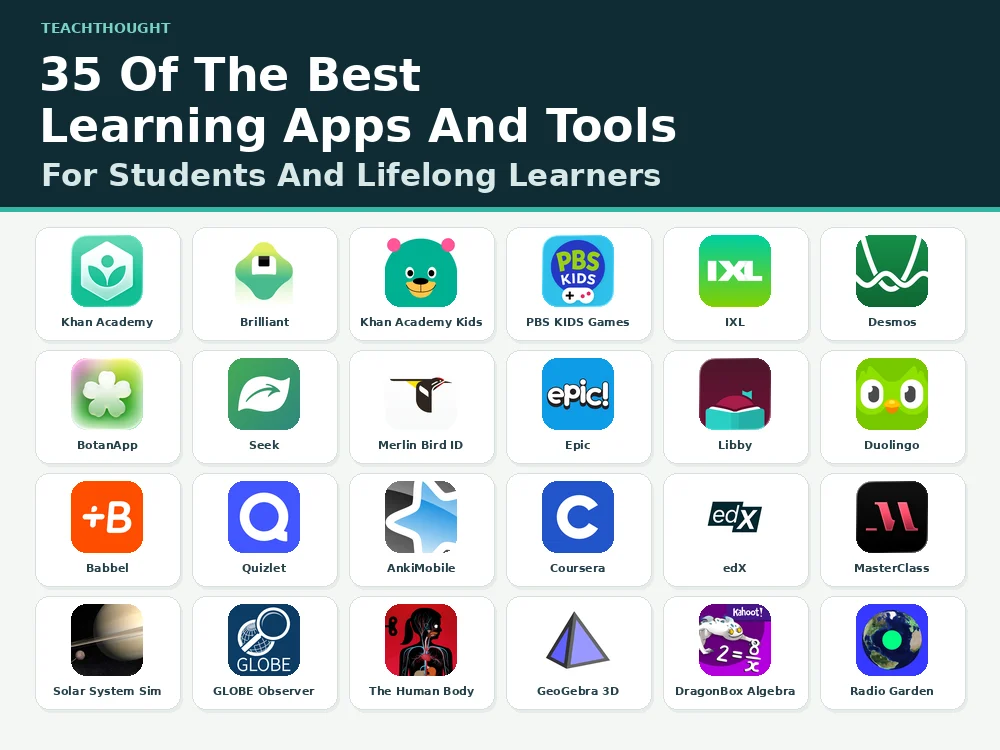
- Khan Academy: Operating as a cornerstone of free digital education, this platform delivers extensive lessons and practice modules across mathematics, science, and humanities. It remains widely accessible via web browsers, iOS, and Android devices, serving as a vital equalizer in modern classrooms.
- Brilliant: Rejecting traditional lecture-first methodologies, Brilliant teaches mathematics, coding, data science, and physics through interactive, problem-solving sequences designed to spark critical thinking.
- IXL: Offering hyper-targeted practice regimens, IXL addresses specific curriculum standards in mathematics, language arts, science, social studies, and Spanish, providing immediate feedback to reinforce skill mastery.
- BrainPOP: Aimed primarily at upper-elementary and middle school students (grades 3 through 8), BrainPOP utilizes short, animated conceptual explanations paired with quizzes and gamified activities to demystify complex school subjects.
- Coursera and edX: These massive open online course (MOOC) providers bridge the gap between secondary education and higher learning, hosting accredited programs, certifications, and specialized courses from top-tier global universities and major technology corporations.
- MasterClass: Focusing on practical, real-world mastery, this subscription video library features notable industry practitioners teaching specialized subjects ranging from creative writing and culinary arts to music production and design.
Early Childhood and Interactive STEM
Engaging younger learners requires a delicate balance of gamification and sound developmental psychology, while STEM education at all levels increasingly relies on visual manipulation and computational logic.
- Khan Academy Kids: A dedicated early-learning application providing toddlers and young children with interactive books, guided games, and foundational activities in reading and basic mathematics.
- PBS KIDS Games: Leveraging familiar television characters, this platform delivers preschool and elementary-age children safe, curriculum-based games that foster social-emotional learning and early literacy.
- Desmos Graphing Calculator: A universally acclaimed, free digital tool that allows students to visualize mathematical equations, explore algebraic relationships, and interact dynamically with graphical data.
- PhET Interactive Simulations: Developed by the University of Colorado Boulder, PhET provides robust, research-backed interactive simulations in physics, chemistry, earth science, and mathematics, helping students connect abstract theories to tangible visual models.
- Scratch: Created by the Lifelong Kindergarten Group at the MIT Media Lab, Scratch introduces children and beginners to programming through a visual, block-based environment where they can build interactive stories, animations, and games.
- Polypad and GeoGebra 3D Calculator: These advanced mathematical workspaces supply digital manipulatives, geometric shapes, and three-dimensional modeling tools that transform abstract spatial concepts into tangible interactive experiences.
- DragonBox Algebra 12+: By gamifying algebraic transformations through visual puzzles, this application gradually introduces formal mathematical notation, making complex equations intuitive for younger students.
- The Human Body by Tinybop: An immersive anatomical model that empowers children to explore human biological systems by interacting directly with on-screen simulations of physiological processes.
Literacy, Reading, and Language Acquisition
Language learning and literacy development have been revolutionized by adaptive spaced repetition and digital library access, connecting readers to global resources instantly.
- Epic: Functioning as a digital library for children, Epic houses thousands of popular ebooks, read-to-me titles, and audiobooks designed to encourage independent reading habits.
- Libby: Connecting patrons directly to their local public libraries, Libby allows users to borrow ebooks, audiobooks, and digital magazines seamlessly across mobile devices and e-readers.
- Duolingo: Utilizing short, gamified, and heavily sequenced lessons, Duolingo helps users build daily language habits focusing on vocabulary retention and fundamental sentence patterns across dozens of global languages.
- Babbel: Taking a more structured, conversational approach, Babbel emphasizes practical dialogues, real-world phrasing, and contextual grammar to accelerate practical fluency for adult learners.
Study Systems and Memory Optimization
Long-term retention relies heavily on active recall and spaced repetition, principles that form the backbone of modern digital flashcard systems.
- Quizlet: A ubiquitous study utility that enables users to create, share, and practice digital flashcard sets, utilize interactive study modes, and test their knowledge before examinations.
- Anki: Operating on advanced spaced repetition algorithms, Anki automatically schedules flashcard reviews based on the user’s historical accuracy, optimizing memory retention for demanding academic and professional fields.
Creative Production and Civic Engagement
Modern education extends beyond consumption into active creation and community participation, fostering digital citizenship and creative expression.
- Book Creator: A versatile platform enabling students and educators to author, design, and publish multimedia digital books incorporating text, original artwork, embedded audio narration, and video.
- iCivics: Founded to combat declining civic engagement, this platform utilizes interactive games and classroom simulations to teach students how democratic institutions, judicial systems, and government frameworks operate.
- Musicca: A dedicated browser-based suite of interactive exercises designed to help aspiring musicians master music theory, ear training, and score notation.
Environmental Science, Exploration, and Citizen Science
Technology has also turned the physical world into an interactive laboratory, enabling students and enthusiasts to contribute directly to global scientific research.
- Botan App and Plant Identifier: Utilizing device cameras and machine learning algorithms, these applications analyze plant photographs to suggest species classifications and provide tailored botanical care instructions.
- Seek by iNaturalist: Encouraging outdoor exploration, Seek gamifies biodiversity tracking, allowing users to point their device cameras at plants, animals, and fungi to identify species in real-time.
- Merlin Bird ID: Developed by the Cornell Lab of Ornithology, this powerful tool identifies North American and global birds through photographs, physical descriptions, or audio recordings of their songs.
- Solar System Sim and NASA’s Eyes: These immersive visualization environments allow users to pilot spacecraft, observe planetary mechanics, and manipulate orbital physics using authentic space agency telemetry.
- GLOBE Observer: A premier citizen-science initiative that enlists everyday users to record environmental observations—such as cloud cover, mosquito habitats, and land cover—directly supporting NASA and international researchers.
- OneZoom: An interactive, zoomable "tree of life" visualization that maps the evolutionary relationships and common ancestry of millions of species across the biological spectrum.
- Zooniverse: The world’s largest and most popular platform for citizen science, connecting volunteers with professional researchers who need human analysis to classify galaxies, transcribe historical manuscripts, and examine ecological data.
- Radio Garden and Explore.org Live Cams: Offering global perspectives, Radio Garden lets users tune into live radio broadcasts by rotating an interactive 3D globe, while Explore.org provides high-definition remote camera feeds of wildlife habitats worldwide.
Economic, Technological, and Institutional Implications
The widespread adoption of these digital learning tools carries significant implications for modern educational equity, institutional budgeting, and pedagogical methodology. On one hand, free browser-based simulations and open-access repositories democratize elite educational resources. A student in a rural district with an internet connection can access university-level mathematics tutorials, explore interactive biological models, or participate in active NASA research projects.
However, the rapid commercialization of educational technology introduces notable economic challenges. Many advanced platforms operate on freemium models, locking premium analytics, personalized study paths, or offline accessibility behind costly monthly or annual subscriptions. For underfunded school districts and low-income families, this digital divide can exacerbate existing educational disparities. Furthermore, reliance on proprietary applications raises critical questions regarding student data privacy, screen time management, and the potential displacement of human pedagogical nuance by automated algorithms.
Strategic Selection for Educators and Learners
Choosing the appropriate educational technology requires a deliberate, goal-oriented framework rather than a superficial assessment of interface design. Educators and independent learners must evaluate three core pillars before committing resources:
- The Core Learning Objective: Clarify whether the goal is conceptual introduction, targeted skill drilling, creative production, or passive exploration.
- The Developmental Stage: Ensure the platform’s cognitive load, reading level, and interface design match the user’s age and developmental maturity.
- The Feedback Mechanism: Prioritize tools that provide constructive, immediate, and actionable feedback rather than mere reward loops.
Ultimately, the most effective learning app is not determined by its ranking on an app store chart, but by how seamlessly it integrates into a broader educational strategy—whether that means a five-minute math simulation in a middle school classroom, an all-year digital library subscription, or a months-long professional certification course.

