
The 100th Macy’s Thanksgiving Day Parade has been officially postponed due to severe weather, marking an unprecedented scheduling change in the century-long history of the iconic American holiday tradition. New York City officials announced late Wednesday evening that the historic milestone march would be moved from Thanksgiving morning to Saturday, November 28, at 8:30 a.m. EST. The decision came as a powerful coastal storm slammed the Northeast and New England regions, bringing torrential rainfall and dangerous wind gusts forecasted between 60 mph and 70 mph.
While the parade has weathered numerous national trials—including economic depressions, wartime shortages, and modern public health crises—it has never before been delayed or rescheduled out of its traditional holiday slot. According to meteorological assessments provided by FOX Weather, projected wind gusts on Thursday morning ranged from 35 mph to 45 mph. These conditions far exceeded strict municipal safety regulations, which dictate that sustained winds must remain below 23 mph, with gusts under 34 mph, to safely navigate the massive helium-filled character balloons through the urban canyons of Manhattan.
A Century of Resilience: Historic Precedents and Weather Disruptions
To understand the weight of this postponement, historians and event organizers look back at a century of perseverance. Even when severe weather threatened past parades, organizers historically kept the march moving on Thanksgiving Day, adapting to the elements rather than changing the calendar.
The closest historical parallel regarding balloon safety occurred in 1971. Heavy rain and high winds forced organizers to ground all the giant balloons for the first time, keeping the inflatables completely deflated while festive floats and marching bands bravely continued down the traditional route. The city’s current, rigid wind limits were not formally codified until after the 1997 parade. During that fateful year, powerful 40 mph gusts blew the beloved "Cat in the Hat" balloon off course, colliding it with a lamppost and causing injuries to spectators. That incident transformed safety protocols, establishing the rigorous wind-monitoring standards enforced by the New York City Police Department and city emergency management today.
Aside from weather-related adjustments, complete cancellations of the parade are exceptionally rare. Prior to this week’s storm, the march had only been completely called off three times in its entire history—marking a three-year hiatus during the height of World War II.
The World War II Hiatus: When Balloons Enlisted for Victory
To find the only years the parade was canceled altogether, observers must step back more than eight decades to the American home front during World War II. Following the devastating December 7, 1941, attack on Pearl Harbor, the United States economy underwent a massive restructuring. American manufacturing plants rapidly shifted to wartime production, and critical raw materials such as rubber and helium—essential components for the Macy’s giant inflatables—were classified as vital military supplies.
For three consecutive years—1942, 1943, and 1944—Macy’s canceled the Thanksgiving Day march so that its materials could directly support the war effort. Rather than issuing a routine corporate press release, Macy’s captured the public imagination by running a poignant 1942 newspaper advertisement written entirely from the perspective of its grounded balloons.
"We Macy balloons have always stood for peace and plenty of fun for all," the advertisement stated, preserved by the American Rosie the Riveter Association. "We were a weaving and bobbing symbol of democracy at play. We figured in a parade devoted to laughter and shenanigans. Fear never marched in our ranks. But now we’ve a war to win and we’ve enlisted, to help make the world safe for future parades full of merriment and good will."
On November 13, 1942, Macy’s executive Jack Strauss formally donated the inventory of giant balloons to New York City Mayor Fiorello La Guardia and the New York City Salvage Committee. In a dramatic public ceremony at City Hall, Mayor La Guardia—costumed as St. George—symbolically slayed an air-filled, 60-foot dragon balloon with a knife. This theatrical gesture converted the iconic parade stars into roughly 650 pounds of scrap rubber, which was promptly routed toward the production of military tires, life rafts, and naval dirigibles.
Canceling the march also conserved crucial civilian resources, including helium, metal cylinders, heavy-duty truck tires, and gasoline. Furthermore, it freed up thousands of New York police officers to safeguard critical wartime infrastructure, such as warehouses and shipping docks, instead of managing a massive, multi-million-person crowd in Midtown Manhattan.
Despite the empty streets, Macy’s maintained holiday cheer by unveiling intricate mechanical window displays designed by artist Russell Patterson. Opening at 9 a.m. on Thanksgiving Day, the 26-float exhibition titled "The Funny Page Parade" provided a localized sense of normalcy for homebound families.

The Triumphant 1945 Return
When the parade finally returned on November 22, 1945, the pent-up enthusiasm transformed the route down Central Park West—stretching from 106th Street to Herald Square—into a scene reminiscent of a military victory celebration. The New York Times reported that an estimated 2 million spectators lined the thoroughfares, with more than 30,000 people packed tightly into Times Square alone.
"For the generation born during the war it was the opening of a new wonderland," contemporary accounts noted.
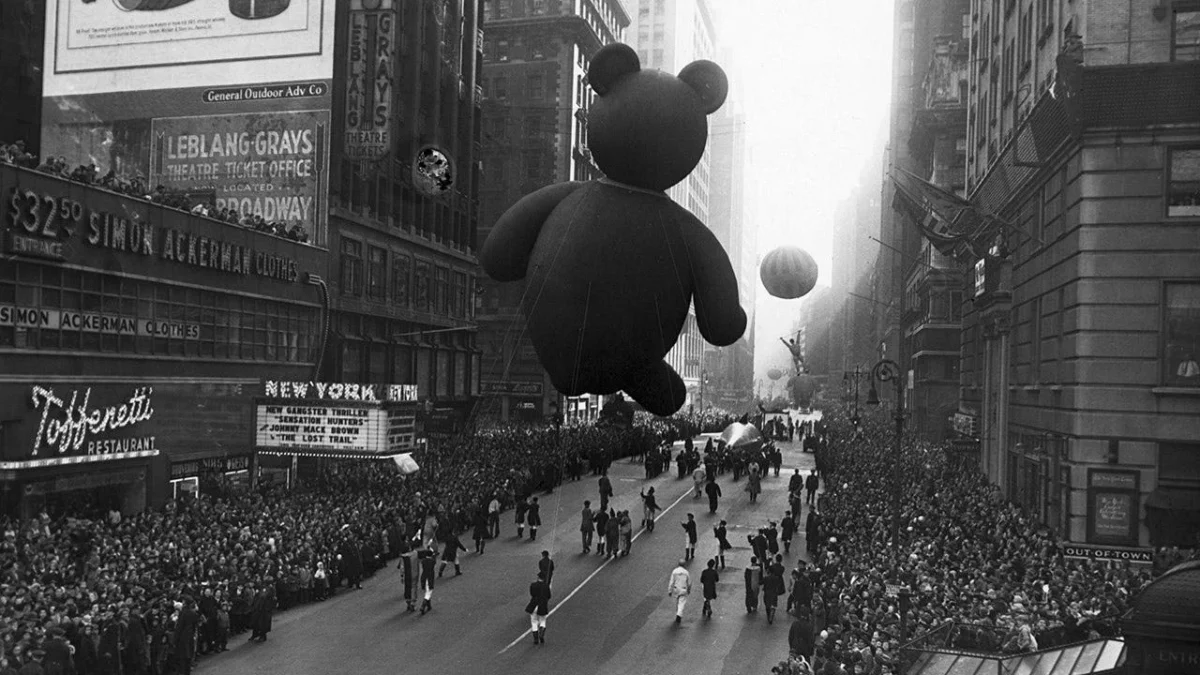
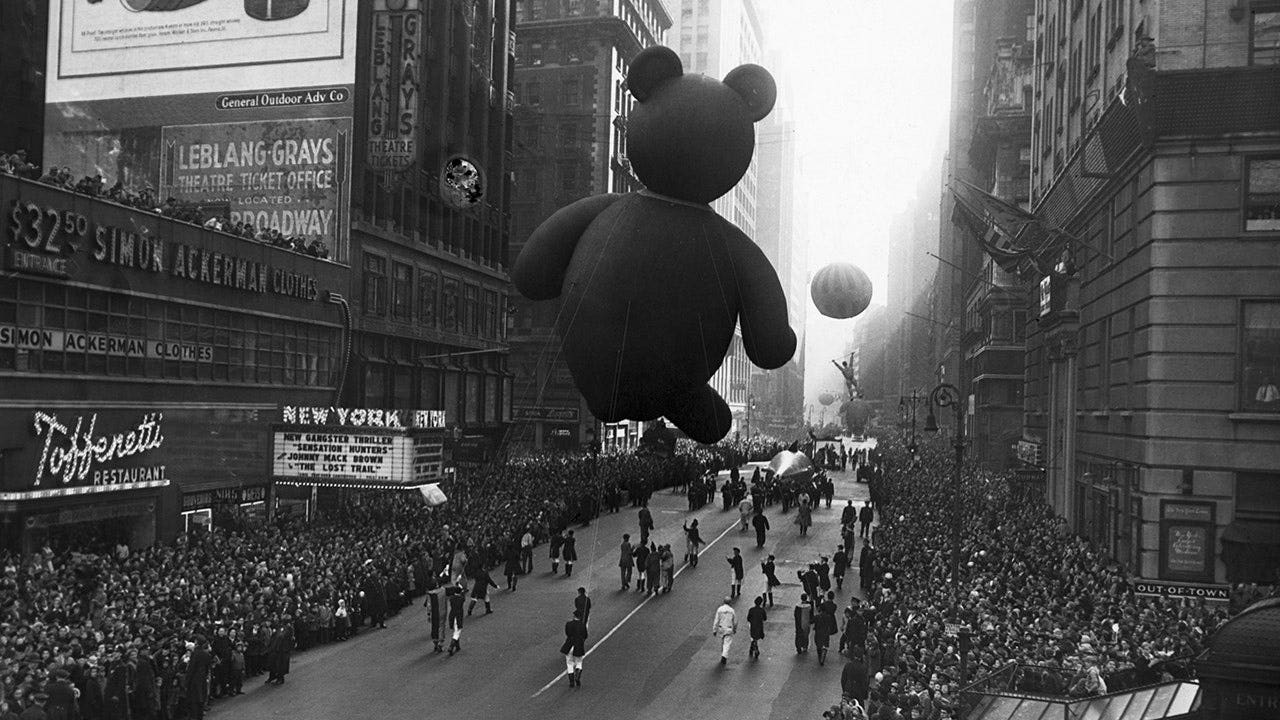
The post-war resurgence featured seven marching bands and 20 elaborate floats passing a towering model of the Statue of Liberty in Times Square. Notably, the event was broadcast on television by NBC for the very first time, expanding the parade’s audience far beyond the physical boundaries of New York City. The helium giants made a triumphant return to the Manhattan skyline, introducing a 45-foot "Bobo the Hobo" balloon containing 6,600 cubic feet of helium, a 40-foot teddy bear, a massive triple-scoop ice cream cone, and a 16-foot aerialist dangling from a 25-foot balloon. The latter required ground crews to perform mid-route helium top-offs when the character’s head began to sag.
Navigating Modern Crises: 2001 and 2020
Since its triumphant 1945 comeback, the parade has maintained its resilient schedule through subsequent national crises, adapting to changing social landscapes up until the severe weather disruption of the current centennial year.
In 2001, just weeks after the September 11 terrorist attacks, city and corporate leaders faced intense logistical and emotional pressures. Speaking with The New York Times at the time, Macy’s Public Relations Vice President Ronnie Taffet confirmed that there was never any serious discussion of canceling the event. Officials "from the mayor on down" emphasized that holding the parade was a vital gesture of civic defiance and community healing.
Decades later, in 2020, the COVID-19 pandemic forced a complete operational redesign. Organizers eliminated the traditional public audience along the multi-mile route, broadcasting the scaled-down, television-first production primarily from a single block outside the Macy’s flagship store in Herald Square.

Broader Implications and Logistical Challenges of the Saturday Rescheduling
The decision to postpone the centennial parade to Saturday, November 28, introduces unprecedented logistical challenges for municipal authorities, corporate sponsors, participating marching bands, and millions of traveling tourists.
Law enforcement agencies, sanitation departments, and transit authorities must rapidly adjust security perimeters, street closures, and staffing schedules originally optimized for a Thursday holiday. For out-of-town visitors who booked holiday hotel packages and travel itineraries ending on Friday or Saturday morning, the schedule shift creates complex travel and financial adjustments. Conversely, local hospitality sectors may experience a shifted economic boost as weekend tourists remain in the city for the rescheduled spectacle.
As meteorologists continue to monitor the trajectory of the coastal storm, city officials maintain that public safety remains the absolute priority. The historic adjustment ensures that while the 100th anniversary celebration is delayed by 48 hours, the beloved pageantry will unfold under safer skies, preserving the integrity and safety of performers, handlers, and millions of spectators alike.

