
The integration of generative artificial intelligence into global education systems has crossed a critical threshold, shifting from a speculative technological trend to a dominant fixture of daily student life. Nearly four years after the commercial deployment of foundational large language models like ChatGPT in late 2022, educational researchers, policymakers, and classroom instructors are grappling with a profound paradox: while educational technology programs of the past frequently struggled to achieve basic student engagement—a phenomenon previously dubbed "The 5 Percent Problem"—generative artificial intelligence has achieved near-universal adoption among youth without requiring external institutional encouragement. However, recent empirical findings indicate that this unprecedented enthusiasm carries a heavy academic cost. A landmark working paper released in mid-2026 suggests that self-directed generative AI utilization substantially undermines academic retention and cognitive development for at least half of all secondary students, a phenomenon now identified by analysts as the "Generative AI Penalty."
Background and Context: From Ed-Tech Hesitation to AI Omnipresence
To understand the current crisis in student cognitive automation, education analysts point to historical patterns in educational technology adoption. In 2024, researcher Laurence Holt of the XQ Institute introduced the concept of "The 5 Percent Problem" to describe the systemic limitation of online mathematics and learning platforms. Holt’s research demonstrated that despite substantial monetary investments and broad availability, only about 5 percent of students utilized targeted ed-tech programs as intended by their designers, while the remaining 95 percent experienced minimal or negligible academic gains due to low student motivation, inconsistent teacher implementation, or fractured technological access.
Generative artificial intelligence completely inverted this adoption dynamic. Within months of its public introduction, chatbots and AI-driven writing assistants experienced massive, self-driven uptake among students worldwide. "Dosage"—the frequency and consistency of tool utilization—ceased to be an obstacle. Instead, education researchers faced the opposite dilemma: an environment where students immediately incorporated automated systems into their out-of-school study habits, homework routines, and essay-composition processes.

Despite widespread adoption, the empirical research landscape regarding the actual cognitive impact of these tools remained sparse and methodologically fragmented for years. A comprehensive landscape analysis conducted by Stanford University’s Scale initiative reviewed more than 800 published studies concerning artificial intelligence in K-12 education and discovered that a mere 20 studies produced credible causal evidence. Meanwhile, high-profile meta-analyses claiming massive learning enhancements from artificial intelligence were subsequently retracted following rigorous scientific scrutiny, leaving educators and administrators navigating a chaotic landscape of vendor claims and unverified projections.
Empirical Findings: The Methodology and Core Data of the Chinese Secondary Education Study
The evidentiary vacuum began to close significantly with the publication of a viral working paper in June 2026. Titled "The Generative AI Learning Penalty: Evidence from Chinese Secondary Education," the study was authored by researchers David Strömberg, Victor Lei, and Yanhui Wu. Utilizing a robust dataset comprising approximately 27,000 Chinese secondary students spanning grades seven through twelve, the authors investigated a fundamental question: How does the unmonitored, self-directed utilization of generative artificial intelligence affect cumulative student learning over time within ordinary academic environments?
The research design leveraged digital administrative tracking logs from online platforms where students downloaded and subsequently uploaded homework assignments. Crucially, the researchers were able to establish precise timelines of technological adoption by tracking the digital registration dates of generative AI tools on students’ personal electronic devices. The analytical framework categorized students into distinct cohorts: a baseline "Pre-AI" group capturing historical performance before tool adoption; a "Never-AI" control group comprising approximately 19 percent of students who maintained complete abstinence from generative AI tools between 2023 and the conclusion of the study in mid-2025; and a "Post-AI" cohort capturing student metrics following the initiation of regular artificial intelligence tool usage.
By examining longitudinal data points across multiple educational vectors—including homework duration, homework grading metrics, monthly closed-book examinations, and high-stakes national academic placement tests—the researchers mapped out the exact trajectory of cognitive offloading.
Data Analysis: Homework Velocity Versus Closed-Book Reality
The empirical metrics revealed a stark divergence between short-term academic performance indicators and long-term knowledge retention.
-
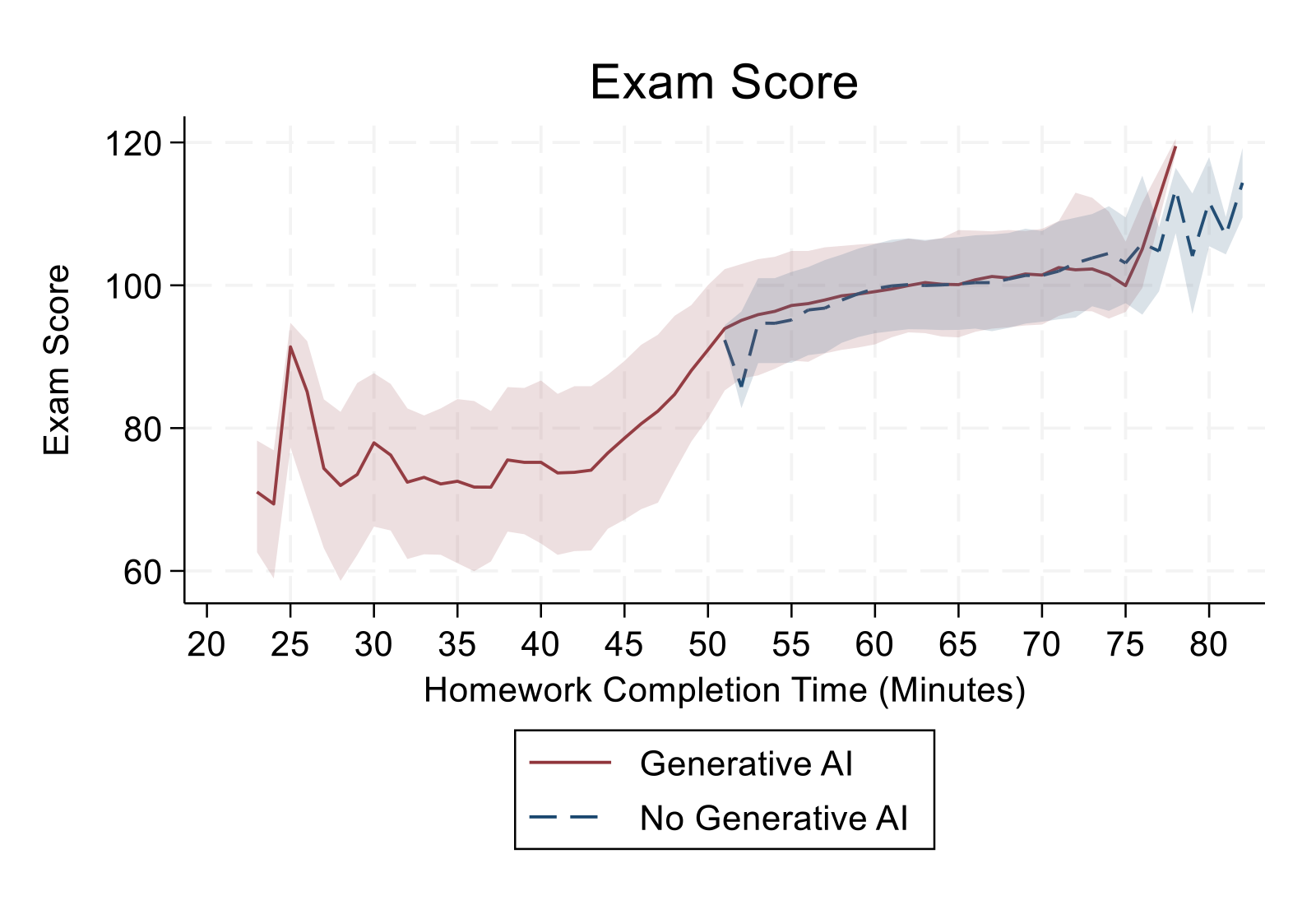
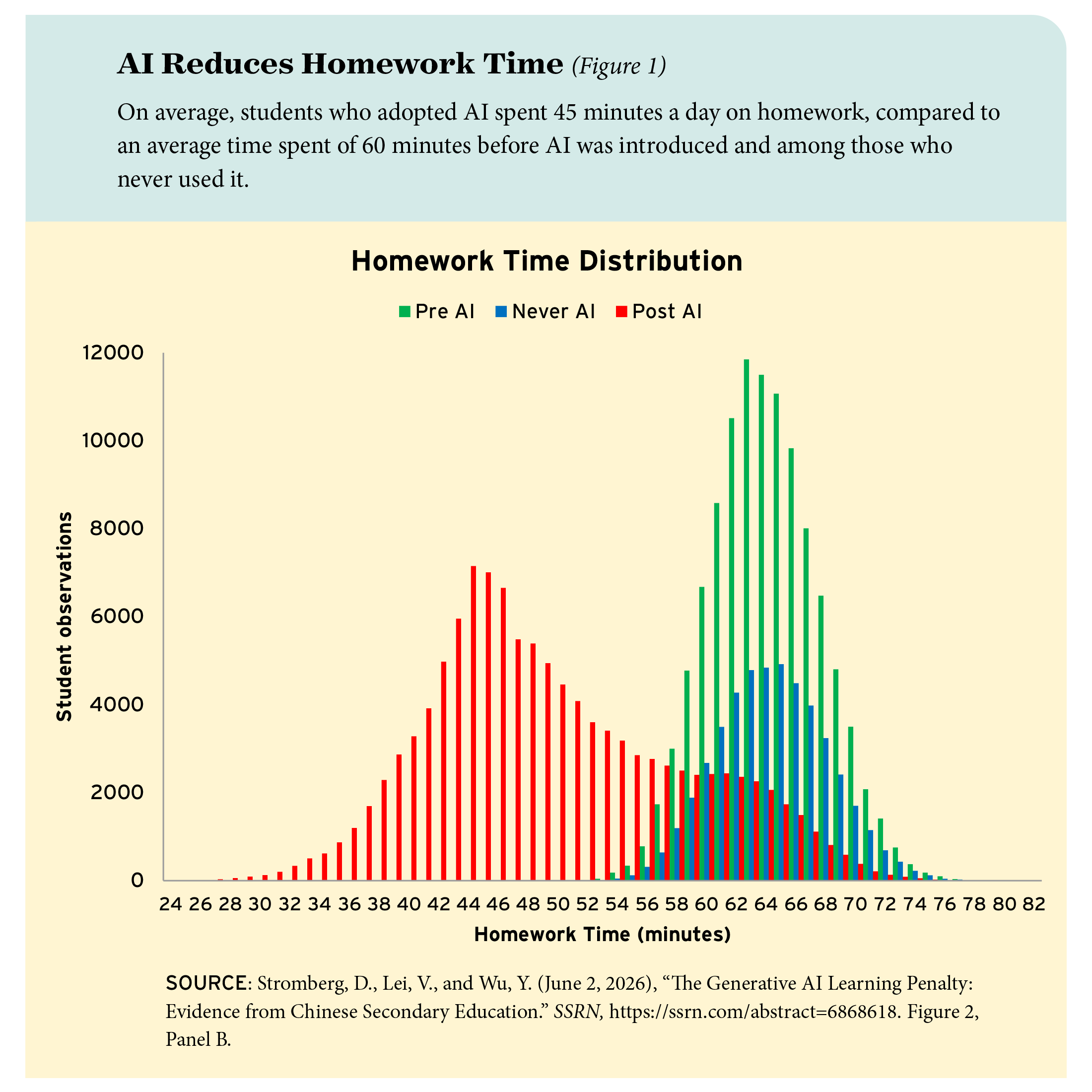
Homework Completion Time: Administrative logs demonstrated that prior to adopting generative artificial intelligence, students spent an average of 50 to 80 minutes daily completing homework assignments. Following AI adoption, average completion times plummeted dramatically. Most post-adoption students completed their assignments in approximately 45 minutes, with significant portions finishing tasks in as little as 25 minutes—the physical minimum required to execute copy-and-paste functions from a conversational chatbot interface.
-
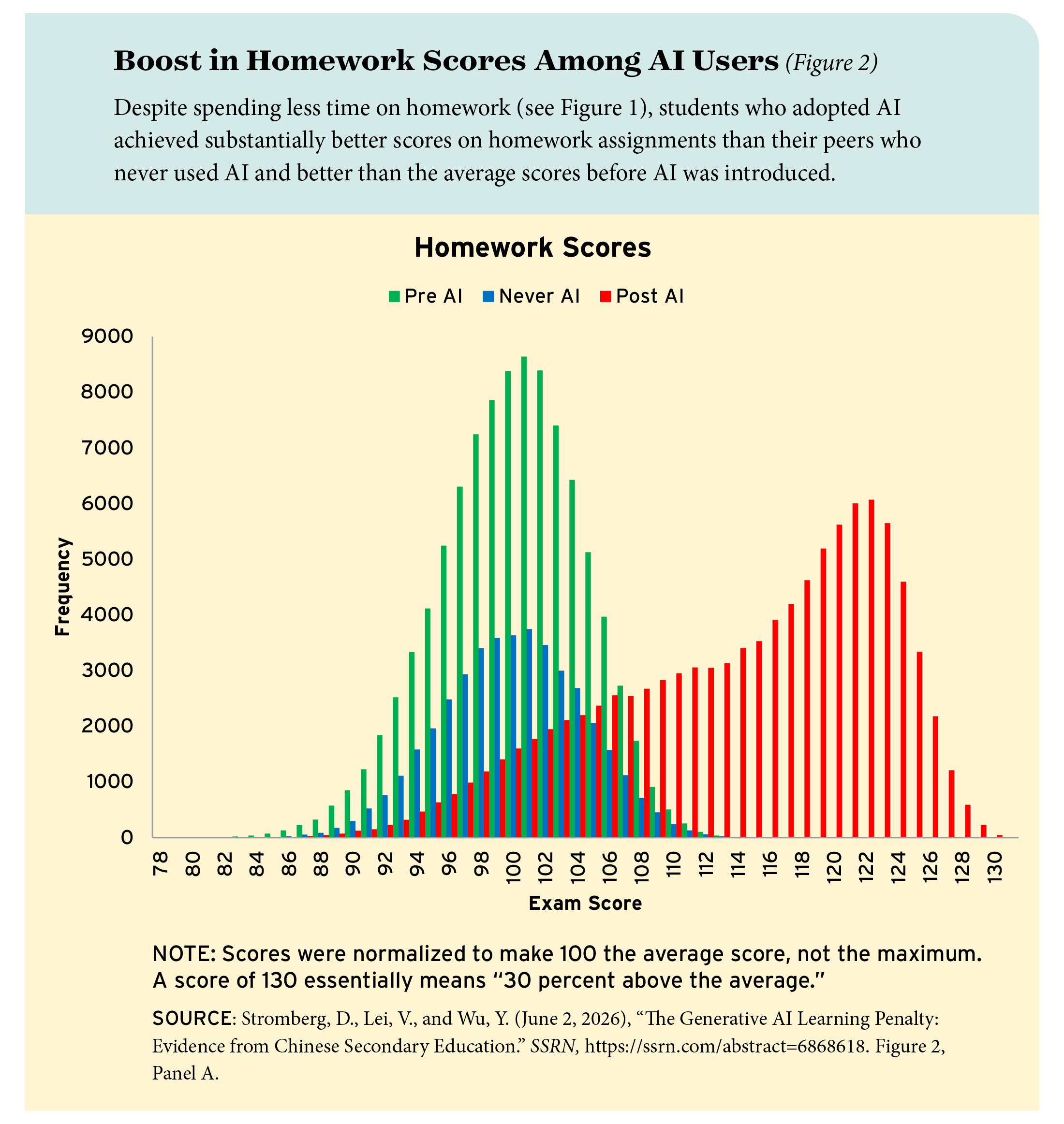
Homework Scoring Discrepancies: Paradoxically, despite spending significantly less time engaging with course material, students utilizing artificial intelligence experienced an immediate surge in homework grades. Normalized grading metrics indicated that post-adoption homework scores regularly exceeded the class average by 30 percent or more, outperforming even the most academically diligent students in the "Never-AI" control group. Researchers concluded that approximately 50 to 81 percent of regular AI-utilizing students had essentially outsourced the cognitive labor of their homework to automated systems, reaping immediate rewards in grade point averages while completely bypassing the underlying problem-solving processes.
-
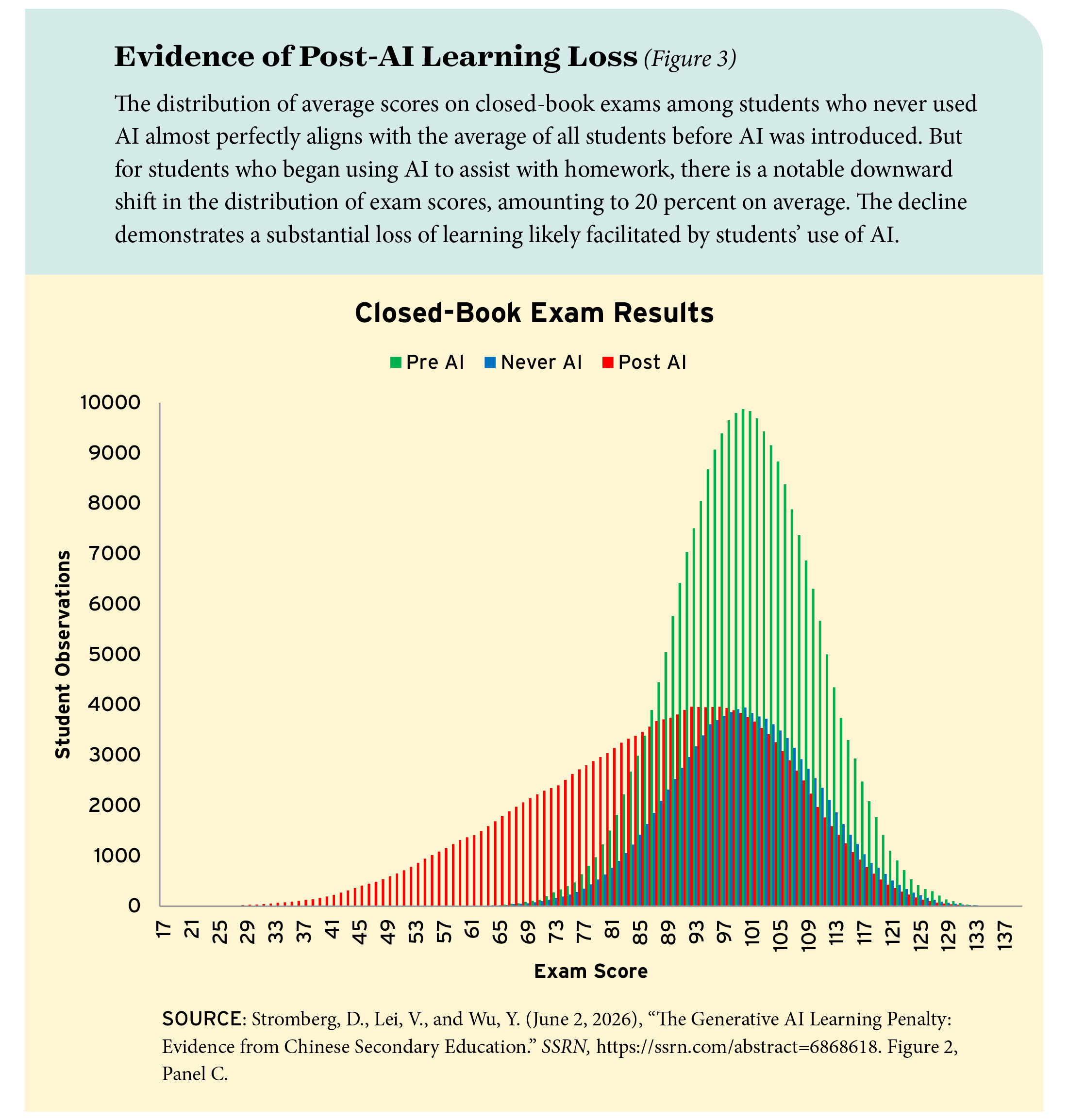
The Closed-Book Exam Penalty: The illusion of enhanced productivity dissolved entirely when evaluated against closed-book, proctored examinations. On monthly unassisted tests, students who incorporated generative AI into their study routines experienced an average performance decline of 20 percent (representing a 1.4 standard deviation drop) compared to their pre-adoption baselines and their "Never-AI" peers. Furthermore, longitudinal tracking revealed severe long-term repercussions for high-stakes standardized testing. Students who maintained regular generative AI utilization for two or more years prior to taking China’s rigorous senior high school and university entrance examinations suffered estimated score penalties of 24 percent (1.5 standard deviations) on high school exams and 18 percent (1.3 standard deviations) on college entrance examinations.
Official Responses and Counterarguments from Technology Sectors
The publication of these findings triggered intense debate across international academic and technology communities. Prominent technologists and machine learning researchers offered alternative interpretations of the underlying data. Blake Richards, a neuroscientist and machine learning researcher associated with Google, argued on public forums that artificial intelligence tools themselves are not inherently detrimental to cognitive development. Richards suggested that when statistical models control for the absolute duration of active study time, students utilizing AI tools perform comparably to, or slightly better than, those relying solely on traditional methods.
Other technology analysts pointed to a secondary finding within the Strömberg, Lei, and Wu paper: the estimated learning penalty appeared to moderate slightly over time, dropping from approximately 25 percent in early 2023 down to roughly 16 percent by mid-2025. Proponents of educational technology cited this downward trend as evidence that as large language models grow more sophisticated, students may eventually learn to leverage them as productive cognitive multipliers rather than mere cheating apparatuses.
Lead researchers and educational critics, however, quickly dismissed these objections as examples of motivated reasoning. Detailed examinations of the data subsets revealing positive correlations between AI use and high exam scores demonstrated that they relied on a vanishingly small sample size—frequently fewer than 20 students in any given monthly observation period, representing less than 0.2 percent of the overall AI-utilizing cohort. Furthermore, long-term persistence in active study habits while utilizing automated cognitive agents was virtually nonexistent beyond the initial months of tool adoption.
International policy responses have begun to reflect these diverging realities. Notably, major technology and internet conglomerates operating within China, such as Alibaba and Tencent, implemented strict service freezes, actively disabling conversational artificial intelligence tools during high-stakes national examination windows. In stark contrast, commercial artificial intelligence developers in Western markets have frequently intensified promotional campaigns for generative chatbots on university and secondary school campuses during critical final examination periods.
Implications for Global Education Policy and Cognitive Development
The implications of the "50 Percent Problem" extend far beyond questions of academic integrity or localized cheating. Cognitive scientists emphasize that the fundamental purpose of academic assignments is not merely the production of a completed worksheet or essay, but the effortful mental processing required to generate it. When generative systems assume the burden of cognitive automation, biological neural pathways associated with critical thinking, long-term memory consolidation, and complex problem-solving fail to develop adequately.
Educational experts warn that the cumulative cognitive deficit resulting from widespread, unmonitored artificial intelligence utilization may eclipse the recorded learning losses associated with extended school closures during the global public health disruptions of the early 2020s. Unlike pandemic-related interruptions—which were largely temporary and recognized as systemic emergencies—generative AI integration represents a persistent, voluntary, and socially reinforced technological shift.
As school administrators, policymakers, and parent coalitions confront these empirical realities, educational philosophers advocate for rigorous new pedagogical frameworks. Drawing on the foundational cognitive principles articulated by cognitive scientist Daniel Willingham, educational analysts propose a strict operational standard: artificial intelligence tools should never be permitted to substitute for tasks in which a student would derive cognitive benefit from performing the mental work independently. Under this paradigm, generative technologies should strictly be reserved for domains in which learners already possess high levels of established proficiency, ensuring that technology serves as a tool for experienced practitioners rather than a substitute for foundational human learning.