
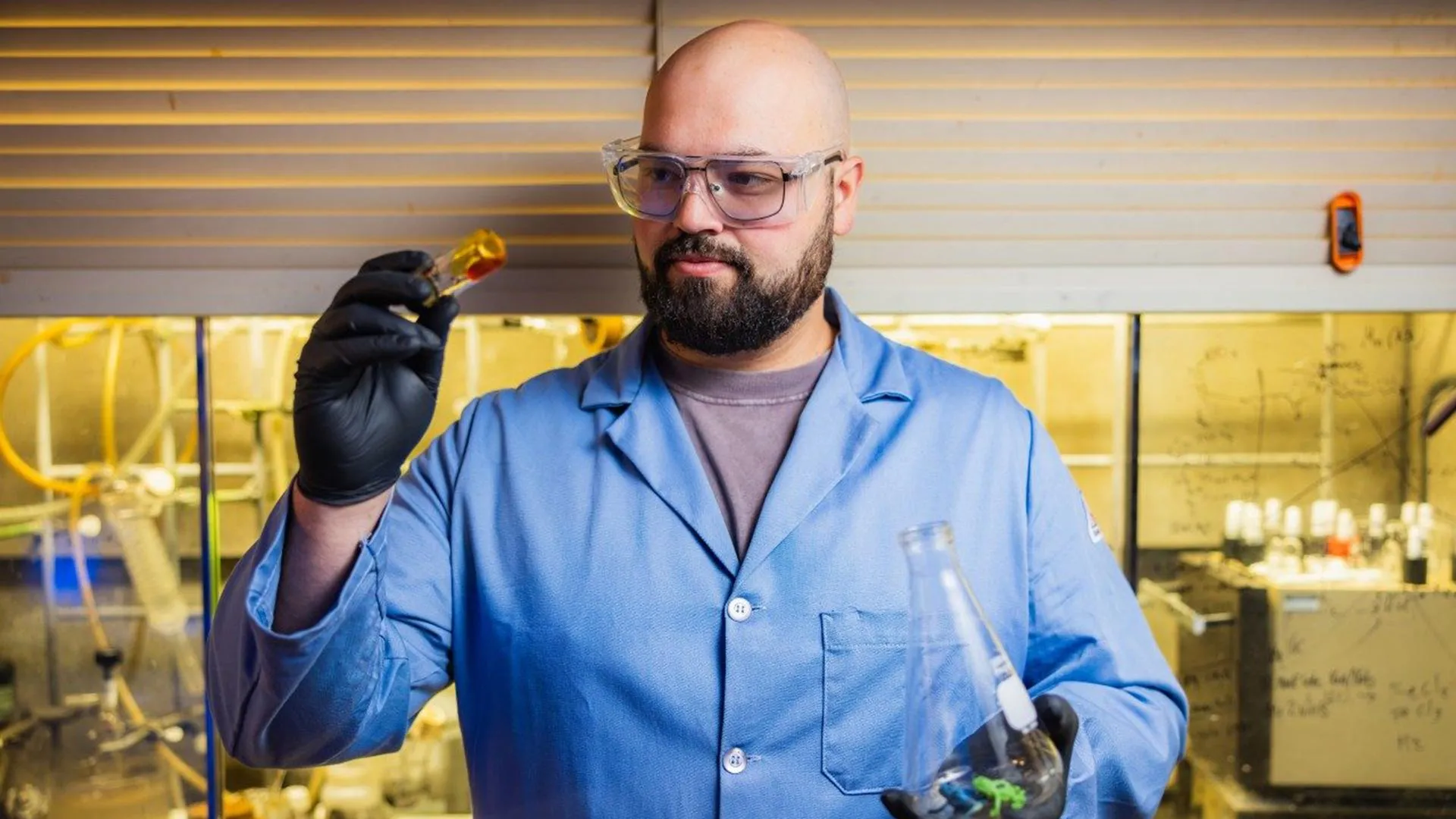
In a breakthrough that could fundamentally reshape the economics of global plastic waste management, a research team at Virginia Tech has successfully developed a chemical process to transform polyvinyl chloride (PVC)—long considered one of the most difficult plastics to recycle—into high-performance polyalphaolefin (PAO) lubricants. Led by Guoliang “Greg” Liu, a chemist and chemical engineer, this innovation provides a dual-pronged environmental solution: it diverts stubborn, non-biodegradable waste from landfills and offers a sustainable, circular-economy pathway for producing the synthetic base oils essential to modern industrial machinery.
The findings, recently published in the journal Nature, mark a significant departure from traditional mechanical recycling methods, which have historically struggled to process PVC due to its high chlorine content and the complex cocktail of additives—such as plasticizers, stabilizers, and flame retardants—incorporated by manufacturers to suit specific industrial or consumer needs. By shifting the paradigm from mere reclamation to chemical upcycling, the Virginia Tech team has demonstrated that the very characteristics that make PVC a recycling nightmare can, through controlled molecular engineering, be leveraged to create valuable, high-performance industrial products.
The Problem with PVC: A Recycling Bottleneck
Polyvinyl chloride is ubiquitous in modern infrastructure. From the rigid pipes that form the backbone of plumbing systems to flexible window frames, vinyl flooring, and even expired credit cards, PVC is engineered for extreme durability. However, this durability is precisely what makes it an environmental liability.
According to data from the Environmental Protection Agency (EPA) and various global waste management organizations, PVC is notoriously resistant to conventional thermal recycling. When heated, PVC releases hydrochloric acid, which can corrode equipment and create hazardous byproducts. Furthermore, the diverse array of additives required to give PVC its versatile physical properties means that recycled PVC often results in a low-grade, brittle material that cannot compete with virgin plastic. As a result, the vast majority of PVC waste—estimated in the millions of tons annually—is relegated to landfills or incinerators, where it persists for centuries.
A Chronology of Innovation
The journey toward this discovery was not linear. It began years ago in Liu’s laboratory, where his team first gained recognition for developing methods to transform other types of plastic waste into surfactants—the active ingredients in soaps and detergents. These early successes, published in Science and Nature Sustainability, served as a proof-of-concept for "upcycling," an approach that aims to increase the market value of waste materials rather than simply recovering them for secondary use.
The specific project focused on PVC began with the recruitment of a core research group, including doctoral candidate Eric Munyaneza Nuwayo and graduate students Connor S. Thompson and Abby Civiello. Liu, referring to the trio as his "three musketeers," encouraged them to investigate the molecular structure of PVC.
Initially, the team sought to replace the chlorine atoms in the PVC chain with other chemical groups to create functional, high-value materials. However, their early experiments proved frustrating; instead of creating a stable material, the process repeatedly yielded soft, sticky, "gooey" substances with little to no industrial utility. It was this failure that led to a pivot in strategy. Rather than attempting to maintain the integrity of the polymer chains, the team began to investigate the potential of breaking the chains down into significantly smaller segments. This realization opened the door to the creation of base oils, which are essentially long-chain hydrocarbons—the same building blocks found in synthetic lubricants.
The Chemical Process: Converting Plastic to Oil
The laboratory-scale process developed at Virginia Tech involves a precise chemical reaction. Researchers submerge PVC scraps in a specialized solvent, introducing aluminum trichloride and alpha-olefins into the mixture. The solution is then heated to 158 degrees Fahrenheit (70 degrees Celsius) for approximately three hours.
During this window, the PVC is deconstructed and integrated with the alpha-olefins to produce polyalphaolefin, or PAO. In the lubricants industry, PAOs are the gold standard for synthetic base oils. They are prized for their high viscosity index, thermal stability, and low-temperature fluidity, making them the primary component in high-performance engine oils used in everything from passenger vehicles to jet engines.
The resulting lubricant produced by the team meets the rigorous requirements for synthetic base oils, proving that waste-derived products can match, or potentially exceed, the performance of virgin materials derived from petroleum.
Collaborative Expertise and Economic Viability
Recognizing that chemical synthesis in a laboratory is only the first step toward commercialization, Liu expanded his team to include interdisciplinary experts. Ali Erdemir, a renowned lubrication scientist at Texas A&M University, spearheaded the performance testing of the synthesized oils, confirming their friction-reduction capabilities. Computational analysis to map the molecular interactions was provided by William Goddard at the California Institute of Technology (Caltech).
Furthermore, the team addressed the critical question of scalability. Xi Chen, a researcher at Virginia Tech, developed economic models to simulate the industrial-scale production of the oil. This analysis is vital, as the feasibility of any upcycling technology depends on its ability to be integrated into existing supply chains without becoming prohibitively expensive.
Implications for the Global Lubricants Market
The global lubricants market is currently valued at tens of billions of dollars and is projected to continue its steady growth as industrialization expands in developing economies. Historically, this demand has been met through the extraction and refining of crude oil, an industry with significant carbon footprints.
The Virginia Tech discovery offers a potential alternative: a “green” lubricant stream. By utilizing PVC waste as a feedstock, the manufacturing process could theoretically reduce the reliance on virgin crude oil, lowering the total carbon intensity of lubricant production. Moreover, it creates a powerful economic incentive for the recycling industry to collect and process PVC, which has previously been viewed as a waste stream with no viable end-market.
Looking Toward the Future
While the laboratory results are promising, the team acknowledges that the transition from a flask-based process to industrial-scale production involves significant engineering hurdles. These include managing solvent recovery, optimizing energy consumption, and establishing a consistent supply chain for waste PVC.
"We have proved that it is feasible to use plastic waste to make high-performance lubricants," Liu stated following the publication of the findings. "These lubricants are green, and they can meet the emerging needs for sustainability by the market."
The "silent heroes" of the mechanical world—the lubricants that prevent engines from seizing and allow machinery to function for years—are now positioned to become part of a larger environmental solution. As Liu and his colleagues continue to refine the technology, the goal is to bridge the gap between academic discovery and industrial application. If successful, the process could transform the ubiquitous, long-lasting PVC pipes and window frames currently filling our landfills into a vital resource that keeps the world’s engines running—a testament to the power of polymer chemistry to turn a long-standing environmental liability into a sustainable asset.

