
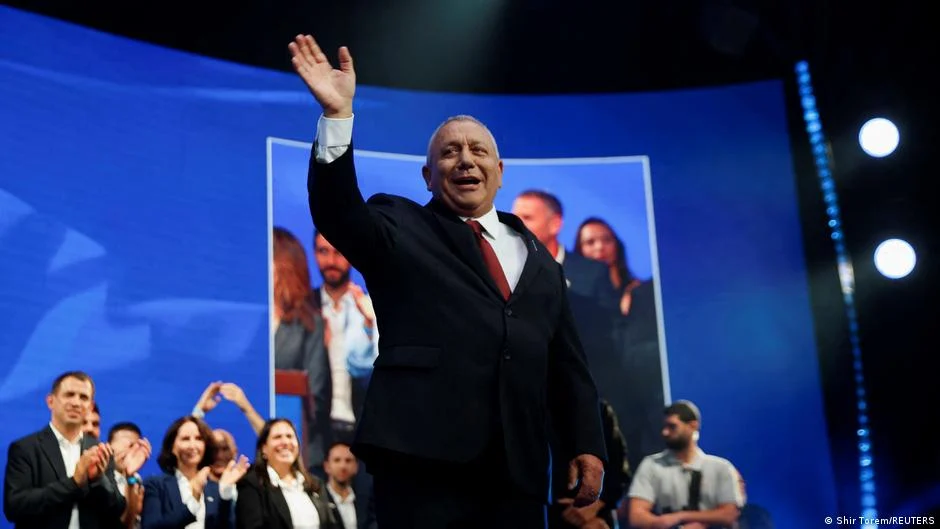
Israeli President Isaac Herzog has officially invited Gadi Eisenkot, the leader of the centrist Yashar party and the architect of a broad anti-Netanyahu alliance, to form the next government. The announcement, delivered on Saturday evening, marks a significant turning point in the nation’s turbulent political landscape following the inconclusive October election. Eisenkot, a former Chief of Staff of the Israel Defense Forces (IDF), is now tasked with navigating a fractured parliament to secure a governing majority, a challenge that will test the resilience of Israel’s democratic institutions.
The decision to entrust Eisenkot with the mandate follows a period of intense deliberation at the President’s residence. While Benjamin Netanyahu’s right-wing bloc secured a plurality of 53 seats in the 120-seat Knesset, he failed to command a clear majority. Conversely, the anti-Netanyahu bloc led by Eisenkot claimed 48 seats. The decision by Arab-majority parties to recommend Eisenkot for the premiership—a move historically unprecedented in its scope—tipped the balance in the President’s calculations, providing a path toward a potential coalition that excludes the former Prime Minister.
The Chronology of a Political Impasse
The current crisis traces its roots to the October 2026 election, the latest in a series of snap polls that have defined Israeli politics for nearly a decade. The electoral cycle began with widespread public fatigue over repeated parliamentary failures and the polarization of the political class.
Following the certification of the election results, President Herzog initiated a round of consultations with leaders from all factions represented in the Knesset. These discussions are a constitutionally mandated feature of Israeli democracy, designed to identify which candidate is best positioned to maintain the confidence of the legislature.
Netanyahu, as the leader of the largest individual faction, initially anticipated receiving the first mandate. However, his inability to bridge the gap between his ultra-Orthodox allies and other potential coalition partners left him short of the 61-seat threshold. Meanwhile, Eisenkot engaged in quiet, intensive negotiations with representatives from across the spectrum, including the Arab-majority lists, to present a unified, albeit ideologically diverse, front. The formal ceremony at the President’s residence this Sunday will initiate the formal 28-day countdown, during which Eisenkot must present a cabinet and a governing program to the Knesset.
Statistical Breakdown of the Knesset
The composition of the current parliament reflects a country deeply divided along ideological, religious, and ethnic lines. The 120 seats are distributed as follows:
- Netanyahu-led Bloc (53 seats): Comprised of Likud and associated right-wing and religious factions. While this bloc remains the largest single ideological grouping, its inability to secure moderate partners has rendered it incapable of forming a government under current conditions.
- Eisenkot-led Anti-Netanyahu Bloc (48 seats): A coalition of centrist, liberal, and secular parties. Their platform focuses on governance reform, economic stabilization, and addressing the judicial challenges that have dominated public discourse.
- Arab-Majority Parties (19 seats): Having achieved their most significant parliamentary presence to date, these parties have become the "kingmakers" of the current cycle. Their decision to back Eisenkot represents a departure from traditional non-engagement, reflecting a strategic desire to influence policy from within the parliamentary process rather than from the fringes.
Official Responses and Political Strategy
The response to President Herzog’s decision has been polarized. Supporters of Eisenkot argue that his background as a former military leader provides the stability and national security credentials necessary to lead the country during a period of heightened regional volatility. His allies emphasize that a broad-based government is the only way to heal the deep societal rifts that have widened during the Netanyahu era.
Conversely, supporters of Benjamin Netanyahu have characterized the move as a "distortion of the voter’s will." In a statement released shortly after the President’s announcement, a spokesperson for the Likud party argued that the mandate should have gone to the leader of the largest party bloc, accusing the President of playing "political games" to sideline the candidate who received the most individual votes.
The Arab parties, for their part, have framed their support for Eisenkot as a pragmatic decision. "Our priority is to ensure that the voice of our community is heard in the halls of power," stated a spokesperson for one of the major Arab lists. "By supporting a candidate who is willing to engage with us, we are acting in the best interests of all Israeli citizens, regardless of their background."
The Challenges of Coalition Building
Eisenkot faces a daunting task. To secure the 61-seat majority, he must reconcile the vastly different policy goals of his diverse partners. The inclusion of Arab parties in a potential government is inherently contentious, as some of his centrist allies have historically expressed reservations about such an arrangement.
Furthermore, the economic pressures facing Israel—including inflation and housing affordability—require a stable government that can pass a national budget. Failure to do so within the constitutional timeframe would result in the collapse of the attempt, potentially triggering yet another general election. This prospect is widely viewed by the public and international observers as a worst-case scenario that could lead to further political instability and economic stagnation.
Implications for the Future of Israeli Policy
Should Eisenkot succeed in forming a government, the implications for Israel’s domestic and foreign policy would be profound. Domestically, the new government would likely prioritize administrative reform and the cooling of the "culture wars" that have dominated the media. There would also be a significant focus on the relationship between the judiciary and the legislature, a flashpoint that has triggered mass protests in recent years.
Internationally, the transition would represent a fundamental change in the style of governance. Netanyahu, who has been a central figure in Israeli politics for decades, has cultivated a specific brand of assertive, security-focused diplomacy. Eisenkot, while also deeply committed to national security, is expected to pursue a more consensus-oriented approach, potentially focusing on strengthening regional partnerships and navigating the complexities of the Middle East with a lower diplomatic profile.
However, the fragility of a potential Eisenkot-led coalition cannot be overstated. With a narrow majority, the government would be susceptible to the demands of its smallest partners, meaning that any major policy shift—particularly regarding the Palestinian issue or religious status—would require delicate, and potentially volatile, negotiations.
Looking Ahead
As Sunday’s ceremony approaches, the eyes of the nation are fixed on the President’s residence. The 28-day mandate is a short window in the complex world of Israeli politics. If Eisenkot fails to build a coalition, the President has the authority to grant a 14-day extension, a common occurrence in past cycles. If those efforts also fail, the responsibility could shift to another candidate or, ultimately, the country would be forced to return to the polls.
For now, the political establishment remains in a state of high alert. The transition of power—or the reinforcement of the current status quo—depends on the ability of disparate political factions to set aside historical animosities in favor of the functional necessity of governance. The coming weeks will determine not only who holds the title of Prime Minister but whether the Israeli parliamentary system can effectively resolve the current crisis of representation.
The task before Eisenkot is not merely to count the seats, but to build a bridge across a profoundly divided society. Whether he can achieve this in the face of intense pressure from both the right-wing opposition and the demands of his own coalition remains the most critical question in Israeli politics today. As the clock begins to tick on his mandate, the nation waits to see if a new chapter of consensus can truly be written, or if the country is destined to remain trapped in the cycle of its own political fragmentation.

