
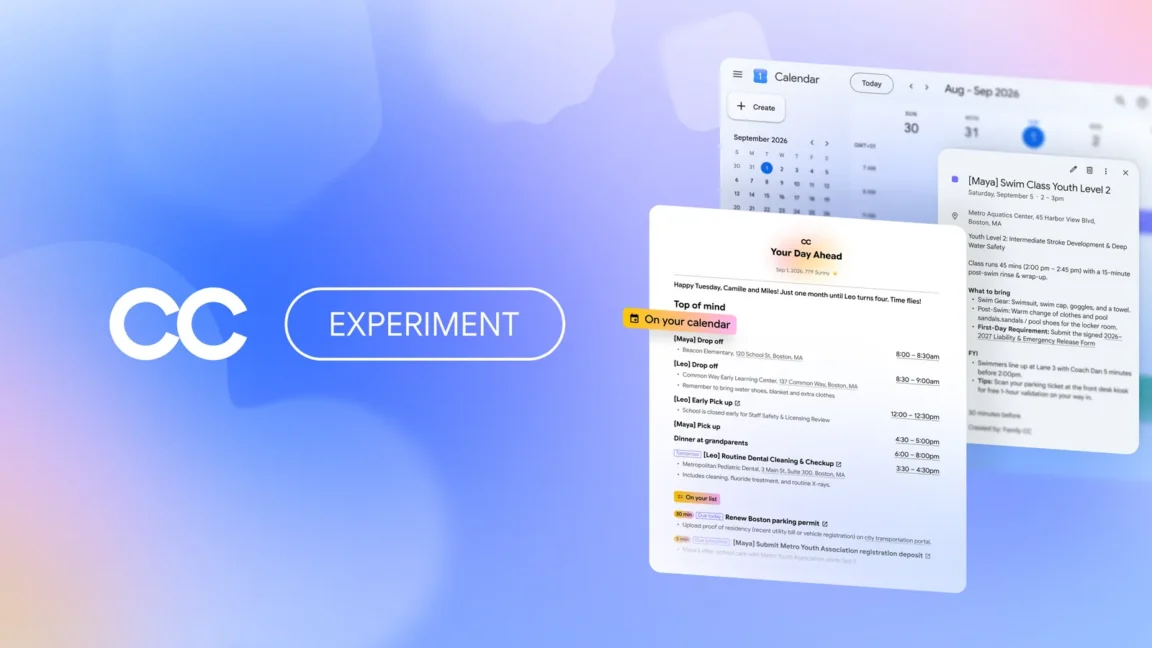
Google has introduced its latest artificial intelligence initiative through its Google Labs division, an experimental platform designated simply as CC, which shifts the focus of personalized AI from individual users to entire households. While industry analysts frequently measure the competitive standing of generative AI models through benchmarks centered on raw processing power, logical reasoning, and multimodal capabilities, technology conglomerates with deeply integrated software ecosystems possess a distinct strategic advantage: vast repositories of contextual user data. For consumers heavily embedded within Google’s suite of productivity, communication, and storage applications, the company’s Gemini models already retain significant personal context. The launch of CC represents a calculated effort to extend this hyper-personalized utility beyond single accounts, synthesizing disparate streams of daily information into a unified, collaborative resource for up to six family members.
The announcement arrives at a critical juncture in the consumer artificial intelligence sector. As major technology firms vie for dominance in the consumer space, the primary challenge has shifted from demonstrating technological prowess to proving daily utility. By targeting the logistical friction inherent in modern family life—coordinating schedules, tracking shared documents, and managing conflicting responsibilities—Google is attempting to position its AI architecture as an indispensable household infrastructure rather than a mere novelty chatbot.
Evolution of the Project and Chronology
The genesis of CC traces its lineage back to organizational developments within Google’s experimental pipelines in early 2025. During initial conceptualization phases, engineers and researchers sought to address the cognitive fatigue associated with managing fragmented digital communications. This early iteration laid the groundwork for features that eventually materialized within the core Gemini ecosystem as the Daily Brief, a tool designed to parse individual Google accounts to generate daily action items, reminders, and contextual suggestions.
Recognizing that household management is rarely an isolated individual responsibility, Google Labs expanded the scope of the project. The newly unveiled CC experiment bridges the gap between individual automation and collective household administration. Rather than remaining confined to a single user profile, the architecture of CC introduces a dedicated, quasi-independent Google account explicitly designed for shared domestic use. This structural evolution allows multiple individuals to contribute to, interact with, and draw insights from a centralized artificial intelligence agent without compromising the granular privacy boundaries of their personal accounts.
Core Architecture and Data Governance
Privacy and data governance represent critical components of the CC framework, given the sensitive nature of household communications, schedules, and financial documents. To address potential apprehension regarding automated data harvesting, Google has engineered CC with strict, opt-in visibility parameters.
By default, the CC agent operates within a controlled perimeter. It does not automatically scour the personal emails, messages, or documents of connected family members. Instead, visibility must be explicitly granted through targeted configurations. For instance, users can designate specific email addresses or domains—such as a local school district’s notification system, pediatric clinic portals, or utility providers—as perpetually accessible to the agent. This ensures that essential logistical information flows seamlessly into the shared system while keeping personal correspondence private.
Furthermore, family members can actively feed information into the CC ecosystem through multiple channels. Content can be transmitted directly to the agent via dedicated email routing or Google Chat interactions. Additionally, CC is capable of monitoring a designated shared Google Drive folder. Within this repository, users can deposit diverse digital artifacts, including party invitations, scanned utility bills, permission slips, legal documents, and travel itineraries. The AI then indexes these materials, rendering them searchable and actionable for all authorized participants within the household group.
Daily Operations and Collaborative Functionality
The primary mechanism through which CC manifests its utility is the "Your Day Ahead" briefing. Delivered each morning directly to the inboxes of registered household members, this consolidated digest synthesizes the collective schedule, pending action items, and status updates regarding ongoing domestic tasks.
Beyond passive reporting, CC functions as an active participant in household administration. The system possesses the capability to autonomously populate shared Google Calendars based on incoming logistical communications, generate task reminders for specific individuals, and draft collaborative documents in response to natural language prompts. If a family member instructs the agent to outline a packing list for an upcoming vacation or synthesize a meal plan based on dietary notes stored in the shared drive, CC processes the request and generates a document accessible across all connected user accounts.
Industry Context and Strategic Implications
The introduction of household-centric AI agents highlights a broader industry shift toward ambient computing. For years, smart home devices such as Google Nest and Amazon Alexa have attempted to serve as central hubs for domestic life. However, these legacy systems have frequently faced criticism for their rigid command-and-response structures, limited contextual understanding, and inability to process complex, multi-step administrative workflows.
By leveraging advanced large language models like Gemini, Google is attempting to transcend the limitations of traditional smart home assistants. An AI capable of parsing unstructured text from a school newsletter, cross-referencing it with a parent’s work calendar, and automatically proposing an optimized schedule represents a generational leap in domestic automation.
Industry analysts note that this strategy addresses a fundamental monetization and retention hurdle for AI developers. While consumers have demonstrated willingness to experiment with standalone AI chatbots, maintaining paid subscriptions requires proving indispensable value in daily routines. By embedding itself into the foundational coordination of families—spanning multiple users and daily touchpoints—Google creates high switching costs, cementing user loyalty across its broader hardware and software ecosystem.
Outlook and Future Development
As CC operates under the Google Labs banner, the platform remains an active experiment subject to user feedback, architectural refinement, and iterative updates. The success of the trial will likely determine whether household-shared AI agents become a standard feature integrated into the broader Google Workspace and consumer Gemini subscriptions.
While technical hurdles remain—particularly concerning edge cases in multi-user authorization, data security, and misinterpretation of ambiguous communications—the rollout of CC signals the next frontier in consumer artificial intelligence. As these systems grow more sophisticated, the boundary between software tool and digital household member will continue to blur, redefining how families navigate the complexities of modern daily administration.

