
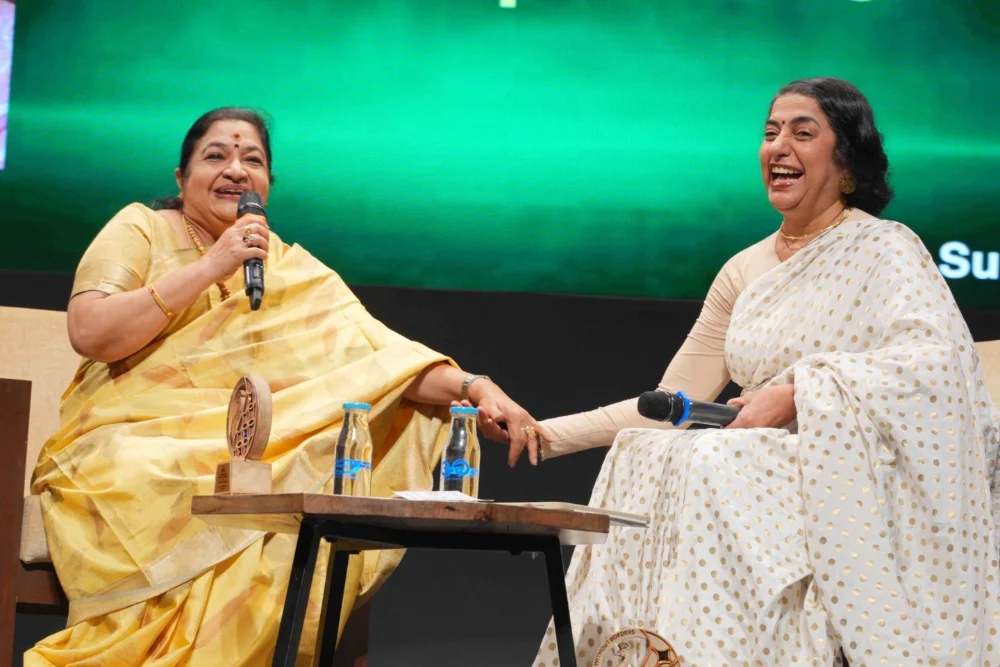
The 57th International Film Festival of India (IFFI) in Goa served as the backdrop for an emotional and scholarly retrospective honoring the indelible legacies of Asha Bhosle and S. Janaki, two titans of Indian playback singing who passed away in 2026. At a session titled “Lata Mangeshkar Talk: The Voice That Echoes Forever”—an homage to the late Mangeshkar, who was Bhosle’s elder sister—celebrated vocalist K.S. Chithra and noted actor-filmmaker Suhasini Maniratnam engaged in a profound dialogue regarding the technical mastery, artistic versatility, and personal humanity of these musical icons.
A Year of Mourning for the Musical Pantheon
The year 2026 has been marked by a significant shift in the Indian cultural landscape, defined by the loss of its most recognizable voices. Asha Bhosle, who commanded a global audience and became a cross-cultural phenomenon through her collaborations with Western artists like Cornershop in the 1997 hit "Brimful of Asha," passed away in April at the age of 92. Her career, spanning over seven decades, saw her record thousands of songs across nearly every major Indian language, earning her two Grammy nominations and a reputation as a pioneer of experimental sound in Indian cinema.
Following her passing, the industry suffered another heavy blow in July with the death of S. Janaki at age 88. Known affectionately as the "Nightingale of South India," Janaki’s vocal range—spanning from the innocence of a child to the depth of a seasoned protagonist—remains a benchmark for South Indian film music. The IFFI session acted as a necessary forum to contextualize their contributions, not merely as singers, but as architects of the emotional architecture within Indian cinema.
The Technical Evolution of Playback Singing
K.S. Chithra, a luminary in her own right with a staggering discography of over 25,000 songs, offered an insider’s perspective on the rigorous standards upheld by Bhosle and Janaki. Her professional trajectory, which spans nearly five decades, allowed her to analyze these women not just as peers, but as formative influences.
Chithra noted that the "distinctive style" of Janaki was an inimitable craft. During her childhood, Chithra recalled attempting to mimic Janaki’s unique vocal flourishes, only to realize the technical impossibility of replicating the texture of her voice. The session highlighted the meticulous nature of early recording sessions, where the lack of digital post-production meant that every emotion had to be captured in a single, live take.
Chithra’s analysis touched upon the emotional depth found in devotional music, specifically noting how the nuances of Mangeshkar’s, Susheela’s, and Janaki’s work shaped the sonic identity of Indian films in the 20th century. For the younger generation of vocalists, this discussion served as a masterclass on the importance of vocal versatility and the necessity of maintaining one’s artistic integrity in a commercial environment.
Anecdotal Insights: The Human Side of Stardom
Suhasini Maniratnam provided a rare glimpse into the collaborative process of the 1990s, focusing on the making of the 1997 masterpiece "Iruvar." The anecdote centered on the legendary composer A.R. Rahman, who, despite his own musical genius, encountered a unique challenge during the production. Rahman sought a specific, high-energy, and character-driven performance for a track but found it difficult to communicate the required stylistic shift to Bhosle, who was then accustomed to more refined, classical arrangements.
Suhasini, drawing on her deep knowledge of the film industry, stepped in to demonstrate the style of L.R. Eswari, a singer known for her raw, earthy, and bold vocal quality. Bhosle’s adaptability was on full display as she seamlessly transitioned into the persona required, resulting in the track "Venilla Venilla." This story underscored a crucial point: these playback singers were not merely vocalists, but character actors who used their voices to manifest the psychological profile of the stars on screen.
Further humanizing the icons, Chithra recounted personal memories of Janaki’s devotion to her art. In an era before digital karaoke, Janaki would record herself singing along to radio broadcasts of Lata Mangeshkar’s songs, pausing the broadcast to insert her own voice—a practice Chithra jokingly termed "karaoke on her own." These stories provided the audience with a view of the discipline and humility that defined the golden age of Indian cinema.
The Pursuit of Musical Identity
A recurring theme during the IFFI session was the struggle of these singers to differentiate themselves in a competitive, often comparison-heavy industry. Bhosle, in particular, was frequently measured against the monumental legacy of her sister, Lata Mangeshkar. Chithra shared that, upon their first meeting, Bhosle was highly critical of Chithra’s tendency to sing in a "high register," a comment that prompted Chithra to reflect on the importance of finding a unique vocal identity rather than imitating established benchmarks.
This desire for autonomy fueled Bhosle’s forays into diverse genres, including ghazals and pop fusion. Her ability to pivot between the melancholic depths of a traditional film song and the playful energy of a dance track is a testament to her mastery of the instrument of the human voice.
Chronology of Musical Legacy
- 1950s–1970s: The emergence of Asha Bhosle and S. Janaki as the definitive voices of Indian cinema, defining the transition from classical-based film music to more rhythmic, genre-fluid compositions.
- 1985: The release of "Sindhu Bhairavi," which cemented K.S. Chithra’s status as a National Award-winning vocalist, featuring the track "Paadariyen."
- 1997: The release of "Iruvar," showcasing the collaboration between A.R. Rahman, Asha Bhosle, and the stylistic guidance of Suhasini Maniratnam.
- 2026: The passing of Asha Bhosle (April) and S. Janaki (July), prompting a national conversation on the preservation of their vocal archives.
- November 2024: The 57th IFFI session, which served as the official industry tribute to these two figures, highlighting their enduring influence on contemporary singers.
Analytical Implications for Future Generations
The discussion at IFFI carries significant weight for the future of Indian music. As the industry moves toward AI-assisted production and heavy vocal processing, the legacies of Bhosle and Janaki serve as a reminder of the value of organic, lived experience in musical performance. The session highlighted that the "emotional depth" attributed to these singers was not merely a result of vocal training, but a byproduct of their ability to connect with the lyrical content of the songs on a human level.
The closing segment of the session, in which Chithra successfully identified five classic songs solely by hearing instrumental clips, underscored the auditory brilliance of this generation of singers. When Chithra concluded by singing "Paadariyen"—with Suhasini lip-syncing in a gesture of shared history—it was a symbolic passing of the torch. It emphasized that while the physical presence of these icons has faded, their methodologies remain the foundation upon which current and future Indian film music is built.
Conclusion
The 57th IFFI tribute was more than a memorial; it was an act of cultural preservation. By documenting the anecdotes of Suhasini Maniratnam and the technical insights of K.S. Chithra, the festival ensured that the nuances of Bhosle’s versatility and Janaki’s character-driven performances are not lost to time. In an era of rapid technological and stylistic change, the "Voice That Echoes Forever" remains a vital link to the heritage of Indian cinema, reminding the public that these singers did not just record tracks—they gave voice to the soul of the nation.

