
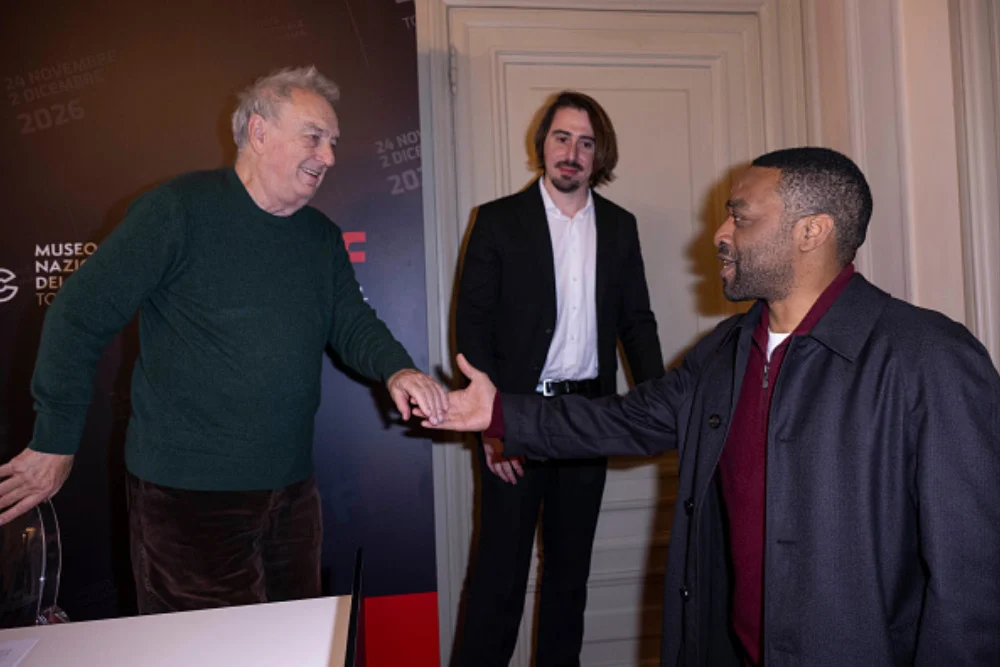
The trajectory of an actor’s career is often viewed through a lens of steady progression—a climb from minor roles to leading status. However, for British actor Chiwetel Ejiofor, the path was inverted from the very start. Speaking at the 2024 Torino Film Festival, where he was honored with the prestigious Stella della Mole award for lifetime achievement, Ejiofor reflected on the paradoxical experience of launching his cinematic career under the direction of Steven Spielberg.
A Baptism by Fire: The Amistad Beginning
For most aspiring performers, working with a master of the craft like Steven Spielberg represents a career pinnacle that typically arrives after years of industry seasoning. For Ejiofor, it was his debut. Cast in the 1997 historical drama Amistad, which chronicled the 1839 mutiny aboard the Spanish ship La Amistad and the subsequent legal battle in the United States, Ejiofor found himself navigating the complexities of high-stakes filmmaking before he had even fully established his professional identity.
"I was definitely worried about it at the time," Ejiofor admitted during his masterclass at the festival. "You feel that there are stages to how you develop as an actor and the opportunities you get, and you think they might follow a very linear path. But of course, my first film role was with Steven Spielberg. I realized then, very early on, that it’s a deeply unpredictable profession."
This realization became a cornerstone of his professional philosophy. Ejiofor noted that the industry is defined by sporadic opportunities that emerge from unexpected directions. He suggests that the primary challenge for any actor is not necessarily to control the outcome of their career, but to cultivate the capacity to "roll with it," embracing the journey without the anxiety of trying to force a linear trajectory.
From the West End to the Global Stage
Despite his early success in Amistad, Ejiofor spent the better part of the following decade firmly rooted in the tradition of British theater. His identity was anchored in the National Theatre and the West End, environments where he honed his craft through rigorous, live performance. His commitment to the stage culminated in a 2008 Laurence Olivier Award for Best Actor for his portrayal of Othello at the Donmar Warehouse—a role that cemented his reputation as one of the most formidable stage actors of his generation.
It was during this period that Ejiofor grappled with the distinction between the "rhythm and poetry of cinema" and the immediacy of theater. The transition was not instantaneous. It required the specific influence of director Stephen Frears and cinematographer Chris Menges, whose 2002 thriller Dirty Pretty Things proved to be the catalyst for Ejiofor’s shift in focus. By providing a gritty, grounded perspective on the life of an immigrant in London, the film allowed Ejiofor to fall in love with the technical and narrative demands of the camera.
The Turning Point: Dirty Pretty Things and Beyond
The screening of Dirty Pretty Things at the Torino Film Festival serves as a reminder of the foundational projects that defined early 2000s independent cinema. The film’s success signaled a departure from traditional casting tropes and helped establish Ejiofor as an actor of profound interiority.
Chronologically, this era marks a pivotal shift:
- 1997: Debut in Steven Spielberg’s Amistad.
- 2002: Starring role in Dirty Pretty Things, sparking a passion for film acting.
- 2008: Laurence Olivier Award for Othello, representing the peak of his theater work.
- 2013: International acclaim for 12 Years a Slave, marking his entry into the global pantheon of elite actors.
The evolution of his career is not just a study in performance, but an exploration of the synthesis between art forms. Ejiofor’s ability to balance theater and film remained steady until he began to expand his creative output into writing and directing. This shift marked a transition from a purely interpretative role to an authorial one, as evidenced by his directorial efforts: The Boy Who Harnessed the Wind (2019) and Rob Peace (2024).
The Weight of History: 12 Years a Slave
No discussion of Ejiofor’s career is complete without addressing his portrayal of Solomon Northup in Steve McQueen’s 2013 masterpiece, 12 Years a Slave. The film, which earned the Academy Award for Best Picture, provided Ejiofor with a role that demanded both physical endurance and emotional vulnerability.
"I hadn’t heard of his story at all," Ejiofor stated regarding the memoir that formed the basis of the film. "When I was sent the script, I was incredibly moved and shocked by it. At its heart, it was always a story about human respect and human dignity."
His collaboration with Steve McQueen is often cited by film critics as a watershed moment in contemporary cinema. McQueen’s meticulous, detail-oriented approach complemented Ejiofor’s disciplined, theater-trained process. The global reception of the film—not just in terms of box office, but in its capacity to force a cultural reckoning with the history of slavery—demonstrates the power of the medium when handled with "cinematic heart," as Ejiofor described it.
The Future of a Multi-Hyphenate
As Ejiofor transitions further into the role of filmmaker, the industry is watching closely to see how his directorial voice evolves. His recent works, The Boy Who Harnessed the Wind and Rob Peace, reflect a thematic preoccupation with resilience, intellect, and the individual’s struggle against systemic forces—themes that have permeated his work since the early days of Amistad.
Despite his focus on directing, Ejiofor remains vocal about his enduring love for the stage. He is currently in negotiations for a return to the theater, aiming for a production in the latter half of next year. This desire to return to his roots, while simultaneously pushing the boundaries of his filmic craft, underscores his status as a "complete" artist in an industry that often incentivizes specialization.
Industry Implications and Legacy
The Torino Film Festival, by awarding Ejiofor the Stella della Mole, recognizes not only his individual body of work but the broader influence he has had on international cinema. His career serves as a blueprint for contemporary actors who seek to navigate the tension between commercial, high-profile projects and deeply personal, character-driven narratives.
The implications of his career path are significant for the next generation of actors. Ejiofor demonstrates that an unpredictable start does not preclude a consistent, meaningful, and award-winning career. His insistence on finding the "human dignity" in every role—whether it is a 19th-century abolitionist, an exiled doctor, or a victim of the antebellum South—serves as a reminder that the craft of acting remains, at its core, a form of historical and social documentation.
As Ejiofor continues to bridge the gap between directing and acting, the film community remains expectant. His journey, from a young actor worried about peaking too early to an established auteur reflecting on his lifetime achievement, serves as a testament to the idea that the most enduring careers are not those that follow a straight line, but those that remain open to the unpredictable, evolving, and often transformative nature of the creative process. Whether on a London stage or behind the camera in a feature film, Chiwetel Ejiofor continues to define his career on his own terms, ensuring that his influence on the industry will be felt for years to come.

