
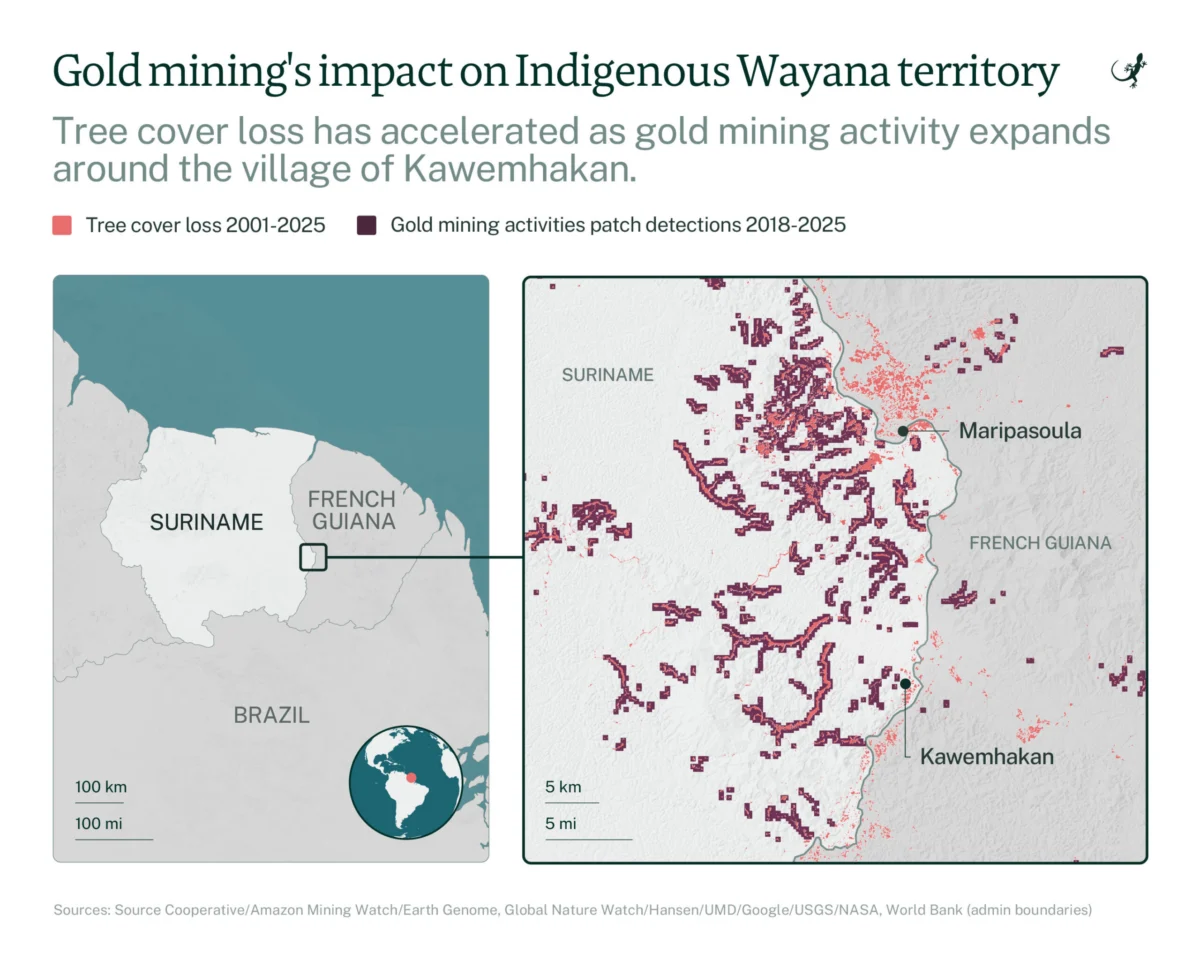
Deep within the dense, emerald canopy of the Amazon rainforest, the village of Kawemhakan stands as a precarious sentinel on the Lawa River. This waterway, which delineates the volatile border between Suriname and French Guiana, has become the epicenter of a desperate struggle for sovereignty, environmental integrity, and the survival of the Indigenous Wayana people. While thousands of square kilometers of rainforest conceal vast, untapped mineral wealth, the human cost of extraction is reaching a breaking point. As illegal mining operations expand, the Wayana find themselves caught in a complex web of economic desperation, lack of formal land rights, and a persistent void of government oversight.

A Geography of Extraction and Exclusion
The logistical isolation of Kawemhakan is both its greatest vulnerability and its only tactical advantage. The village, accessible only by light aircraft or long, arduous river journeys, serves as a gateway to some of the most remote mining frontiers in the Guiana Shield. The community’s primary connection to the outside world—a dirt airstrip situated squarely within the village—has become the focal point of a power struggle. Indigenous leaders, including the current chief Ipomadi Toko Pelenapün, have historically utilized their control over this critical infrastructure to exert influence over the influx of prospectors, traders, and machinery.
However, the rapid expansion of gold mining—driven by soaring global prices and the influx of foreign miners from Brazil and beyond—is systematically overwhelming these traditional forms of authority. According to data from the Monitoring of the Andean Amazon Project (MAAP), approximately 25,000 hectares of forest were lost to mining activities along the border region between 2021 and 2024. This trend continued into 2025, with an additional 2,800 hectares of deforestation recorded, signaling an acceleration of habitat destruction that threatens the traditional hunting and fishing grounds upon which the Wayana rely.

The Informal Economy of the Lawa River
The economic ecosystem surrounding the Lawa River operates largely outside the reach of formal Surinamese law. Along the riverbanks, an array of makeshift grocery stores, many operated by foreign traders, provide the necessary lifeblood for mining camps: fuel, generators, mercury, and heavy machinery. These trading posts serve a dual purpose, functioning as informal gold exchange hubs where minerals are weighed and traded for cash in foreign currencies, including euros and U.S. dollars.
This shadow economy feeds into a larger, more structured supply chain that leads to Paramaribo. Once in the capital, the gold is often funneled through intermediaries and processed by facilities like the Kaloti Suriname Mint House, a venture with state participation. This entanglement of local, national, and international interests complicates efforts to regulate the industry. For the miners, the work is grueling and dangerous. One anonymous source described a cycle of debt and maintenance, where operators must constantly reinvest their earnings into equipment that is frequently confiscated or destroyed by the infrequent, yet disruptive, law enforcement interventions.

The Rise and Fall of the Spence Family
The fragility of local alliances was most vividly illustrated by the rise and subsequent fallout of the Spence family, who for years held significant sway in the region. Initially welcomed by the Wayana as partners in developing infrastructure—including the very airstrip the village relies upon—the Spences eventually shifted from contractors to enforcers. As they climbed the mining hierarchy, their methods became increasingly predatory.
Reports indicate that the family began employing intimidation tactics, utilizing armed bodyguards and recruiting local youth to extort other mining operations. The conflict peaked around 2023, when allegations of widespread robbery and coercion led to a standoff with the community. While the exact circumstances of their departure remain shrouded in the complex social dynamics of the region, the Spences eventually retreated, leaving behind abandoned, boarded-up properties.

The vacuum left by the Spences, however, has not brought peace. Instead, it has paved the way for larger, corporate-backed entities to formalize their presence. The recent entry of companies like Founders Metals, which acquired the Mine Rehab N.V. concession, signals a transition from small-scale, unregulated extraction to large-scale industrial exploration. While these companies publicly pledge to adhere to legal and environmental regulations, the Wayana community remains skeptical, fearing that corporate expansion will further erode their autonomy and accelerate the degradation of their ancestral lands.
The Legislative Impasse and Land Rights
The core of the Wayana’s vulnerability lies in the continued absence of legally recognized land titles. Suriname remains the only country in South America that has failed to grant formal land rights to its Indigenous communities, despite a landmark 2007 ruling by the Inter-American Court of Human Rights. This legal limbo leaves communities like Kawemhakan without the mandate to challenge government-issued mining concessions that overlap with their traditional territories.

The government of Suriname has, on several occasions, pledged to combat illegal mining and mercury contamination, citing commitments to maintain 90% forest cover and preserve its status as a net-negative carbon emitter. Yet, these national pledges often clash with the reality on the ground. In Kawemhakan, the lack of a permanent state presence means that directives from Paramaribo are often unenforceable or outright ignored by the transient mining population.
A Future Beyond the Gold Rush
Despite the mounting pressure, the Wayana are not passive observers of their own displacement. The Mulokot Foundation, an advocacy group working closely with the community, is spearheading efforts to diversify the local economy and strengthen their legal standing. By utilizing satellite imagery to monitor forest loss and engaging in independent mapping of their ancestral territory, the community is building a database of evidence that could prove vital in future litigation.

Education remains a central pillar of this resistance. While the COVID-19 pandemic forced the closure of the local school, the foundation is working to implement online learning models. The goal is to provide the younger generation with the skills to engage with the outside world—and the Surinamese state—on their own terms, rather than relying solely on the mining economy for survival.
"If they don’t stop this mining thing, our territory, our land, won’t be the same anymore," said Marciano Pelenapün, the son of the chief and a vocal advocate for his people. His sentiment reflects a broader existential anxiety. For the Wayana, the struggle is not merely about preventing environmental damage; it is about the survival of a culture that has existed in harmony with the Lawa River for generations.

The path forward is fraught with uncertainty. As international mining interests consolidate their hold on the region, the pressure on the Wayana will only intensify. The outcome of this struggle will serve as a bellwether for the future of the Amazon, testing whether the rights of Indigenous communities can be upheld against the relentless, high-stakes pressure of the global gold market. Without a decisive shift in government policy toward the recognition of land rights, the future of the Wayana—and the integrity of the forest they protect—remains hanging in the balance.

