
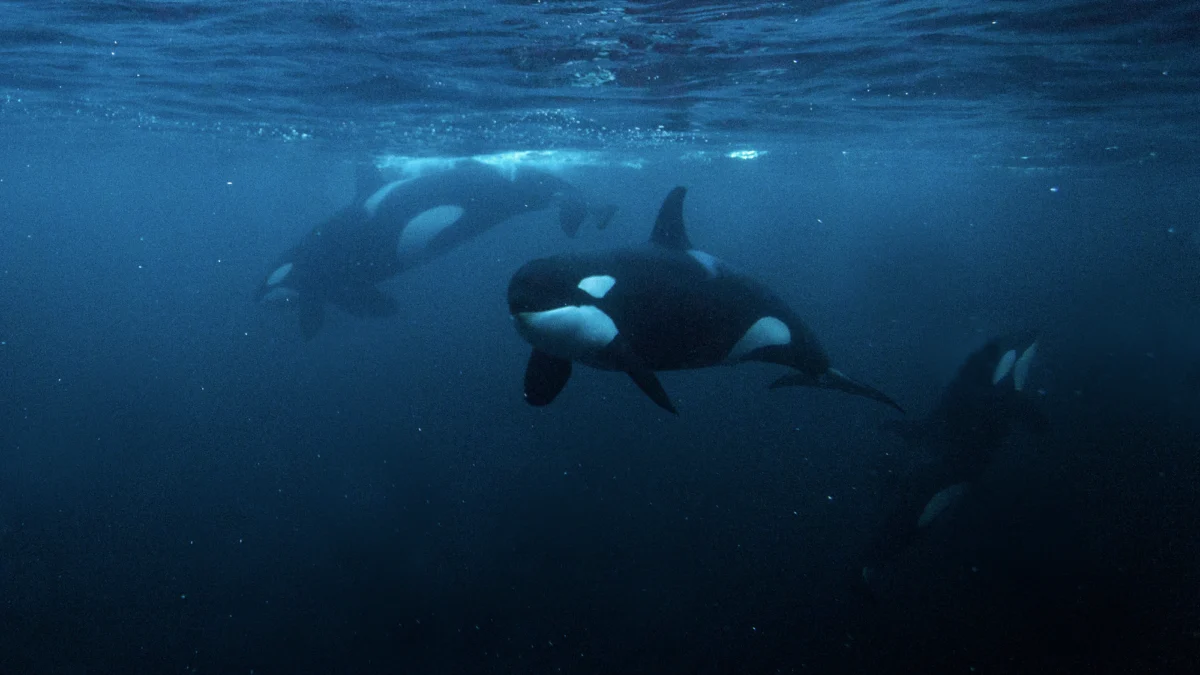
In the crystal-clear waters of the Gulf of California, a series of extraordinary predatory encounters has revealed a sophisticated and brutal new hunting strategy employed by orcas (Orcinus orca). Marine biologists have documented a coordinated "anvil and hammer" maneuver where these apex predators use high-speed kinetic energy to literally shatter the carcasses of giant sharptail mola (Masturus lanceolatus), a species of sunfish that can weigh over a ton. This behavior, detailed in a recent study published in the journal Frontiers in Ethology, adds a startling new chapter to the growing catalog of culturally transmitted hunting techniques observed in different orca populations worldwide.
The phenomenon involves a two-whale system designed to bypass the sunfish’s nearly impenetrable biological defenses. According to the research, one orca acts as a stabilizer, gripping the sunfish in its jaws to hold it in place. A second orca then retreats to gain significant distance before accelerating toward the target at full speed. Upon impact, the sheer force causes the sunfish’s body to undergo what scientists describe as a "tissue explosion," breaking the dense, collagen-heavy skin into manageable fragments. This method of "kinetic butchery" allows the pod to access the nutrient-rich meat beneath a skin layer that is otherwise resistant to standard biting and tearing.
A Chronology of Discovery in the Sea of Cortez
The documentation of this behavior is the result of years of opportunistic sightings and dedicated field research. The first recorded instance occurred in December 2021, when marine biologist Erick Higuera Rivas of Conexiones Terramar witnessed a pod of orcas engaging in what appeared to be an unnecessarily violent interaction with a sharptail mola. Higuera Rivas noted that the energy of the impact was so intense that it sent debris and tissue flying through the water column, a sight rarely seen in typical marine predation.
Following the 2021 encounter, researchers remained on high alert for similar behaviors. The strategy was observed again in 2024 and 2025, confirming that the initial event was not an isolated incident but a repeatable, learned behavior within this specific group of orcas. By the third observation, scientists were able to capture high-definition drone and underwater footage, allowing for a frame-by-frame analysis of the physics involved.
The timeline suggests a period of refinement and potential transmission. While the 2021 event was the first scientific recording, local anecdotal reports suggest that orcas in the Gulf of California—often referred to as the "World’s Aquarium"—may have been developing this niche-specific tactic for some time. The consistency of the three documented cases indicates that the "anvil and hammer" routine is now a stable part of the pod’s behavioral repertoire.
The Biological Obstacle: The Collagen Shield of the Sharptail Mola
To understand why orcas have resorted to such extreme measures, one must look at the unique anatomy of the sharptail mola. Unlike most fish, which are covered in scales, the sunfish family (Molidae) is encased in a thick, leathery hide composed of dense collagen fibers. In larger specimens, this skin can be several inches thick and is described by researchers as a "waterlogged shield."
Erick Higuera Rivas explained that sunfish skin cannot be "unzipped" or torn in the way a shark’s skin or a whale’s blubber might be. The collagen structure provides incredible tensile strength, making it nearly impossible for an orca to simply bite through the carcass to reach the muscle meat. By using kinetic energy, the orcas transition from trying to cut the material to shattering it.
"Instead of using tension to rip it, the orcas use massive kinetic energy," Higuera Rivas stated in an interview with ScienceAlert. This shift from biological "slicing" to mechanical "crushing" represents a high level of problem-solving. The orcas have essentially recognized that the sunfish’s skin is vulnerable to sudden, high-impact force rather than sustained pressure.
Forensic Analysis of the Kill: Butchery vs. Predation
One of the most intriguing findings of the study is that the ramming itself is often not the cause of death. Close examination of the footage and recovered tissue samples revealed that in several instances, the sunfish were already deceased before the high-speed impact occurred. Furthermore, the internal organs—most notably the liver, which is highly prized by orcas for its high lipid content—had already been surgically removed.
This indicates that the ramming is a secondary phase of the feeding process. After the orcas have harvested the "easy" nutrients by flipping the fish or attacking its softer underbelly, they are left with a massive, nutrient-dense carcass that is difficult to process. The ramming serves as a butchery technique to break down the "armored" remains. This distinction is vital for ethologists, as it demonstrates that orcas possess the foresight to manage a food source in stages, utilizing different physical techniques for different parts of the same prey.
Cultural Transmission and the Training of Juveniles
The social structure of orca pods is centered around the transmission of knowledge from matriarchs and experienced adults to the younger generation. The Gulf of California study provided clear evidence that the sunfish ramming serves an educational purpose. In at least one of the documented events, a juvenile orca was observed hovering nearby during the impact, immediately moving in to feed on the smaller fragments created by the collision.
The sharptail mola is a slow-moving, largely defenseless animal, making it an ideal "training dummy" for young orcas. Learning the precision required for a high-speed ram—without injuring oneself or the "anvil" partner—is a complex task. By practicing on a ton-heavy mola, juvenile orcas can develop the coordination and power necessary for more dangerous hunts, such as those involving larger whales or agile sea lions.
This aligns with observations in other parts of the world. In the Antarctic, orcas teach their young how to create synchronized waves to wash seals off ice floes. In the Pacific Northwest, they teach specific techniques for catching Chinook salmon while avoiding less nutritious species. The "sunfish punch" is the Gulf of California’s version of this cultural schooling.
A Global Context of Orca Innovation
The behavior in the Gulf of California is part of a broader trend of orca "cultures" emerging across the globe. Orcas are among the few non-human species known to possess true culture, defined as a suite of behaviors shared by a community and passed down through social learning rather than genetics.
- Iberian Peninsula: In recent years, a subpopulation of orcas off the coast of Spain and Portugal has gained international notoriety for "attacking" sailboats, specifically targeting and breaking the rudders. While scientists debate whether this is play or a defensive reaction, it represents a rapidly spreading cultural fad.
- South Africa: Two male orcas, known as Port and Starboard, have revolutionized the local ecosystem by systematically hunting great white sharks and consuming only their livers. This has caused a massive shift in shark populations, with great whites fleeing their traditional hunting grounds to avoid the "serial killers."
- New Zealand: Pods here have mastered the "ray-flip," where they grab venomous stingrays by the tail or head and flip them over to induce tonic immobility before consuming them, avoiding the dangerous barbs.
- Norway and Iceland: Orcas utilize "carousel feeding," where they swim in circles around schools of herring, blowing bubbles and flashing their white bellies to herd the fish into a tight ball before stunning them with powerful tail slaps.
The documentation of sunfish ramming adds a new dimension to this list, showcasing an orca population that has adapted to the specific challenges of their environment and the biology of their local prey.
Scientific and Ecological Implications
The discovery of this behavior has significant implications for the study of marine biology and animal cognition. It highlights the role of "innovation" in apex predators. As environmental conditions change and prey availability shifts, the ability of a species to invent and transmit new hunting strategies is a key factor in its long-term survival.
Furthermore, the impact on the Gulf of California ecosystem must be considered. The sharptail mola is an elusive deep-water species, and little is known about its population dynamics. If orca pods are systematically targeting these giants, it could have a trickling effect on the food web. However, researchers suggest that because the orcas are utilizing the entire carcass through these kinetic techniques, they are maximizing the caloric intake per kill, which may actually reduce the total number of animals they need to hunt.
Conclusion: The Evolving Apex Predator
The image of an orca "punching" a ton-heavy fish until it explodes is a vivid reminder of the raw power and chilling intelligence of these marine mammals. As Erick Higuera Rivas noted, the sheer scale of the "tissue explosion" was something researchers had never anticipated.
The study in Frontiers in Ethology underscores that we are only beginning to understand the complexity of orca society. Far from being driven by mere instinct, these animals operate with a level of tactical planning and cultural heritage that rivals some primate societies. In the Gulf of California, the sharptail mola has become the latest subject in a masterclass of marine predation—a testament to the orca’s status as the ocean’s undisputed and most innovative chaos agent. As researchers continue to monitor the Sea of Cortez, the question is no longer whether orcas will exhibit new behaviors, but rather how long it will take for the next "tradition" to be born.

