
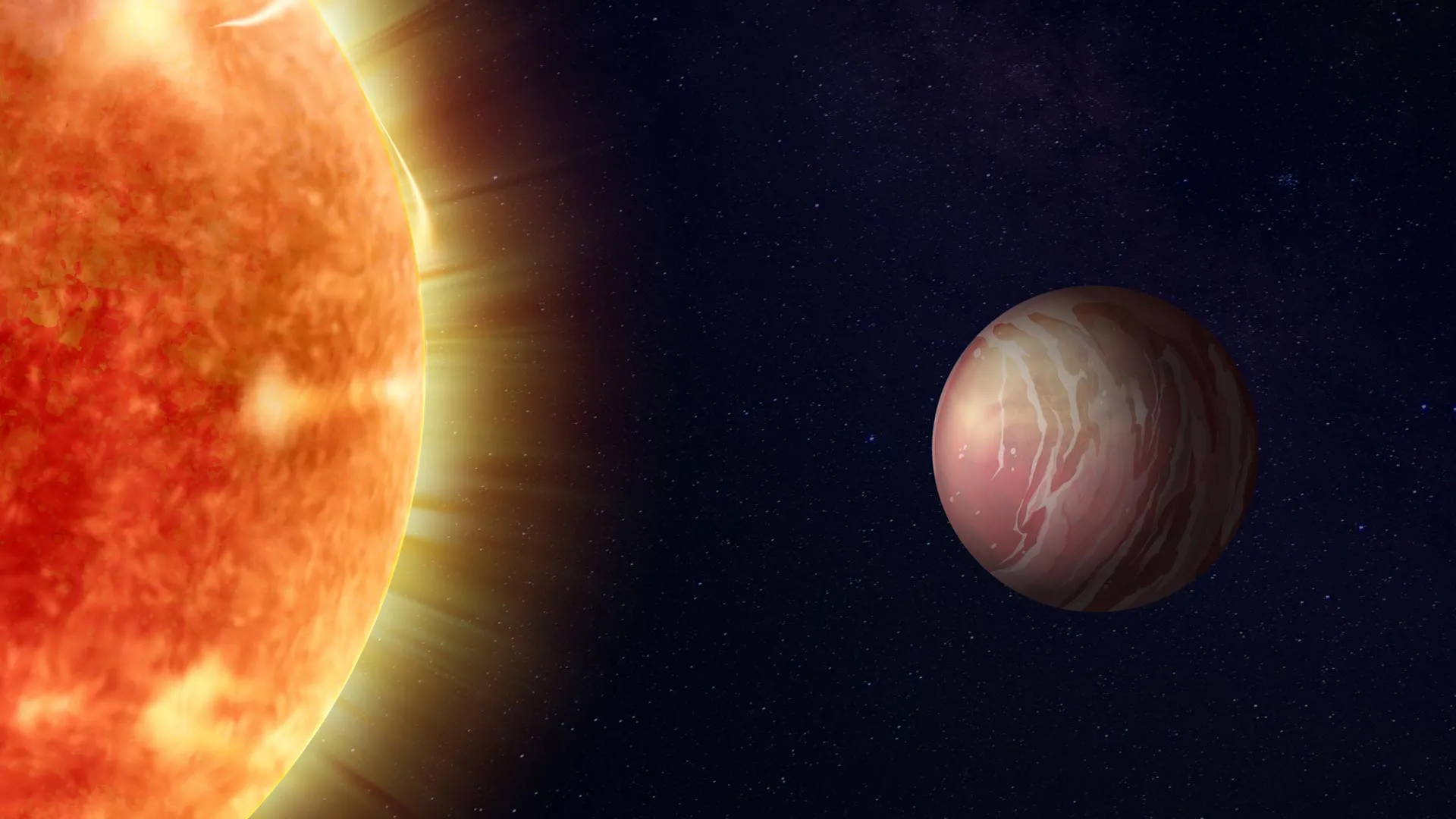
Astronomers have unveiled a groundbreaking discovery concerning TOI-561 b, a scorching exoplanet situated 280 light-years from Earth that defies conventional planetary science. Despite its proximity to its host star and a surface composed of molten rock, the planet appears to be shielded by a dense, reflective atmosphere that functions much like a massive celestial sunscreen. This finding, published in The Astronomical Journal, challenges the long-standing belief that rocky, highly irradiated planets orbiting close to their stars should have long ago lost their gaseous envelopes to stellar winds and intense radiation.
The research, led by an international team including astrophysicists from the University of Birmingham and the University of Waterloo, utilized the unprecedented sensitivity of the James Webb Space Telescope (JWST) to peer into the conditions of this extreme world. By monitoring the planet over a 37-hour period—covering nearly four full orbits—the team was able to capture the elusive "phase curve" of the planet, providing a comprehensive look at how its temperature and brightness shift as it faces its star and rotates toward the darkness of space.
A World That Should Not Exist
TOI-561 b is categorized as a "super-Earth" in terms of its size, but its environment is anything but Earth-like. Orbiting its star with such intensity that its surface is a global ocean of magma, the planet represents one of the most extreme environments ever studied. Standard astrophysical models suggest that a planet of this nature, subjected to such relentless bombardment of high-energy particles and photons from its host star, should have been stripped of any primary atmosphere billions of years ago.
For decades, the consensus in the field of exoplanetary science was that such planets would be essentially bare rocks, unable to maintain a gaseous layer. However, the JWST data suggests a more complex reality. The planet exhibits a reflective capability of approximately 75%, a figure that rivals the cloud-covered Venus. This high albedo, or reflectivity, indicates that a substantial amount of solar radiation is being bounced back into space before it can contribute to the already intense surface heat, thereby tempering the planet’s extreme temperatures.
Chronology of the Discovery
The investigation into TOI-561 b is the culmination of years of data gathering and collaborative international effort. Initial detection of the planet occurred through transit photometry, which measures the periodic dimming of a star as a planet passes in front of it. While early data confirmed its existence, the nature of its atmosphere remained a mystery.
In recent years, the deployment of the JWST has revolutionized the study of exoplanetary atmospheres. In the lead-up to this specific study, researchers noted a persistent anomaly: the dayside of TOI-561 b was significantly cooler than the physical models predicted for a dark, basaltic rock surface. This discrepancy suggested that heat was not being absorbed in the way a barren, airless rock would absorb it.
During the 37-hour observation window facilitated by the JWST, the team focused on the planet’s nightside—a region that never receives direct starlight due to the planet being tidally locked. By measuring the temperature differential between the dayside and the nightside, researchers confirmed that heat is being efficiently redistributed around the planet. This, combined with the high reflectivity, serves as definitive evidence that a thick, persistent atmosphere is present.
The Mechanism of the Sunscreen
The leading hypothesis to explain this phenomenon involves a layer of high-altitude clouds composed of silicate minerals. As the planet’s surface roils with volcanic activity and molten magma, vaporized minerals such as silicon dioxide (SiO2) and magnesium silicate (MgSiO3) are likely lofted into the upper atmosphere. Once they reach cooler altitudes, these minerals condense into reflective cloud particles.
These silicate clouds act as a planetary-scale umbrella, reflecting a large percentage of incoming stellar radiation. This "sunscreen" effect explains why the planet’s dayside remains cooler than expected, preventing the surface from reaching even more extreme, unsustainable temperatures. This mechanism not only moderates the surface heat but also protects the lower atmospheric layers from being entirely eroded by the star’s intense energy.
Insights from the Research Team
Dr. Anjali Piette, an Assistant Professor in Astronomy at the University of Birmingham, emphasized the disruptive nature of these findings. "Our discovery challenges current theories," Dr. Piette stated. "We would expect a heavily irradiated rocky planet like TOI-561 b to have lost its atmosphere billions of years ago. Instead, the evidence suggests it still has a significant atmosphere today. This raises major questions such as whether the planet started with an unusually large supply of gases or if the ocean of molten rock covering its surface acts as a planet-wide volcano that is constantly feeding its atmosphere."
Professor Lisa Dang, who led the project at the University of Waterloo, highlighted the methodology used to reach these conclusions. "We measured how the planet’s brightness and heat changed throughout its orbit. This technique, known as a phase curve, revealed that the planet reflects a significant amount of light from its star, and that heat is being redistributed around the planet instead of only on the sunlit side. Together, these point to the presence of an atmosphere."
Implications for Exoplanetary Science
The existence of an atmosphere on TOI-561 b opens a new chapter in how astronomers define "habitable" or "survivable" conditions for planets around M-dwarf stars. While the conditions on TOI-561 b are clearly hostile to life as humans understand it, the processes keeping its atmosphere alive are of great interest.
If the atmosphere is indeed being replenished by a molten interior, it suggests that the interior of these super-Earths may be much more active than previously thought. This could imply that "lava worlds" are not just dead husks, but geologically active bodies that continuously recycle their atmospheric components. This cycle of volcanic outgassing and cloud formation could be a common feature of rocky planets in close proximity to their stars, a finding that would require a significant revision of existing exoplanetary climate models.
Future Research Directions
The scientific community is now focused on identifying the chemical signature of this atmosphere. The two primary candidates currently under consideration are a thick, carbon dioxide-heavy atmosphere—similar to the runaway greenhouse effect observed on Venus—or an atmosphere dominated by sulfur dioxide, reminiscent of the volcanic activity on Jupiter’s moon Io.
Distinguishing between these two possibilities is the next major objective for the research team. By utilizing the JWST to observe the planet at longer, infrared wavelengths, scientists hope to capture the specific spectral fingerprints of the gases present. This data will be crucial in determining whether the atmosphere is a relic of the planet’s formation or a modern product of ongoing volcanic, planetary-scale recycling.
The mystery of TOI-561 b serves as a stark reminder of the limitations of current astronomical models. As the James Webb Space Telescope continues its mission, the study of such extreme environments provides the necessary data to refine our understanding of planetary evolution. Whether TOI-561 b represents a unique outlier or a common class of "protected" lava worlds remains to be seen, but the discovery of its reflective sunscreen has undoubtedly provided one of the most compelling insights into the resilience of planetary atmospheres in the face of extreme stellar proximity.
As the team prepares for further observation cycles, the broader scientific community looks on with anticipation. The study of this distant, glowing orb is not merely an investigation into a single planet, but a probe into the fundamental processes that govern the lifecycle of rocky worlds throughout the galaxy. By understanding how TOI-561 b maintains its veil of clouds, researchers move one step closer to solving the puzzle of how planets endure, evolve, and persist in the volatile environments of deep space.

