
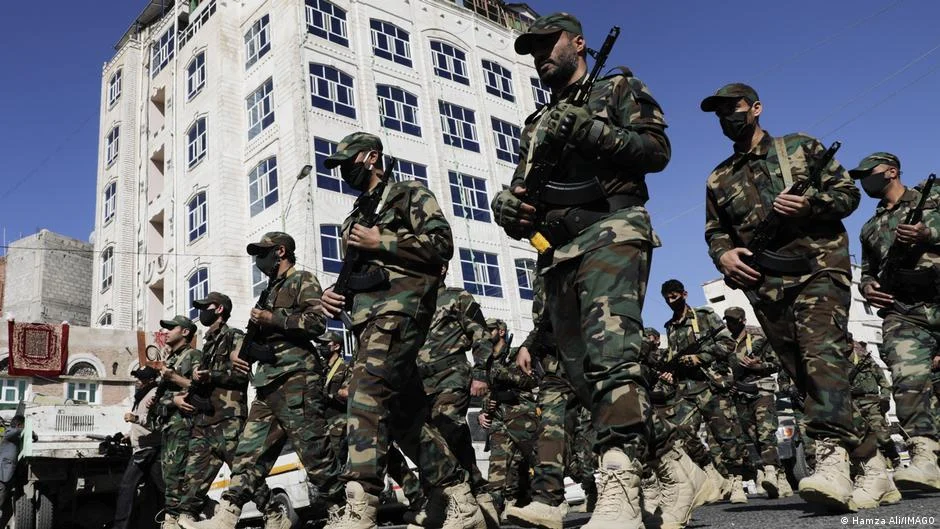
In the shifting sands of the contemporary Middle East, a profound transformation is occurring within the coalition of Iran-aligned factions known as the Axis of Resistance. As recent footage from Baghdad illustrates, the rhetoric and symbolic posturing once synonymous with Lebanese Hezbollah are now being mirrored by Shiite paramilitary groups in Iraq and, most notably, the Houthi movement in Yemen. This ideological and operational convergence suggests that the regional security architecture is undergoing a seismic shift, with the Houthi movement emerging as the vanguard of a hardened, more autonomous, and increasingly potent paramilitary force.
A Chronology of Escalation
The current geopolitical climate in the Middle East has been shaped by a rapid succession of escalations beginning in early 2026. Following the onset of direct military engagements between the United States, Israel, and Iran in late February 2026, the various components of the Axis of Resistance began to synchronize their tactical responses. While groups like Hezbollah in Lebanon and various militias in Syria initially bore the brunt of these exchanges, the Houthi movement—formally known as Ansar Allah—adopted a strategy of opportunistic expansion.
By mid-2026, the Houthis had successfully consolidated control over significant portions of the Yemeni coastline and several strategically vital islands in the Red Sea. This territorial expansion was not merely a local victory; it was a calibrated effort to establish a permanent, non-state maritime presence. By September 2026, analysts at the Institute for the Study of War reported that these maneuvers were specifically designed to exert control over regional energy chokepoints, effectively challenging the status quo in the Red Sea and complementing Iran’s ongoing efforts to dictate transit through the Strait of Hormuz.
Comparative Strategic Capabilities: The New Hezbollah?
For years, the Lebanese group Hezbollah served as the gold standard for Iranian-backed proxy warfare. With deep roots in Lebanese society, a sophisticated political arm, and a robust social welfare network, Hezbollah functioned as a state-within-a-state. However, the degradation of its infrastructure due to sustained Israeli military operations and the loss of its strategic depth in Syria have created a power vacuum within the Axis.
The Houthis appear to be filling this void with a different, and in some ways more dangerous, operational profile. Unlike Hezbollah, which historically had to balance its militant activities with the domestic political realities of a diverse Lebanese population, the Houthis operate with minimal social or political constraints. Their ideology, which emphasizes martyrdom and views economic hardship as a divine test, renders them largely immune to the traditional deterrents of international sanctions or conventional military pressure.

Evidence of their increasing technical sophistication was highlighted this week, when Houthi forces successfully downed a Saudi F-15 fighter jet. While Hezbollah has historically engaged with Israeli drones and conducted limited sorties, the Houthi ability to deploy and modify surface-to-air missile systems to strike high-value assets represents a significant leap in their offensive capabilities. This development confirms that the Houthis are no longer merely a local insurgency but are evolving into a regional actor with power-projection capabilities that far exceed those of their predecessors in the Axis.
The Dynamics of Iranian Influence
The nature of the relationship between Tehran and the Houthi movement remains a subject of intense academic and intelligence debate. While Iranian state media, including the conservative publication Kayhan, frequently celebrates Houthi gains as victories for the broader anti-Western cause, the relationship is characterized by a unique degree of operational autonomy.
Unlike Hezbollah, which has historically functioned as an extension of the Islamic Revolutionary Guard Corps (IRGC), the Houthis possess a distinct domestic constituency and a singular territorial project. This autonomy is a double-edged sword for Tehran. While it allows the Houthis to act as a disruptive force that can be plausibly denied by Iranian officials, it also means the group cannot always be restrained by Iranian diplomatic directives.
However, recent intelligence reports suggest that the degree of alignment has tightened significantly. The transfer of sophisticated long-range weaponry and intelligence-sharing regarding maritime transit in the Bab el-Mandeb Strait suggests a level of coordination that transcends mere ideological affinity. Allison Minor, a former U.S. deputy special envoy for Yemen, noted in recent analyses that even as Houthi leaders frame their actions within local grievances, their strategic alignment with Tehran has become increasingly indistinguishable from that of other formal proxies.
Humanitarian and Regional Implications
The consequences of this shifting landscape are felt most acutely by the civilian population of Yemen. Since the beginning of September 2026, the United Nations has reported the displacement of at least 125,000 individuals due to intensified conflict. The Houthi governance model—which prioritizes military expenditure over the provision of basic public services or civil administration—has created a humanitarian crisis of historic proportions.
From a geopolitical perspective, the implications are equally grave. The Houthi focus on controlling global oil export routes creates a high-stakes scenario for international markets. By turning the Red Sea into a contested body of water, the group has effectively added a second, southern front to the ongoing conflict in the Strait of Hormuz. This dual-chokepoint strategy increases the vulnerability of global energy supplies and forces the United States and its regional allies to allocate significant naval assets to ensure the freedom of navigation.

Expert Analysis and Future Outlook
Farea al-Muslimi, a research fellow at Chatham House, posits that the Houthi leadership, particularly Abdul Malik al-Houthi, has successfully cultivated a persona that rivals the late Hassan Nasrallah in regional influence. By mirroring the rhetorical style and strategic maneuvers of the former Hezbollah leader, al-Houthi is positioning himself as the new "fixer" of the Axis of Resistance.
The central challenge for international policymakers lies in the fact that traditional methods of engagement are largely ineffective against the Houthi movement. Because the group does not participate in the global financial system and relies on a "zero-sum" ideological framework, standard economic levers—such as asset freezes or banking restrictions—fail to gain traction.
"They have become more valuable to the Axis than Hezbollah ever was," says Andreas Krieg, a senior lecturer at King’s College London. "Hezbollah provided deterrence, but the Houthis provide leverage—leverage over Saudi Arabia, over Israel, and over the global economy."
As the conflict in the region persists, the Houthi movement’s transition from a localized rebel group to a regional power-broker appears nearly complete. With their increasing ability to strike sophisticated aircraft, their tactical focus on maritime chokepoints, and an uncompromising ideology that welcomes the prospect of total war, the Houthis have fundamentally altered the threat matrix for the Middle East. Whether this trajectory leads to a consolidation of their power or an eventual confrontation with the combined military might of regional and international powers remains the central question of the ongoing crisis. The current evidence suggests that the group is fully prepared to endure that confrontation, prioritizing their strategic objectives above the stability of the state they seek to govern and the regional order they aim to dismantle.

