
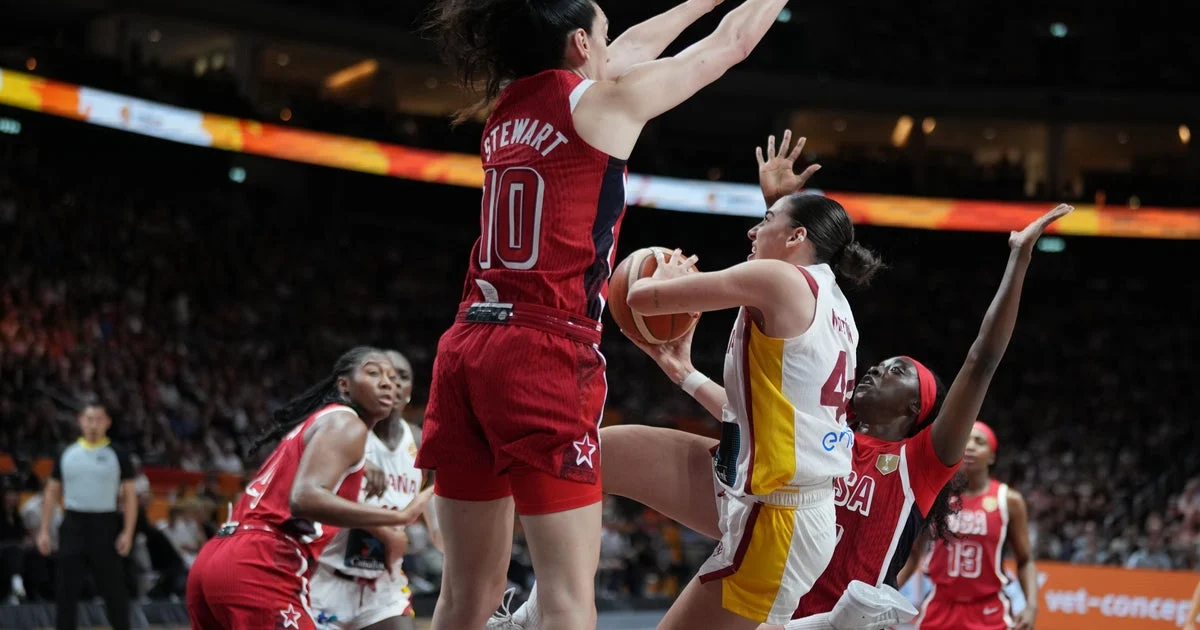
Breanna Stewart scored 16 points and Kahleah Copper added 13 to help the U.S. beat Spain 76-66 on Saturday, advancing to the championship game of the women’s FIBA World Cup. The Americans will face France in a high-stakes rematch of the 2024 Paris Olympics gold medal game, a contest the United States narrowly clinched by a single point. This victory marks a significant milestone in the U.S. program’s quest for international dominance, as they are now just one win away from securing a fifth consecutive World Cup title, a feat that would allow them to equal the legendary record held by the former Soviet Union.
A Hard-Fought Semifinal Battle
The semifinal clash in Berlin served as a stern test for the American squad, which had largely cruised through the tournament with dominant performances. Unlike their previous outings, the U.S. team faced a highly disciplined and physical Spanish defense that disrupted their offensive rhythm from the opening tip-off. Spain signaled their intentions early, surging to a 9-1 lead in the opening minutes—the largest deficit the Americans have faced throughout the entire 2026 tournament.
The game remained a defensive struggle for the majority of the first half. The officials were heavily involved, as the physical nature of Spain’s interior defense led to a parade of free throws. By the time the halftime whistle blew, the U.S. had already attempted 27 free throws, converting 19 of them, compared to just 26 total field-goal attempts. This tactical reliance on the charity stripe allowed the U.S. to take a narrow 39-36 lead into the locker room, despite the team struggling to find a consistent flow from the perimeter.
Fourth Quarter Decisiveness
Entering the final frame, the tension in the arena was palpable with the score deadlocked at 58-58. The fourth quarter, however, saw the American depth and experience take center stage. The U.S. went on a clinical 12-2 run during the first five minutes of the quarter, stretching their lead to 70-60. This 10-point cushion, established with 5:20 remaining on the clock, proved to be the decisive momentum shift. Spain, despite valiant efforts from their perimeter shooters, was unable to narrow the gap to fewer than eight points for the remainder of the contest.
Historical Context and Legacy
The U.S. women’s basketball team’s dominance in the World Cup is a cornerstone of modern sports history. With Saturday’s win, the Americans have extended their winning streak in the tournament to 35 consecutive games. The last time the U.S. suffered a defeat in the FIBA World Cup was in the 2006 semifinals against Russia. Since then, the program has remained virtually untouchable, consistently evolving its roster to blend veteran leadership with emerging stars.
This current run mirrors the historic dominance of the Soviet Union, which claimed five consecutive world titles between 1959 and 1975. Should the Americans defeat France in the upcoming final, they will officially etch their names alongside that historic squad, cementing their status as the most successful continuous era in the history of the sport.
For Breanna Stewart, the game against Spain carried a sense of full-circle resonance. Her international debut with the senior national team occurred during the 2014 World Cup, where she helped the U.S. defeat Spain in the gold medal game. Twelve years later, she remains the focal point of the team’s tactical approach, providing both scoring output and defensive versatility.
Statistical Breakdown and Tournament Implications
The reliance on free-throw shooting was a statistical anomaly in this semifinal. By the end of the game, the U.S. had made 27 of 35 attempts from the line. This reliance on the charity stripe highlights the physical pressure applied by the Spanish defense, which forced the U.S. to attack the basket relentlessly rather than relying on their usual transition game or outside shooting.
Spain, now relegated to the bronze medal game, will face host nation Germany on Sunday. While they fell short of a final appearance, their performance in Berlin showcased the closing gap between the American program and the rest of the world. Spain’s ability to limit the U.S. to only 76 points—well below their tournament average—will likely be analyzed by the French coaching staff as they prepare their defensive scheme for the championship game.
The Final Showdown: A Rematch of Paris 2024
The upcoming final against France is arguably the most anticipated game of the 2026 international calendar. The rivalry between the two nations was ignited during the 2024 Paris Olympics, where the gold medal game was decided by the narrowest of margins. The U.S. victory in that game was a testament to their composure under pressure, and the French side is expected to be highly motivated by the prospect of redemption on the world stage.
Analysts suggest that the French team’s familiarity with the American playstyle, combined with the high level of individual talent currently present in their roster, makes this a true "pick ’em" game. The U.S. coaching staff will need to adjust their offensive sets to avoid the stagnation experienced against Spain, particularly against a French team known for its tactical discipline and high basketball IQ.
Reactions and Official Outlook
While official post-game press conferences focused on the immediate tactical requirements for the final, the sentiment within the U.S. camp remained grounded. Coaching staff emphasized that while the 35-game win streak is an impressive metric, the primary focus remains on the "one-game-at-a-time" philosophy that has defined their success over the last two decades.
"We knew Spain was going to play with incredible intensity," a team representative noted in the post-game media scrum. "They forced us to play a different type of game, and I am proud of the way our players stayed disciplined at the line and executed during the closing minutes when it mattered most."
Broader Impact on Women’s Basketball
The global interest in the 2026 FIBA World Cup has been significant, with record-breaking viewership numbers in European markets. The tournament has served as a showcase for the rapid professionalization of women’s basketball globally. The physicality witnessed in the U.S.-Spain semifinal is indicative of a trend where international teams are no longer content with simply participating; they are actively developing schemes designed to negate the athletic advantages traditionally held by the United States.
As the tournament moves toward its conclusion, the focus shifts to the final showdown in Berlin. The world will be watching to see if the U.S. can sustain its historic run or if France can deliver the first major upset in the World Cup since 2006. Regardless of the outcome, the 2026 FIBA World Cup has already succeeded in elevating the competitive standards of the sport, ensuring that the path to gold remains the ultimate challenge in international basketball.

