
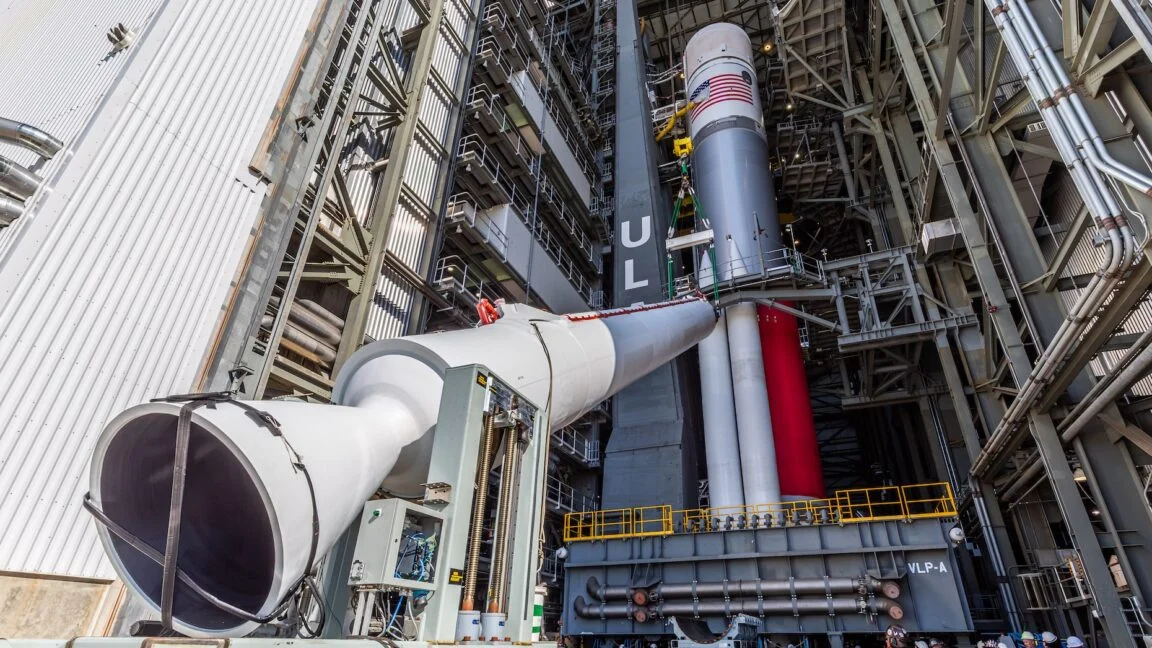
United Launch Alliance has officially announced its targeted return-to-flight schedule for the Vulcan heavy-lift rocket, setting a launch date of November 13 from the Florida Space Coast. The upcoming mission, which is still contingent upon final range approval from regulatory authorities, comes approximately nine months after an in-flight anomaly involving a solid rocket booster temporarily disrupted the company’s ambitious manifest and forced a comprehensive engineering review.
The upcoming flight carries immense significance not only for United Launch Alliance as an aerospace enterprise, but also for its commercial and national security partners. The payload consists of 40 operational satellites destined for the Amazon Kuiper low-Earth orbit broadband constellation. This mission represents the inaugural launch of a monumental 38-flight contract secured by Amazon to deploy the lion’s share of its global internet-beaming satellite network. Liftoff is scheduled to take place from Space Launch Complex 41 at Cape Canaveral Space Force Station.
The return-to-flight operation marks a critical inflection point for United Launch Alliance. The company’s next-generation flagship launch vehicle has faced rigorous scrutiny following nozzle anomalies observed on its Northrop Grumman-built solid rocket boosters during two of its first four developmental and operational flights. The most recent failure occurred during a high-profile mission in February, prompting an immediate grounding of the rocket fleet while engineering teams scrambled to diagnose the root causes of the structural degradation. Although the vehicle successfully managed to compensate for the anomaly on both occasions and ultimately delivered its payloads to their intended trajectories, the incidents severely eroded the confidence of key stakeholders, most notably the United States Space Force.
The Stakes for National Security and Commercial Space
As the primary institutional customer for United Launch Alliance, the Department of Defense maintains a vested interest in the absolute reliability of the Vulcan launch system. The Pentagon has positioned the Vulcan rocket as a cornerstone of its heavy-lift architecture, awarding the vehicle roughly half of all major national security space launch assignments through the early 2030s under the National Security Space Launch (NSSL) program.
The trust placed in the vehicle was underscored when the Space Force officially certified the Vulcan rocket for national security missions in 2025. Following certification, ULA successfully executed two high-profile national security flights before the fleet-wide grounding was enacted in the wake of the February booster incident. Consequently, military leadership has mandated exhaustive oversight of ULA’s remediation efforts, signaling that future national security launch assignments will depend heavily on the performance and data gathered during the November 13 return-to-flight mission.
Decoding the Engineering Fix: What Went Wrong and How It Was Solved
In an official corporate statement released Wednesday, United Launch Alliance executives and engineering leads declared that the company had made substantial strides in diagnosing the precise mechanics behind the February solid rocket booster anomaly.
"Engineering teams have identified several potential contributors, which have been mitigated through design and process improvements to the nozzle," the company stated.
The anomaly itself centered on the exhaust nozzles of the solid rocket boosters, which experience extreme thermal and mechanical stress during the initial phases of atmospheric ascent. The localized failures observed in previous flights involved unexpected erosion patterns and material separation. To permanently resolve these vulnerabilities, ULA and its booster suppliers implemented geometric reinforcements, modified thermal protection layers, and refined manufacturing tolerances.
Rather than waiting for a static ground test of the updated hardware, ULA has opted to fly the newly redesigned nozzle directly on the Amazon Kuiper mission. Company leadership defended this aggressive path by emphasizing the irreplaceable value of empirical, in-flight data.
"To support our customers, this upcoming launch will utilize the improved nozzle design, and additional testing and analysis will continue in parallel with the mission," ULA explained. "By flying the improved design, ULA gains valuable flight data that validates these improvements and is the most beneficial path in support of all our customers."
Chronology of the Vulcan Program: From Inception to Grounding
Understanding the gravity of the current situation requires examining the rapid and demanding timeline of the Vulcan rocket program. Conceived as a replacement for the venerable Atlas V and Delta IV rockets, Vulcan was designed to offer high performance at a competitive price point while eliminating reliance on Russian-built RD-180 engines.
January 2024: Vulcan makes its historic debut flight, successfully launching the Peregrine lunar lander for Astrobotic Technology, though the spacecraft ultimately failed to reach the Moon due to an unrelated propellant leak.
April 2024: ULA executes Certification-2 (Cert-2), the second required test flight, carrying a dummy payload and successfully proving the vehicle’s structural integrity and engine performance.
Late 2024: The Space Force officially certifies Vulcan for national security missions, clearing the path for operational military payloads.
January 2025: ULA conducts its first dedicated national security launch, placing a classified payload into orbit.
February 2025: During a subsequent mission, telemetry and post-flight imagery reveal a solid rocket booster nozzle anomaly similar to one observed during an earlier flight. Although the mission succeeds, the United States Space Force orders a temporary pause on all pending Vulcan launches pending a comprehensive mishap investigation.
February through October 2025: ULA, alongside the Space Force and booster manufacturer Northrop Grumman, conducts exhaustive forensic testing, materials analysis, and computational fluid dynamics simulations to isolate the root cause of the nozzle degradation.
October 2025: ULA officially announces the November 13 return-to-flight date, armed with redesigned hardware and a renewed commercial manifest.
The Amazon Kuiper Connection
The success of the November 13 mission is not only vital for ULA’s standing with the Pentagon, but it also holds monumental economic and strategic importance for retail giant Amazon. The company’s Project Kuiper is an ambitious initiative designed to deploy a constellation of over 3,200 satellites in low-Earth orbit to provide high-speed, low-latency broadband connectivity to underserved and unserved regions across the globe.
To achieve the deployment milestones mandated by its federal communications license, Amazon has booked dozens of heavy-lift rocket launches across multiple aerospace providers, including ULA, Blue Origin, and Arianespace. ULA’s contract for 38 Vulcan launches represents the single largest block of launch capacity secured for the constellation.
Any extended delay to the Vulcan return-to-flight schedule threatens to cascade through Amazon’s deployment timeline, potentially forcing the company to seek alternative, highly constrained launch providers to keep pace with regulatory deadlines. Consequently, Amazon engineering and logistics teams have been working in close coordination with ULA to monitor the progress of the nozzle redesign and prepare the 40-satellite batch for integration at Cape Canaveral.
Broader Industry Implications and the Commercial Landscape
The temporary grounding of the Vulcan rocket highlights the unforgiving nature of modern aerospace engineering, where minor component deviations can disrupt multi-billion-dollar supply chains. For the broader commercial launch market, ULA’s hiatus has temporarily tightened the availability of medium-to-heavy lift capacity, placing additional operational pressure on competitors like SpaceX.
Industry analysts note that ULA’s transparent approach to sharing mitigation strategies with the Space Force and its commercial clients has helped maintain stakeholder confidence during a turbulent period. However, the margin for error on November 13 is vanishingly small. A flawless flight will cement the Vulcan rocket as a reliable, highly capable workhorse capable of servicing both national security priorities and massive commercial constellations for decades to come. Conversely, any lingering anomaly during the ascent phase would trigger immediate regulatory fallout, potentially forcing a prolonged pause that could jeopardize ULA’s market share in an increasingly competitive global launch sector.
As teams at Cape Canaveral finalize vehicle stacking, acoustic testing, and payload encapsulation ahead of the mid-November target, the eyes of the global aerospace community remain firmly fixed on pad 41. The upcoming launch will serve as the ultimate proving ground for a vehicle designed to anchor the future of American space dominance and global digital connectivity.

