
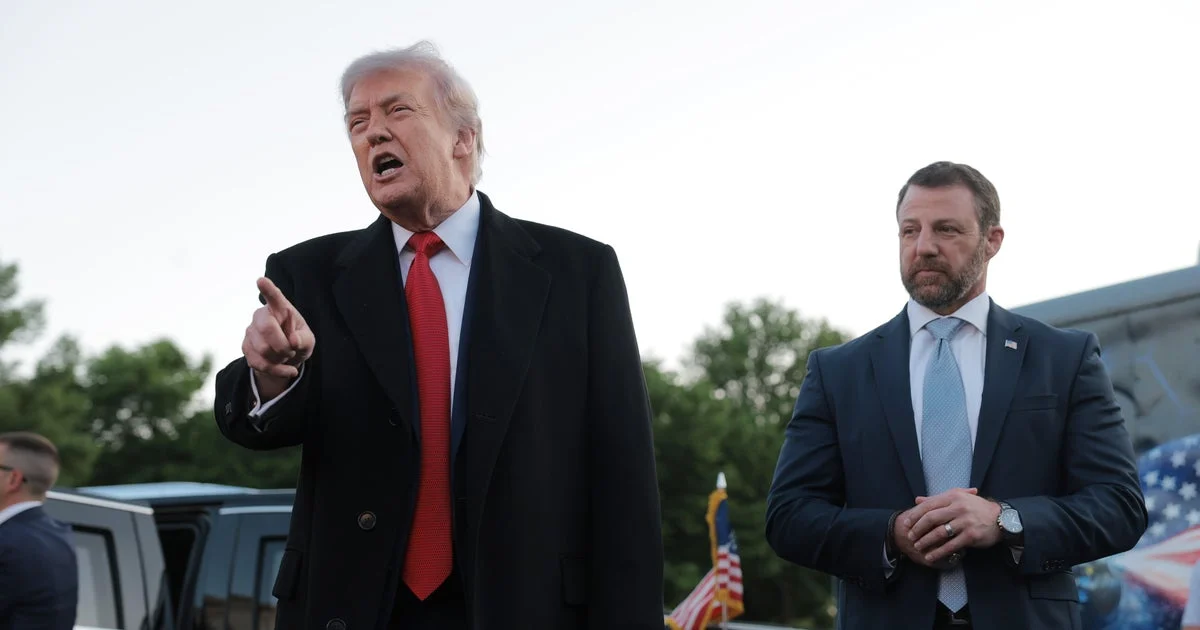
Washington D.C. – Homeland Security Secretary Markwayne Mullin on Friday continued to amplify President Trump’s assertion that over a quarter of a million non-citizens were registered to vote across four key states, even as the administration has yet to provide granular details or a transparent methodology for how it arrived at this significant figure. The announcement, following President Trump’s recent address to the nation focused on election security, immediately reignited a contentious debate surrounding voter integrity and the administration’s aggressive posture towards state-run election systems.
During a news conference, Secretary Mullin specified that the alleged 250,000 non-citizens believed to be registered voters were located in California, Pennsylvania, New Jersey, and Nevada. These four states have notably not complied with the Trump administration’s earlier demands for extensive voter data to be handed over to the federal government. Furthermore, Mullin stated that in 23 other states that have cooperated with the Trump administration and submitted their voter records for analysis through an overhauled centralized federal database, an additional 28,000 non-citizens were purportedly identified as registered to vote.
However, independent investigations, including one conducted by CBS News, quickly indicated that the claims put forth by President Trump and Secretary Mullin regarding the prevalence of non-citizens on voter rolls might be significantly exaggerated. The initial estimate of 250,000 non-citizen registered voters across the four non-compliant states, a White House official told reporters, was based on an analysis of commercial databases. This method, election experts warn, is inherently prone to generating false positives, leading to a substantial overestimation of non-citizens on voter rolls. David Becker, executive director and founder of the Center for Election Innovation and Research, articulated this concern during a CBS News special report, stating, "I guarantee you, that data includes a ton of people, maybe even a majority of people, who are absolutely eligible voters, and states would probably be breaking the law if they remove those voters from the rolls."
Historical Context: Trump’s Enduring Focus on Election Integrity
President Trump’s current emphasis on non-citizen voting is not an isolated event but rather a continuation of a long-standing narrative he has cultivated, particularly since the 2020 presidential election. Following his loss to former President Joe Biden, Trump repeatedly claimed, without presenting verifiable evidence, that the election was "rigged" against him. These claims led to dozens of lawsuits seeking to overturn election results in pivotal battleground states, all of which were overwhelmingly dismissed by courts, including the Supreme Court. Furthermore, the Justice Department, under a prior administration, explicitly stated at the time that there was no evidence of widespread fraud that would have altered the outcome of the 2020 election.
Despite these judicial and investigative findings, President Trump has persistently sought to expand the federal government’s role in the oversight and administration of U.S. elections throughout his second term. This concerted effort includes a series of executive actions and legislative pushes designed to tighten voting regulations, often framed under the banner of "election security." His administration has signed two executive orders aimed at, for instance, tightening rules for mail-in ballots and requiring documentary proof of citizenship to register to vote in federal elections. Both of these executive orders have faced significant legal challenges and have been blocked by federal courts, which have questioned the President’s constitutional authority to unilaterally regulate federal elections in such a manner. Concurrently, the Justice Department has embarked on an aggressive campaign, suing dozens of states to compel them to provide their complete voter data to the federal government. On the legislative front, President Trump has been actively pressuring Congress to pass the SAVE America Act, a proposed bill that would mandate photo identification for all voters at the polls and require in-person proof of citizenship for voter registration. These initiatives collectively underscore a robust, multi-pronged strategy to reshape the landscape of American election administration.
The timing of the President’s election security-focused speech, coming just months before the crucial November midterm elections, is also highly significant. These elections will determine the balance of power in both the House of Representatives and the Senate, and the narrative surrounding election integrity could play a pivotal role in mobilizing voters and shaping political discourse.
Deconstructing the Administration’s Methodology and Expert Critiques
The administration’s assertion that 250,000 non-citizens are registered to vote across four states relies on an analysis of commercial databases, a method widely criticized by election integrity experts for its inherent flaws. David Becker of the Center for Election Innovation and Research highlighted that such databases are notoriously imprecise for verifying citizenship status in the context of voter registration. These databases often contain outdated information, errors, or records of individuals who may have since become naturalized citizens. Relying on them without rigorous cross-verification against official state records and federal immigration data can lead to a significant number of "false positives," incorrectly identifying eligible citizens as non-citizens.
The Center for Election Innovation and Research, through its own extensive work, has consistently found that allegations of non-citizens casting ballots or registering to vote typically "appear to arise from misunderstandings, mischaracterizations, or outright fabrications about complex voter data." When these claims are subjected to thorough scrutiny and investigation, the number of alleged instances of non-citizens identified on voter rolls invariably drops dramatically. Confirmed cases of non-citizens voting in U.S. elections remain exceedingly rare, often isolated incidents rather than systemic issues. This expert consensus directly challenges the broad claims made by the Trump administration, suggesting that their figures are likely inflated due to methodological deficiencies.
Statistical Context: The Scale of the Claims
To put the administration’s claims into perspective, it is crucial to compare the alleged figures against the total number of registered voters nationwide. Neither Secretary Mullin nor President Trump explicitly stated that the 250,000 non-citizens allegedly registered to vote in the four states actually cast ballots. Furthermore, the administration has refrained from making public the specific methodology used to generate this estimate.
However, even assuming the 250,000 figure is accurate, it represents a minute fraction of the overall American electorate. According to a comprehensive survey conducted by the U.S. Election Assistance Commission (EAC), there were more than 209 million active registered voters for the 2020 general election, with over 161 million ballots counted. For the more recent 2024 general election, the EAC reported more than 211 million active registered voters, with over 158 million ballots cast and counted.
In this context, the 250,000 non-citizens that the Trump administration claims are registered in Nevada, California, New Jersey, and Pennsylvania constitute roughly 0.1% of all registered voters nationwide. When focusing solely on the four states in question, where approximately 40 million people were registered to vote in 2024, the 250,000 figure represents about 0.6% of their combined voter rolls.
It is important to underscore that federal law explicitly prohibits non-citizens from voting in federal elections. Furthermore, no U.S. state currently allows non-citizens to vote in statewide contests. Limited exceptions exist only at the municipal level in just three states and the District of Columbia, where non-citizens may be permitted to vote in local elections, such as for school boards.
The Department of Homeland Security’s letters sent to the secretaries of state for California, New Jersey, Nevada, and Pennsylvania further broke down the preliminary review figures: up to 190,832 non-citizens allegedly registered in California, 35,152 in New Jersey, 15,903 in Nevada, and 14,576 in Pennsylvania. These specific figures, however, have been met with immediate and strong skepticism from state officials.
Official State Responses: Refutations and Commitments
The targeted states have responded to the DHS allegations with a mix of defiance, skepticism, and a commitment to review any credible information. Pennsylvania Secretary of State Al Schmidt, a Republican, firmly stated that the state’s voter rolls are "properly maintained and updated." While indicating the state would review any information provided by DHS to evaluate its claims, Schmidt reiterated, "In Pennsylvania, every voter must take steps to verify their identity before they cast a ballot, including providing proper identification every time they register to vote, vote by mail, or vote at a new polling place. All evidence has shown that noncitizen voting is extremely rare across the country, including in Pennsylvania."
Nevada Secretary of State Francisco Aguilar, a Democrat, was more direct in his refutation of the Trump administration’s claims regarding 15,903 non-citizens on his state’s voter rolls. "These numbers are wildly speculative at best and the Department of Homeland Security hasn’t shared anything that backs it up," Aguilar asserted. Supporting his stance, data provided to The New York Times indicated that out of Nevada’s 2.1 million active registered voters, only 138 had not provided a state driver’s license or Social Security number when registering. Even these 138 individuals might have used another acceptable form of identification to register, highlighting the potential for misinterpretation of data.
California Secretary of State Shirley Weber, a Democrat, also expressed significant skepticism. While affirming her state’s willingness to "welcome legitimate best practices that comply with state and federal law while protecting Californians’ personal information," she criticized the federal claims. "However, the information provided during the President’s remarks and on the White House website, do not inspire any level of confidence in the methodology used or the conclusions reached," Weber stated, underscoring a lack of trust in the federal data’s foundation.
Empirical Evidence from Other State Audits
The skepticism from the targeted states is reinforced by findings from several other states that have proactively conducted audits of their voter rolls in recent years. These audits, often undertaken to ensure the accuracy and integrity of voter registration data, consistently reveal that instances of potential non-citizens being registered to vote are exceedingly rare and constitute a tiny fraction of the total electorate.
In Georgia, a comprehensive citizenship audit performed in 2024 by Secretary of State Brad Raffensperger, a Republican, identified only 20 non-citizens among the state’s 8.2 million registered voters. An additional 156 individuals required further investigation into their citizenship status, indicating a rigorous and thorough process yielding minimal confirmed cases.
Ohio’s citizenship verification audit in 2024, led by Secretary of State Frank LaRose, similarly identified 597 non-citizens who had registered to vote out of approximately 8.2 million registered voters statewide. Of these, 138 individuals appeared to have cast ballots and were subsequently referred to the attorney general for further action. While these cases are serious, they represent an infinitesimal percentage of the state’s voting population.
Texas, a state with over 18.6 million registered voters as of the 2024 presidential election, reported finding 2,724 potential non-citizens on its voter rolls. While a larger raw number, this still constitutes a minuscule proportion of the total registered electorate.
Louisiana’s investigation into the citizenship status of its voter rolls identified 390 non-citizens who had registered to vote. Secretary of State Nancy Landry stated in September that among these 390 individuals, 79 had voted in at least one election. With over 2.9 million people registered to vote in Louisiana as of July 1, this represents an extremely small number of confirmed instances.
Iowa also conducted an audit that identified 277 confirmed non-citizens registered to vote. Of these, 35 cast ballots that were counted in the 2024 general election, and five others attempted to vote but had their ballots rejected. Iowa had over 2.1 million registered voters as of July 2.
Collectively, these state-level audits provide compelling empirical evidence that confirmed cases of non-citizens registering or voting are statistically insignificant, typically representing far less than 0.01% of the total registered electorate in any given state. These findings starkly contrast with the broad, unverified claims made by the Trump administration and underscore the robust mechanisms many states already have in place to maintain accurate voter rolls.
The Administration’s Broader Strategy and Legal Roadblocks
Since President Trump’s return to the White House, his administration has launched a multi-pronged campaign targeting what it alleges is widespread non-citizen voting. This campaign serves as a foundational premise for many of his proposed election reforms, most notably the SAVE America Act. This legislative package, which the administration is pushing Congress to pass, would implement stringent federal voting regulations, including requiring photo identification to cast a ballot and mandating in-person proof of citizenship for voter registration.
Further demonstrating its proactive stance, the administration signed an executive order last year aimed at requiring documentary proof of citizenship for voter registration. However, federal courts have largely prohibited the Trump administration from implementing this requirement. Judges have consistently ruled that the U.S. Constitution does not grant the president specific authority to regulate federal elections in this manner, thereby upholding the traditional role of states in election administration.
A key component of the administration’s strategy involved overhauling the Systematic Alien Verification for Entitlement (SAVE) system. This updated system was designed to enable state and local election officials to verify the citizenship or immigration status of individuals attempting to register to vote, drawing on records from the Social Security Administration and DHS. Several states, including North Carolina, Texas, and Iowa, did indeed run their voter records through the modified SAVE database to identify non-citizens. However, this initiative also faced significant legal challenges. A federal judge in Washington, D.C., found that the Trump administration acted unlawfully in creating this centralized database. Critically, the court also determined that the clearinghouse had been utilized by some states to incorrectly remove legitimate U.S. citizens from their voter rolls, raising serious concerns about voter disenfranchisement.
In parallel, the Justice Department has vigorously pursued full copies of voter registration lists from nearly all 50 states and Washington, D.C. While more than a dozen states have cooperated with these requests for unredacted voter rolls, according to the Brennan Center for Justice, the Justice Department has also filed lawsuits against 30 states and D.C. in an effort to compel them to surrender this sensitive information, which includes voters’ names, addresses, partial Social Security numbers, and driver’s license numbers. The judicial response to these lawsuits has been largely unfavorable to the administration; judges across the country have dismissed 16 of these cases. One federal appeals court, in a notable ruling, explicitly stated that the Justice Department was not entitled to the unredacted voter registration list from Michigan, further limiting the federal government’s reach into state-managed voter data.
Societal and Political Implications
The Trump administration’s persistent claims of widespread non-citizen voter registration, coupled with its aggressive pursuit of federal oversight in elections, carry significant societal and political implications. At the core, these narratives risk eroding public trust in the integrity of democratic processes. By repeatedly asserting the existence of widespread voter fraud without providing conclusive, verifiable evidence, the administration can foster a climate of suspicion and doubt, potentially leading to lower voter confidence and increased polarization.
This federal push also highlights an ongoing tension between federal authority and state sovereignty in election administration. Historically, U.S. elections have been largely decentralized and managed at the state and local levels. The administration’s attempts to centralize data collection and impose federal regulations represent a significant shift, challenging established constitutional norms and raising concerns among states about overreach and the potential for federal interference in their election systems.
Furthermore, the debate over election integrity versus voter access is intensified by these claims. Proponents of stricter voting laws argue that such measures are necessary to prevent fraud and maintain the sanctity of the ballot box. Conversely, critics contend that overly stringent requirements, particularly those based on unverified allegations, can disproportionately disenfranchise eligible voters, especially minority groups, the elderly, and those with limited resources to obtain specific forms of identification or proof of citizenship.
As the nation approaches the critical November midterm elections, these narratives will undoubtedly play a significant role in political campaigning and voter mobilization efforts. The administration’s focus on non-citizen voting may serve to energize its base and frame the upcoming elections as a battle for the very foundations of American democracy. However, it also risks alienating independent voters and reinforcing the perception of partisan attempts to suppress votes rather than genuinely enhance security. The long-term impact on the stability and perceived legitimacy of U.S. elections remains a central concern for policymakers, election officials, and the public alike.
Jennifer Jacobs, Arden Farhi, and Aaron Navarro contributed to this report.

