
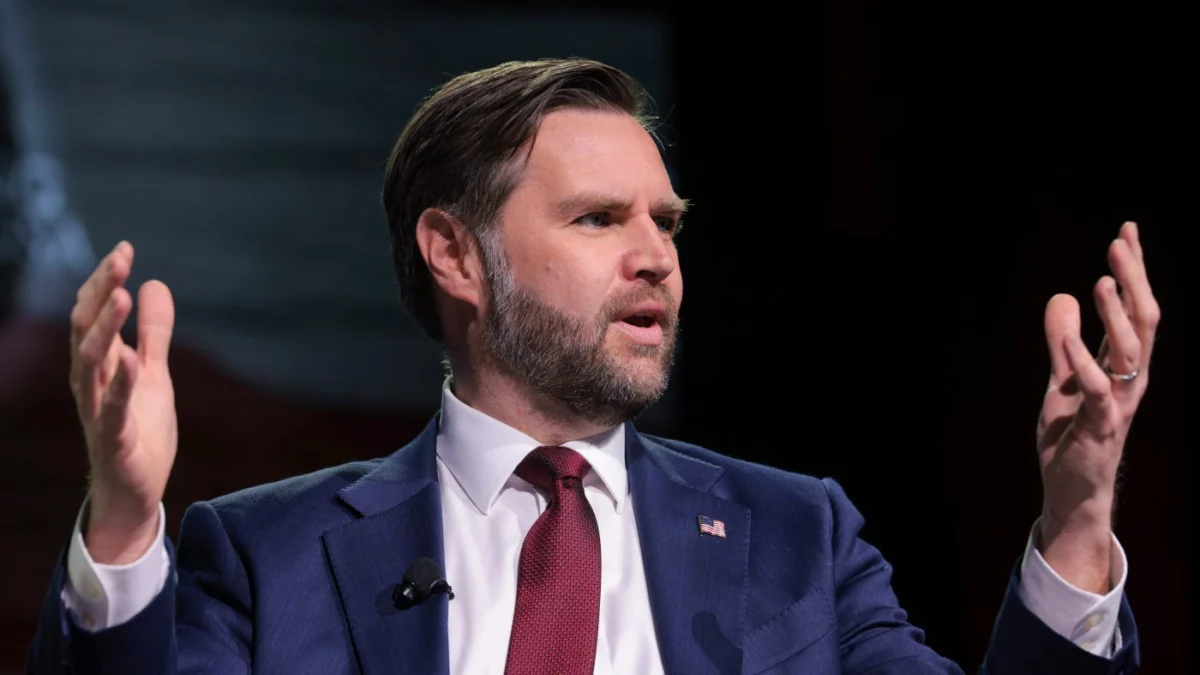
Vice President Vance on Tuesday defended President Trump’s Middle East policy toward Iran and Gaza, acknowledging during a candid engagement with young conservatives in Athens, Georgia, that younger voters “do not love” the administration’s actions in the volatile region, even as he faced immediate and vocal protest from the audience. The event, hosted by Turning Point USA, also saw Vance navigate the politically charged friction between President Trump and Pope Leo XIV, offering a nuanced perspective on the intersection of faith and statecraft amidst global crises.
The Vice President’s appearance, a strategic move to rally conservative youth ahead of the 2026 midterm elections, quickly devolved into a microcosm of the broader national debate on foreign policy and humanitarian concerns. Just ten minutes into his address, hecklers interrupted Vance, echoing widespread sentiments of moral outrage over ongoing conflicts. "Jesus Christ does not support genocide!" one individual reportedly shouted, according to The New York Times, which covered the event. This was swiftly followed by cries of "You’re killing children! You’re bombing children!", a clear reference to the devastating war between Israel and Hamas in Gaza, which has drawn global condemnation for its humanitarian toll.
Vance, maintaining a composed demeanor, directly addressed the palpable discontent. "I recognize that young voters do not love the policy we have in the Middle East, OK," he stated, adding, "I understand." Rather than dismissing the criticism, he attempted to bridge the divide, emphasizing the administration’s broader agenda and urging greater civic participation. He mapped out what he characterized as the Trump administration’s successes, ranging from its robust immigration policies to its economic agenda, before appealing to the audience for unity beyond single-issue disagreements. "I’m not saying you have to agree with me on every issue. What I’m saying is don’t get disengaged because you disagree with the administration on one topic," Vance urged. "Get more involved. Make your voice heard even more. That’s how we ultimately take the country back." This appeal underscored the administration’s perceived vulnerability among younger demographics, who, polls consistently indicate, hold distinct views on international affairs and human rights compared to older generations.
Navigating the Complexities of Middle East Policy
The Trump administration’s Middle East policy has been characterized by a blend of assertive diplomacy, strategic alliances, and a willingness to challenge established norms. In the context of the Georgia event, Vance highlighted a temporary ceasefire between the U.S. and Iran, presenting it as evidence of the administration’s proactive approach to problem-solving rather than mere complaint. "We’ve tried as much as we can to solve the problems, not just complain about them like the guy who just ran away," he asserted, implicitly rebuking the heckler.
This temporary ceasefire with Iran, while details remain largely undisclosed to the public, is understood by analysts to be a fragile diplomatic achievement in a region perpetually on edge. It likely followed a period of heightened tensions, potentially involving proxy conflicts or naval confrontations, and could have been facilitated by third-party mediators. For the Trump administration, such a deal would be touted as a demonstration of its ability to de-escalate crises through direct engagement, even with long-standing adversaries. However, the underlying strategic rivalry between the U.S. and Iran, particularly concerning Iran’s nuclear program and its regional influence, ensures that any such truce is inherently precarious.
The ongoing Israel-Hamas conflict in Gaza, meanwhile, represents a severe humanitarian crisis that has deeply polarized global opinion. The conflict, which escalated dramatically in late 2025 following renewed hostilities, has resulted in a staggering number of civilian casualties, widespread displacement, and severe damage to infrastructure in Gaza. International organizations and numerous governments have called for a permanent ceasefire and increased humanitarian aid, with many expressing alarm over the reported conduct of the war. The United States, under the Trump administration, has largely maintained its traditional strong support for Israel, while simultaneously engaging in diplomatic efforts to secure aid access and de-escalate the conflict. This dual approach has, however, proven unsatisfactory to a significant segment of the American populace, particularly younger voters, who are increasingly critical of Israel’s military actions and perceive U.S. policy as complicit in the humanitarian disaster.
Youth Sentiment and Political Disengagement
Data from various polling organizations consistently reveals a generational divide in foreign policy attitudes. Surveys conducted by institutions like the Pew Research Center and Gallup in the lead-up to 2026 indicated that young Americans (aged 18-34) are significantly more likely than older cohorts to express sympathy for Palestinians, favor a more neutral U.S. stance in the Israeli-Palestinian conflict, and oppose large-scale military interventions abroad. They also tend to be more critical of the U.S.’s role in global conflicts and more inclined to prioritize diplomacy and international cooperation over unilateral action. This divergence helps explain the strong emotional reaction Vance encountered in Athens; for many young voters, the moral implications of conflicts in the Middle East, particularly those involving civilian suffering, transcend traditional political allegiances. Their discontent is not merely political but often deeply ethical, fueled by real-time information shared through digital platforms and a heightened awareness of global humanitarian issues.
Vance’s call for engagement, despite disagreement, reflects a strategic effort to prevent this discontent from translating into outright political alienation. The Republican party, historically reliant on older, more conservative voters, recognizes the imperative of appealing to younger demographics, even on contentious issues. The challenge, however, lies in convincing a generation that feels profoundly disconnected from current foreign policy decisions to participate within a system they view as unresponsive or even morally compromised.
The Vatican and the White House: A Clash of Ideologies
Beyond the immediate crisis in the Middle East, Vance also found himself addressing another high-profile ideological clash: the ongoing feud between President Trump and Pope Leo XIV. This dispute has added a complex layer to the foreign policy debate, bringing matters of faith, morality, and political authority into sharp relief. Pope Leo XIV, who assumed the papacy in 2025, has consistently emerged as a vocal critic of military aggression worldwide, often leveraging the moral authority of the Catholic Church to advocate for peace and denounce violence. He has specifically condemned military aggression abroad and, as reported, has expressed strong disapproval regarding the "U.S.-Israeli conflict in Iran." While the specifics of such a direct conflict remain a subject of geopolitical speculation, the Pope’s statements reflect a broader concern over regional destabilization and the potential for wider war involving major powers. His Palm Sunday address in 2026, for instance, saw him reject "war prayers," instead calling for profound introspection and a commitment to peace.
President Trump, known for his combative style, has not shied away from directly confronting the pontiff. He has publicly pushed back against Pope Leo XIV’s pronouncements, famously accusing him of being "weak" on crime and even suggesting that the Pope’s election by last year’s papal conclave would not have occurred had Trump not been president. This unprecedented public spat between a sitting U.S. president and the head of the Catholic Church has sent ripples through both political and religious circles.
Vice President Vance, himself the second Catholic Vice President in U.S. history, has been tasked with navigating this delicate dynamic. Prior to the Georgia event, he addressed the issue on Fox News, stating that the Pope should "stick to matters of morality, to stick to matters of what’s going on in the Catholic Church and let the president of the United States stick to dictating American public policy." This statement encapsulated a traditional view of the separation of church and state, or at least the distinct spheres of religious and political authority.
In Athens, however, Vance adopted a more conciliatory tone, acknowledging the value of the Pope’s dialogue. He welcomed Leo’s statements, noting that "at the very least, they invite conversation," as reported by The Associated Press. Yet, he swiftly pivoted to a nuanced defense rooted in Catholic intellectual tradition: "There is more than a thousand-year tradition of just-war theory, OK?" he reminded the audience. He elaborated, "Now, we can of course have disagreements about whether this or that conflict is just. But I think that it’s important, in the same way that it’s important for the Vice President of the United States to be careful when I talk about matters of public policy, I think it’s very, very important for the pope to be careful when he talks about matters of theology."
Vance’s invocation of the "just-war theory" is significant. This venerable Catholic doctrine, developed over centuries by theologians like St. Augustine and St. Thomas Aquinas, provides ethical guidelines for the use of military force. It posits that war can be morally justifiable under specific conditions, including having a just cause, legitimate authority, right intention, proportionality, and being a last resort. By referencing this complex theological framework, Vance implicitly suggested that the administration’s policies are considered through a lens of moral reasoning, even if the Pope disagrees with the practical application or the assessment of specific conflicts. He was effectively advocating for a careful distinction between theological principles and their real-world political execution, implying that while the Pope speaks from a position of moral authority, the President operates within the complex, often messy, realities of statecraft.
Political Implications and the Road to 2026
The dual challenges faced by Vice President Vance in Athens—youth disengagement over foreign policy and the unprecedented public feud with the Vatican—underscore the complex political landscape heading into the 2026 midterm elections. For the Trump administration, maintaining its conservative base while attempting to broaden its appeal, especially among younger and faith-based voters, is crucial.
The youth vote, while often less reliable in terms of turnout, represents a significant demographic whose shifting allegiances can sway outcomes in tight races. Alienating this group on moral or humanitarian grounds, particularly concerning highly visible global conflicts, poses a considerable risk. The administration’s efforts to frame its Middle East policy as one of problem-solving and diplomatic engagement, as Vance did, are designed to counteract the narrative of indifference or aggression.
The friction with Pope Leo XIV, meanwhile, carries its own set of political risks, particularly among the sizable Catholic electorate in the United States. While Catholic voters are not monolithic in their political leanings, a public quarrel with the spiritual leader of over a billion adherents worldwide could impact perceptions of the administration, especially among more devout or socially conservative Catholics who value the Church’s moral authority. Vance, as a prominent Catholic within the administration, plays a critical role in attempting to mitigate these tensions, seeking to respect the Pope’s moral voice while defending the President’s policy decisions. His careful distinction between theology and policy reflects a strategy to reconcile these competing pressures.
The 2026 midterms will serve as a critical barometer for the Trump administration’s foreign policy legacy and its ability to unify disparate factions of the American electorate. Issues like the Israel-Hamas conflict, relations with Iran, and the role of the U.S. in global affairs are increasingly becoming domestic political flashpoints, influencing voter behavior as much as traditional economic or social issues. The events in Athens, Georgia, offered a vivid illustration of these intersecting challenges, highlighting the administration’s ongoing struggle to articulate a foreign policy vision that resonates across diverse demographic and ideological lines.
Broader Discourse and Future Outlook
The incident at the Turning Point USA event also speaks to a broader trend in American political discourse: the increased willingness of audiences to directly confront political figures, even at events intended for supportive crowds. This reflects a heightened sense of urgency and activism, particularly among younger generations, who are less constrained by traditional political decorum. For youth advocacy groups and opposition parties, the heckling serves as a potent symbol of widespread discontent, offering ammunition for critiques of the administration’s foreign policy. Religious commentators, on the other hand, might interpret the Trump-Pope feud as a dangerous politicization of faith, or conversely, as a necessary assertion of moral authority against perceived injustice.
As the political cycle progresses towards 2026, the administration will likely continue to face scrutiny over its Middle East policies and its relationship with global religious leaders. The delicate balance between defending national interests, upholding alliances, and addressing humanitarian concerns will remain a central challenge. Vice President Vance’s performance in Athens, navigating both vocal protests and a high-stakes theological debate, epitomized the tightrope walk required of leaders in an increasingly polarized and globally interconnected political environment. The question remains whether his calls for engagement and his nuanced arguments can bridge the chasm of discontent or if the deep divisions on foreign policy and moral authority will continue to define the political landscape.
Copyright 2026 Nexstar Media Inc. All rights reserved. This material may not be published, broadcast, rewritten, or redistributed.

