
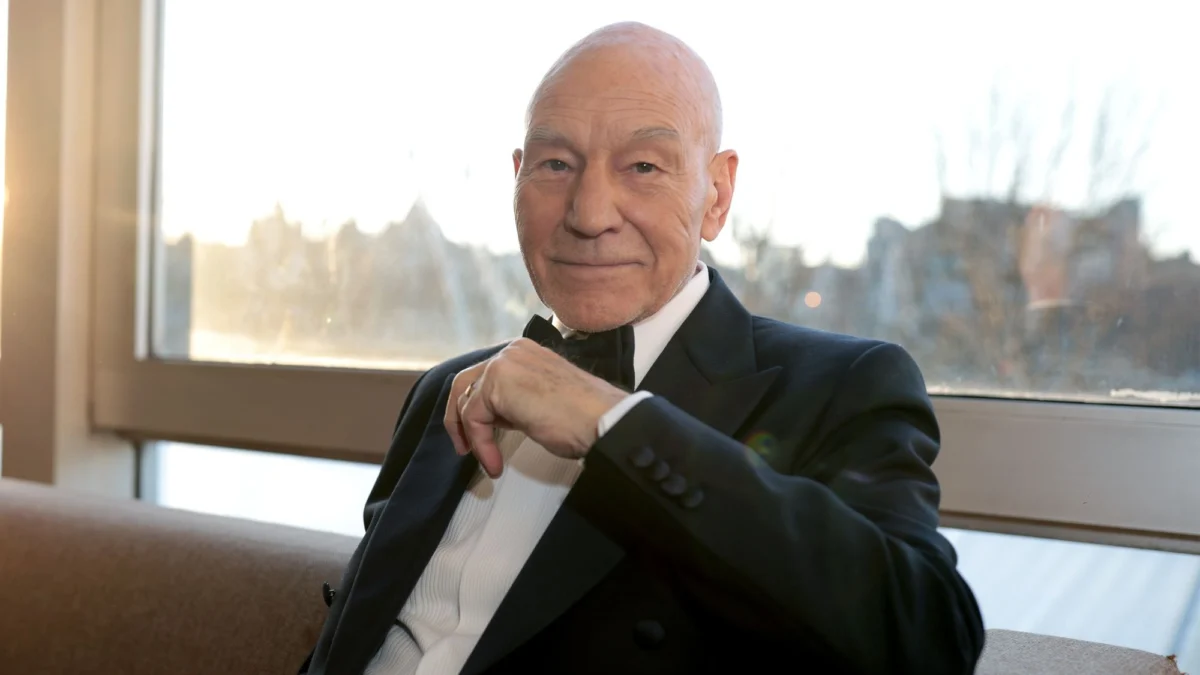
Sir Patrick Stewart, whose commanding stage presence, unmistakable voice, and iconic portrayals of science-fiction and fantasy legends defined generations of entertainment, has died at the age of 86. The celebrated actor, equally renowned for his towering Shakespearean stage performances as for his stellar turns on the silver and television screens, passed away at his home in Los Angeles.
His longtime spokesperson, Kelly Bush Novak, confirmed the news in a public statement, noting that the actor died following a brief and poignant journey with Alzheimer’s disease and Lewy body dementia. Stewart spent his final moments surrounded by loved ones, embraced by family and friends in an atmosphere defined by live music, prayer, tears, and laughter.
The passing of Sir Patrick marks the end of a remarkable era in contemporary culture. Spanning a career of over six decades, Stewart transitioned effortlessly from the classical British theater to Hollywood blockbusters, leaving an indelible imprint on the global consciousness. From the bridge of the USS Enterprise to the halls of the Xavier Institute for Higher Learning, his characters served as archetypes of wisdom, moral clarity, and quiet strength.
A Life in Theater and Film: The Early Years and Rise to Prominence
Born in Mirfield, Yorkshire, England, on July 13, 1940, Patrick Stewart experienced a modest upbringing that stood in stark contrast to the regal, aristocratic personas he would later master. Raised in a working-class household, he discovered his passion for acting at an early age through local school programs and youth theater groups. By his teenage years, his talent was undeniable, leading to a scholarship at the Bristol Old Vic Theatre School.
Stewart’s professional stage career began in earnest during the 1960s. He joined the prestigious Royal Shakespeare Company (RSC) in 1966, quickly establishing himself as one of the premier classical actors of his generation. Over the next two decades, he commanded West End and Broadway stages, tackling some of the most demanding roles in the English dramatic canon, including Macbeth, Hamlet, Antony, and Prospero. His mastery of verse, combined with a mesmerizing physical presence and a resonant, authoritative baritone voice, made him a darling of theater critics.
Despite his theatrical success, mainstream international recognition eluded him until middle age. Throughout the 1970s and 1980s, Stewart made numerous television and film appearances, often cast as villains or stern authority figures in British productions. However, his life—and the landscape of modern science fiction—changed forever in 1987 when he accepted a role that he initially feared would ruin his career.
Engaging Deep Space: The Star Trek Legacy
When creator Gene Roddenberry cast a bald, classically trained Shakespearean stage actor from Yorkshire to lead the revival of television’s most famous franchise in Star Trek: The Next Generation, many industry observers were skeptical. Yet, as Captain Jean-Luc Picard, Stewart shattered expectations, transforming the role into a masterclass in diplomacy, intellectual rigor, and compassionate leadership.
Aired from 1987 through 1994, Star Trek: The Next Generation became a cultural touchstone, outperforming its predecessor in syndication and cementing a fiercely loyal global fanbase known as "Trekkies." Stewart’s Picard was not merely a military commander; he was a philosopher, an explorer, and an ethical compass for the late 20th-century television audience. His catchphrases—most notably "Make it so" and "Engage"—entered the vernacular, while his complex moral dilemmas addressed contemporary political, social, and philosophical issues.
Following the conclusion of the television series, Stewart seamlessly transitioned Picard to the cinematic realm, starring in four feature films: Star Trek Generations (1994), Star Trek: First Contact (1996), Star Trek: Insurrection (1998), and Star Trek: Nemesis (2002). Decades later, he returned to the role in the critically acclaimed streaming series Star Trek: Picard (2020–2023), proving that his connection to the character remained as vital and resonant as ever.
Mutant Leadership: Entering the Marvel Universe
Just as one defining sci-fi franchise seemed to be winding down, Stewart embarked on another. In the year 2000, director Bryan Singer released X-Men, a film that launched the modern superhero cinematic boom. Stewart was cast as Professor Charles Xavier, the telepathic founder of a school for mutants who fights for peaceful coexistence between humanity and mutantkind.
Much like Jean-Luc Picard, Professor X allowed Stewart to play a figure of immense intellect, moral authority, and deep empathy. His chemistry with co-star Ian McKellen, who played the antagonist Erik Lehnsherr/Magneto, anchored the sprawling franchise in genuine dramatic weight and emotional resonance. Stewart reprised the role across multiple sequels and prequels, including X2 (2003), X-Men: The Last Stand (2006), X-Men: Days of Future Past (2014), and a critically lauded, emotionally devastating swan song in James Mangold’s Logan (2017). He later surprised fans with a multiverse cameo in Doctor Strange in the Multiverse of Madness (2022).
Through these twin pillars of pop culture—Star Trek and X-Men—Stewart achieved a rare feat: he became the paternal, ethical anchor for two entirely distinct generations of science fiction and comic book enthusiasts.
A Public and Private Battle with Dementia
In his final years, Stewart faced private health challenges with the same dignity that characterized his public performances. His spokesperson, Kelly Bush Novak, revealed that the actor’s passing followed a brief and poignant journey with Alzheimer’s disease and Lewy body dementia.
Lewy body dementia is a complex neurodegenerative condition characterized by the abnormal buildup of protein deposits inside nerve cells, affecting thinking, movement, behavior, and mood. Alzheimer’s disease, the most common cause of dementia, progressively impairs memory and cognitive function.
Despite the physical and cognitive toll of these conditions, Stewart’s family ensured that his final chapter was defined by comfort, peace, and artistic expression. According to the official statement released by Bush Novak, the actor was "held in the warm embrace of family and friends, surrounded by live music, prayer, tears, laughter and the kind of profound emotion that only he could inspire after a lifetime of devotion to us all."
The statement added, "We will forever cherish the peaceful ease and reflection on his face, an enduring reminder of his invincible grace."
Global Tributes and Industry Reactions
Following the public confirmation of his passing, an outpouring of grief and tribute flooded social media platforms from colleagues, fans, and cultural figures worldwide. Among the most prominent responses came from Kevin Feige, president of Marvel Studios, who worked closely with Stewart during his tenure in the Marvel Cinematic Universe.
"I’ll never forget the first time I saw Sir Patrick Stewart on the set of the first X-Men," Feige wrote in a heartfelt statement. "After years of knowing him as the inimitable Captain Picard, I was in awe — and he turned out to be everything I had seen on screen and more: brilliant, charming, warm, generous, with a quiet strength and gravitas."
Feige continued to emphasize the personal warmth that lay beneath the actor’s formidable exterior: "Away from the cameras, he was even more remarkable, with a wonderfully sharp sense of humor. It was a true privilege to know him and to work with him. His legacy lives on not only in decades of extraordinary work, but in the many, many people he mentored. He will be deeply missed."
Co-stars from Star Trek, theater veterans from the Royal Shakespeare Company, and fans across the globe similarly shared memories of his mentorship, wit, and unyielding professionalism. Colleagues frequently noted his meticulous dedication to his craft, his humility in spite of his legendary status, and his passionate advocacy for social and humanitarian causes.
Honors, Awards, and Lasting Cultural Impact
Over the course of his illustrious career, Sir Patrick Stewart received numerous accolades recognizing his contributions to the arts. He was nominated for multiple Primetime Emmy Awards and Golden Globe Awards for his television work, as well as several Laurence Olivier Awards for his stage performances. In 2010, his artistic achievements and charitable endeavors were formally recognized by the British Crown when Queen Elizabeth II knighted him for services to drama.
Beyond his professional work, Stewart was known for his philanthropic commitments. He served as a patron of Refuge, a UK-based charity supporting women and children escaping domestic violence, drawing on his own childhood experiences to advocate for change. He was also a vocal supporter of human rights, environmental causes, and freedom of speech, utilizing his platform to champion progressive ideals.
The Broader Implications of His Passing
The death of Sir Patrick Stewart closes a chapter on a vanishing breed of classical actors who successfully bridged the worlds of high-culture theater and mass-market commercial entertainment. In an era dominated by rapid technological changes in media and celebrity culture, Stewart maintained an old-world elegance, proving that intellectual curiosity, rigorous training, and emotional authenticity remain timeless.
As the entertainment world mourns his loss, analysts and cultural historians note that his legacy is permanently etched into the fabric of modern mythology. Whether remembered as the quintessential Starfleet captain exploring the final frontier, the visionary mutant leader guiding the next generation, or the definitive stage voice of Shakespearean tragedy, Sir Patrick Stewart leaves behind a body of work that will continue to educate, inspire, and entertain for generations to come.
Funeral arrangements and memorial services are expected to be private, in accordance with the wishes of his family. Contributions in his honor are anticipated to be directed toward dementia research organizations and the theatrical charities he long supported.

