
In the northern reaches of the Jordan Rift Valley, a single fossilized molar, belonging to an extinct species of giant elephant, has unlocked a treasure trove of environmental data that reconstructs the prehistoric Levant as it appeared roughly 700,000 years ago. This discovery, centered at the Gesher Benot Ya’aqov (GBY) archaeological site, provides more than just a snapshot of a long-vanished megafauna; it offers a comprehensive window into a lush, stable ecosystem that served as a critical lifeline for early human populations migrating out of Africa.
The research, published in the journal Quaternary Science Reviews, represents a multidisciplinary triumph. Led by Hannah Farrell, a PhD candidate at the University of Haifa, the study utilized a battery of advanced analytical techniques—including CT scanning, 3D reconstruction, microscopic wear analysis, isotope geochemistry, and palynology—to transform a piece of enamel into a high-resolution map of an ancient world.
The Straight-Tusked Titan: Palaeoloxodon antiquus
The fossil in question originated from Palaeoloxodon antiquus, or the straight-tusked elephant. During the Pleistocene epoch, these creatures were among the most formidable land mammals to roam the earth. Standing significantly taller and heavier than modern African or Asian elephants, P. antiquus inhabited a variety of environments across Eurasia. Their presence at the Gesher Benot Ya’aqov site is particularly telling; these elephants were highly sensitive to environmental quality, requiring vast quantities of water and nutrient-dense vegetation to sustain their massive caloric needs.
By examining the isotopic signatures within the tooth enamel, researchers were able to infer the elephant’s dietary patterns and the hydrologic conditions of its habitat. The results confirmed that the Hula Valley of that era was not merely a transient stop, but a persistent, resource-rich oasis. The presence of these giants confirms that the landscape was capable of supporting massive biomass, which in turn provided the necessary ecological stability for other species—including early hominins—to thrive.
Archaeological Context: The Acheulian Connection
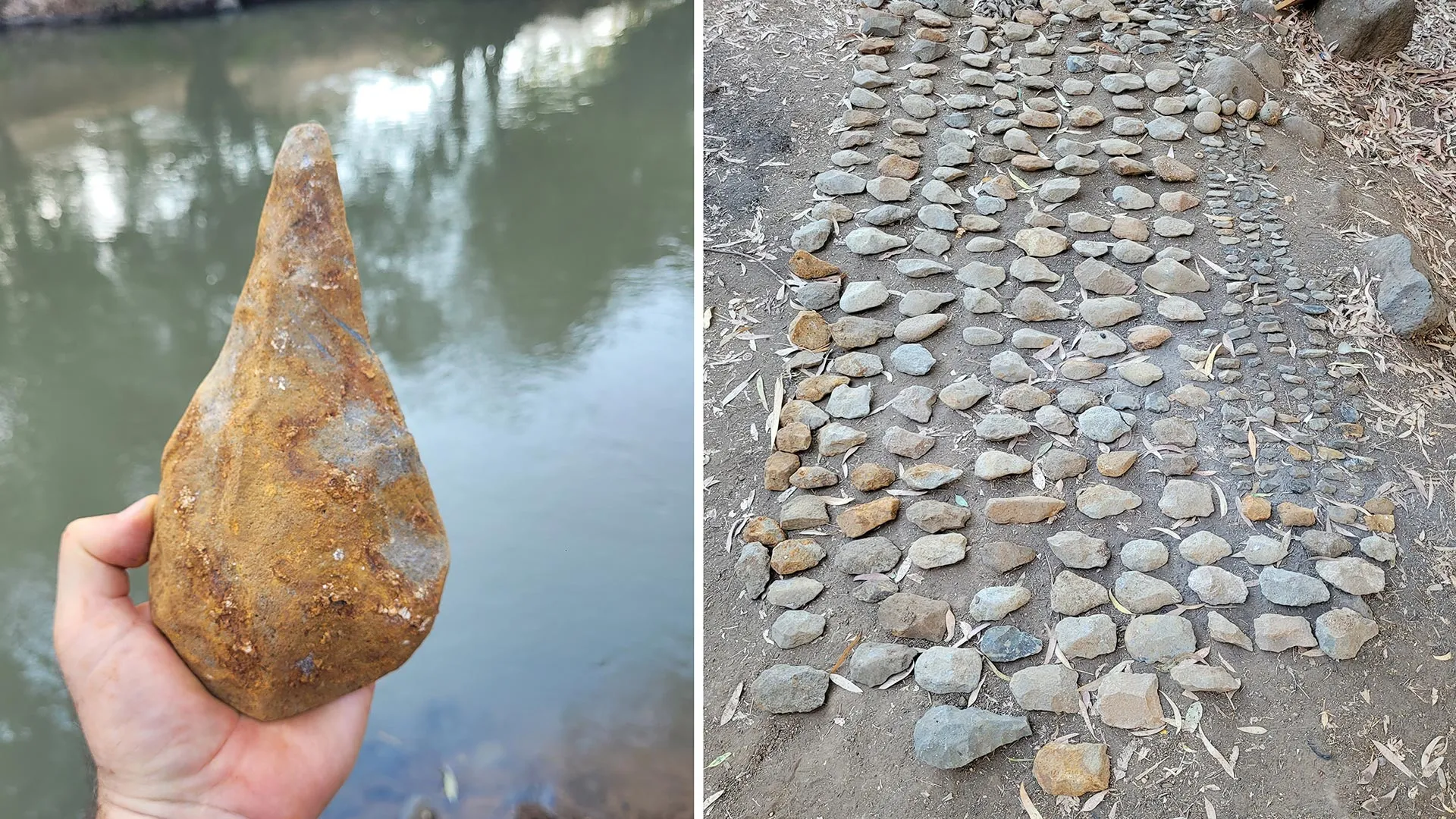
Gesher Benot Ya’aqov is widely recognized in the paleoanthropological community as one of the most significant sites for understanding the Acheulian tradition. This stone tool industry, characterized by the creation of sophisticated handaxes and cleavers fashioned from volcanic basalt, represents a major cognitive leap in human evolution. The fact that these tools were unearthed in direct association with the remains of P. antiquus suggests a complex interaction between early humans and the megafauna they shared their environment with.
The excavations, led by Professor Gonen Sharon of Tel-Hai University, have been ongoing for years, meticulously peeling back the layers of time in the Jordan Rift Valley. The site serves as a bridge between two worlds: the African origins of early human ancestors and their eventual dispersal into the Eurasian continent. The proximity of stone tools to elephant remains suggests that early humans were well-adapted to this specific ecological niche, utilizing the riverine forests and wetlands to hunt, scavenge, or manage the local wildlife.
A Multidisciplinary Investigation into the Past
The strength of the current study lies in its methodological breadth. To reconstruct the climate of 700,000 years ago, the team employed a range of forensic technologies:
- CT Imaging and 3D Reconstruction: These allowed researchers to study the internal morphology of the tooth without damaging the specimen, providing insights into the growth and health of the elephant.
- Microscopic Wear Analysis: By examining the microscopic scratches on the surface of the molar, scientists could determine the specific types of vegetation the animal consumed, revealing a diet rich in both woody browse and grasses.
- Isotope Geochemistry: Analysis of oxygen and carbon isotopes provided a definitive record of the water sources and the general aridity levels of the period, pointing toward a highly reliable, permanent water supply.
- Pollen Analysis (Palynology): Carried out in collaboration with Tel Aviv University, this analysis identified a diverse array of flora, including reeds, sedges, willow, and tamarisk. This confirms the existence of a mosaic landscape: dense riparian forests flanking open grasslands and seasonal wetlands.
The Levantine Corridor as a Human Refuge
The geographical placement of the Gesher Benot Ya’aqov site is central to its importance. Situated in the Levantine Corridor, the site sits on the primary terrestrial route linking Africa and Eurasia. For early humans moving out of Africa during the Middle Pleistocene, the ability to find stable, resource-rich zones was essential. The Hula Valley, with its perennial rivers and abundant vegetation, acted as an ecological refuge that mitigated the risks associated with long-distance migration.
This stability is a key finding. Rather than being a harsh, unpredictable environment, the region appears to have offered a predictable ecological buffer. This predictability allowed early human groups to inhabit the region for extended periods, perhaps even serving as a staging ground for subsequent expansions further north and east. The availability of water, coupled with the presence of large game like P. antiquus, created an environment where survival was not only possible but sustainable.
Perspectives from the Field
"Understanding how humans and animals responded to environmental change hundreds of thousands of years ago helps us better understand the forces that shaped our species," noted Professor Gonen Sharon. The research underscores the necessity of moving beyond the study of artifacts in isolation. Instead, the focus must be on the "archaeological landscape"—the total environment in which human action occurred.
The collaboration, which spanned several Israeli institutions, included experts in archaeozoology such as Nimrod Marom and isotope specialists like Cheryl A. Makarewicz. Their collective effort emphasizes that the "lost world" of the Hula Valley was a complex, interdependent system. The feedback from the scientific community has been largely positive, with many experts noting that this study sets a new standard for how we interpret the relationship between Pleistocene megafauna and human behavioral adaptation.
Implications for Human Evolution and Climate Adaptability
The broader implications of this study are profound. By demonstrating that the Hula Valley maintained a consistent ecological profile for a significant duration, the researchers have provided a model for how early humans navigated changing climates. As the Earth shifted through various glacial and interglacial cycles during the Pleistocene, the ability to identify and occupy "refugia" would have been the primary driver of human survival.
If the Hula Valley was a stable oasis during periods when surrounding regions might have been significantly more arid, it explains the high density of Acheulian artifacts found at the site. It suggests that our ancestors were not merely wandering aimlessly; they were strategic inhabitants of the landscape, capable of identifying and utilizing areas with high ecological carrying capacity.
Furthermore, the data suggests that the migration out of Africa was likely a pulsed event, influenced by these localized pockets of abundance. As we continue to refine our understanding of these ancient environments, we are moving away from a narrative of "struggle against the elements" and toward a more nuanced view of early humans as highly adaptable beings who thrived by mastering the resource landscapes of their time.
Future Research Directions
The success of the Gesher Benot Ya’aqov study has paved the way for future investigations. The team aims to apply similar multidisciplinary techniques to other fossils recovered from the site, hoping to build an even more granular record of the fauna that occupied the valley. There is also potential for expanding these studies to other sites along the Levantine Corridor to determine if the stability observed at GBY was widespread or if the Hula Valley was a unique anomaly in an otherwise fluctuating climate.
In conclusion, the investigation into the straight-tusked elephant tooth is a testament to the power of modern science to bridge the vast gap of 700,000 years. By integrating the physical remnants of the animal with the chemical and biological traces of its home, researchers have successfully reconstructed a vibrant, thriving world. This work not only honors the complexity of the ancient Hula Valley but also provides vital context for the history of our own species, proving that our success as a global population is rooted in our ancestors’ ability to read, navigate, and utilize the natural world.

