
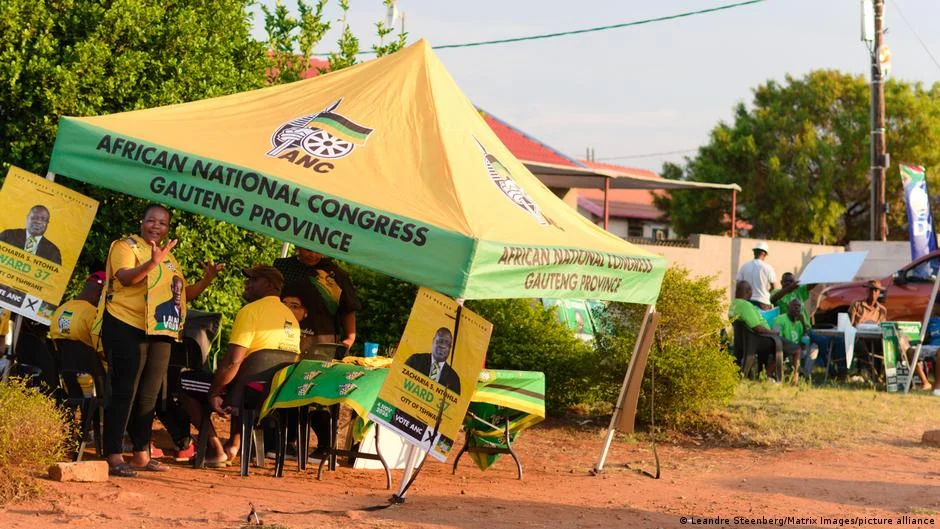
The African National Congress (ANC), the party that once dismantled the apartheid regime and ushered South Africa into democracy, is currently navigating its most precarious political chapter since 1994. Final tallies from Wednesday’s municipal polls, released on Sunday, confirm a historic decline for the governing party, which secured less than 31% of the national vote. This result serves as a stark barometer of public disillusionment, signaling that the liberation movement’s traditional mandate is rapidly eroding in the face of persistent service delivery failures, systemic corruption, and an unforgiving economic climate.
The Electoral Commission of South Africa (IEC) confirmed that the ANC has lost its majority in six of the country’s eight metropolitan municipalities. This outcome has left the political landscape in a state of flux, necessitating complex and volatile coalition negotiations to establish functional municipal governments. As the dust settles, the Democratic Alliance (DA), the country’s primary opposition, has solidified its position, capturing nearly 25% of the vote and positioning itself as the kingmaker in several major urban centers, including Pretoria and Johannesburg.
A Chronology of Declining Influence
To understand the current volatility, one must examine the steady erosion of the ANC’s electoral dominance over the last decade. Historically, the ANC functioned as the unquestioned political hegemon, securing overwhelming majorities in every election from 1994 through the early 2010s.
- 2016 Municipal Elections: The ANC’s downward trend became undeniable as it lost control of major metros, including Johannesburg and Tshwane (Pretoria), marking the first time since the dawn of democracy that the party’s urban base began to fracture significantly.
- 2021 Municipal Elections: The party’s support plummeted to roughly 46%, a psychological blow that forced the ANC into unfamiliar territory, requiring it to seek coalition partners in municipalities across the country.
- May 2024 General Election: The national parliamentary vote represented a watershed moment. For the first time in three decades, the ANC failed to secure an outright majority in the National Assembly, forcing the formation of a Government of National Unity (GNU) involving a broad spectrum of ideological rivals.
- October 2026 Municipal Polls: The current results confirm that the trend of decline has not only continued but accelerated, with the party’s national support dropping to 31%.
The Anatomy of Voter Backlash
The primary drivers of the ANC’s decline are rooted in the daily realities of the average South African citizen. Infrastructure failure has become a defining feature of life in many municipalities. Chronic water shortages, rolling blackouts (load-shedding), and the collapse of sewage and waste management systems have fostered a deep sense of betrayal among the electorate.
Economic indicators provide further context for the political shift. South Africa continues to struggle with one of the highest unemployment rates in the world, hovering near 33%, with youth unemployment exceeding 50%. This economic stagnation, coupled with reports of state capture—a term describing the systemic political corruption that flourished under previous administrations—has turned the ANC’s historical narrative of liberation into a liability rather than an asset.
Fikile Mbalula, the ANC’s Secretary-General, did not mince words during a press briefing on Saturday. In a candid admission, Mbalula described the outcome as "catastrophic" for the movement. "We cannot ask the people to trust us merely because of our history," he stated, acknowledging that the party’s past successes are no longer a buffer against present-day grievances.
The Rise of the Opposition and the New Coalition Reality
The Democratic Alliance, led by Geordin Hill-Lewis, has emerged as the primary beneficiary of the ANC’s collapse. By focusing on a "pro-business" and "clean governance" platform, the DA has successfully consolidated its hold on the Western Cape and is now aggressively maneuvering to secure power in the country’s economic heartland.
"All of the cut and thrust that comes with the election is now over, and it is time now to put together governments that can actually fix these towns and cities," Hill-Lewis remarked following the announcement of the results. The DA’s strategy involves excluding the ANC from local power structures wherever possible, preferring coalitions with smaller, ideologically aligned parties.
However, the political landscape is no longer a simple binary contest between the ANC and the DA. The emergence of smaller, populist, and regional parties—such as the uMkhonto weSizwe (MK) party—has further fragmented the vote. These smaller entities often act as spoilers, preventing either major party from gaining a clear path to governance and ensuring that municipal councils remain fractious and prone to instability.
Implications for the 2029 General Elections
Political analysts view the 2026 municipal results as a definitive bellwether for the 2029 general elections. Daniel Silke, a veteran political analyst, noted that the severity of the result undermines the ANC’s ability to project authority, both locally and nationally.
"This is the most severe result that the ANC would have feared," Silke stated. "It represents an existential threat to the party’s status as a governing force. If they cannot stabilize the municipalities, the national government will likely remain paralyzed by the same issues of inefficiency and public distrust."
The implications are two-fold. First, the national Government of National Unity, which was intended to bring stability to a country in transition, is now under immense pressure. As the ANC loses its local support, its partners in the national coalition may feel emboldened to push for more concessions or even withdraw, potentially leading to early elections or a total collapse of the current administration.
Second, the ANC must undergo a radical transformation if it hopes to survive the next decade. Party leadership, including President Cyril Ramaphosa, faces the daunting task of re-evaluating the party’s internal structure, addressing the pervasive corruption that has alienated its base, and delivering tangible results before the next national ballot. In his weekly presidential newsletter, Ramaphosa admitted that "municipal failures have contributed to declining public trust," yet he has yet to articulate a clear, actionable strategy to reverse the tide.
A Turning Point for South African Democracy
The outcome of these municipal elections marks the end of an era. The ANC’s transition from a liberation movement to a modern, competitive political party has been fraught with difficulties, and it is now clear that the party has lost the ability to rely on its historical legacy as a source of legitimacy.
The path forward for South Africa will likely be characterized by unstable, short-lived coalitions at the municipal level, as no single party holds a dominant grip on the electorate. While this environment is conducive to democratic accountability, it also carries the risk of policy paralysis. For the voters, the message is clear: they are no longer willing to wait for the promise of change. They are actively seeking alternatives, and the political parties that can provide stable, corruption-free, and effective service delivery will be the ones to define the future of the nation.
As the country looks toward 2029, the focus remains on whether the ANC can reform itself from within, or if the current results represent the beginning of its final decline into the ranks of the minority. For now, South Africa remains in a state of political transition, with the electorate having decisively ended the monopoly of the old guard, leaving the door wide open for a new, uncertain, and highly competitive era of governance.

