
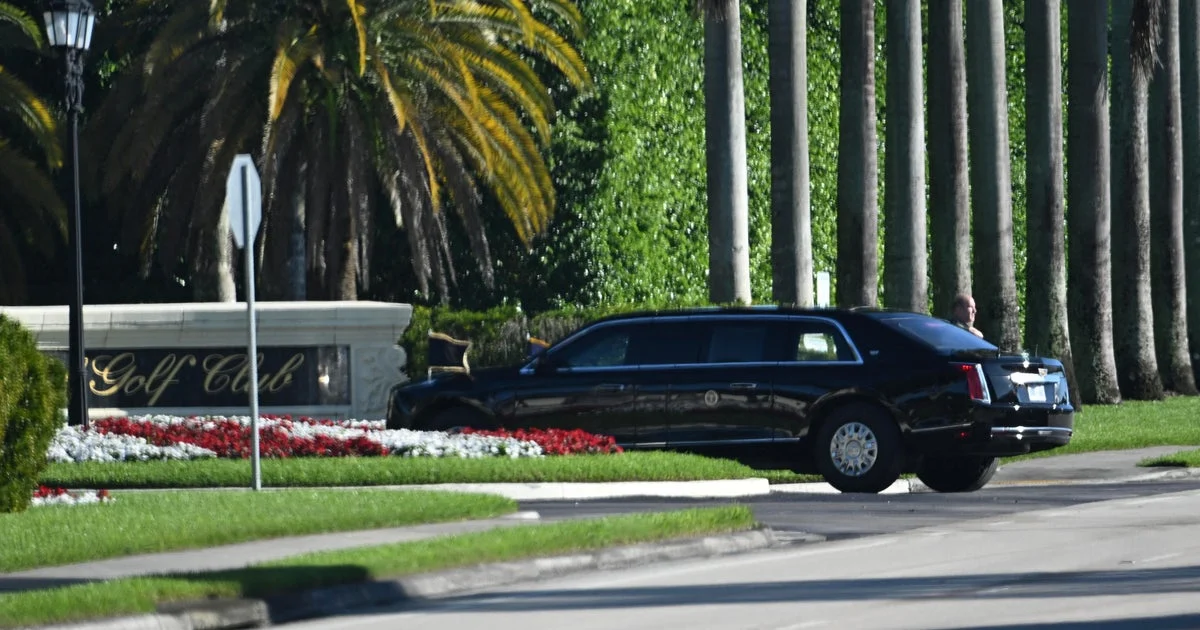
President Donald Trump spent the Thanksgiving holiday at his Mar-a-Lago estate in Palm Beach, Florida, balancing routine holiday traditions and high-level national security diplomacy with a flurry of contentious social media commentary. While the holiday is traditionally reserved for unity and gratitude, the president’s public statements on Thursday morning targeted a sweeping array of political adversaries, federal agencies, and recent economic data releases, injecting political friction into the national day of rest.
According to the White House schedule, the president began his Thursday with an early-morning policy briefing before heading to his nearby golf club. Accompanied by First Lady Melania Trump, the president was slated to participate in the traditional Thanksgiving evening phone calls to express gratitude to deployed U.S. service members stationed around the globe. Yet, the tranquility of the holiday schedule contrasted sharply with the tone of a lengthy digital statement published hours earlier.
Controversial Holiday Messages and Economic Data Accusations
In a holiday message posted to social media on Thursday morning, President Trump extended formal greetings to "American patriots who have worked so hard to make our country great!" However, the sentiment quickly shifted as the president pivoted to direct grievances toward a wide array of critics, political opponents, and institutions.
Among the primary targets of the president’s holiday post was the U.S. Department of Commerce. Mr. Trump voiced harsh criticism regarding the release of economic metrics, claiming that "fake Economic Numbers" had been deliberately published ahead of recent midterm congressional elections that saw significant Republican losses.
The president’s allegations centered on a routine economic revision announced by the Commerce Department earlier in the week. On Wednesday, the agency revised its calculation of the gross domestic product (GDP) for the third quarter, adjusting the annualized growth rate upward to 4.3% from a previous estimate of 3.4%. Government economists routinely update monthly and quarterly macroeconomic indicators—including GDP, retail sales, and employment reports—as more comprehensive datasets become available from businesses, tax receipts, and state agencies. Despite standard statistical revision protocols, President Trump demanded a formal federal investigation into the Commerce Department’s reporting procedures, though he did not provide factual evidence of data manipulation.
The president’s holiday commentary extended beyond macroeconomic data. In the same statement, he leveled critiques at immigration policies, the Somali-American community, and political figures on the "radical far left." He also targeted individuals critical of his ongoing White House ballroom construction project, alongside generalized warnings regarding judicial systems and property distribution policies.
Diplomatic Engagements and Foreign Policy Discussions
While domestic grievances dominated his public statements, the president’s holiday week also featured significant international diplomacy. On Wednesday night, President Trump held a high-profile meeting at Mar-a-Lago with NATO Secretary General Mark Rutte.
The two leaders subsequently released a joint statement characterizing their discussions as "very impactful." The talks focused heavily on ongoing geopolitical hotspots, specifically the wars in Ukraine and the Middle East involving Iran. According to the joint communiqué, President Trump and Secretary General Rutte emphasized "the importance of Russia avoiding any actions that intentionally, or unintentionally, expand the war," underscoring Western concerns regarding military escalation along NATO’s eastern flank.
The diplomatic summit followed a quieter start to the holiday week. Earlier in the week, President Trump participated in the annual White House tradition of pardoning Thanksgiving turkeys, granting clemency to two birds named Freedom and Feathers, who were subsequently sent to live out their natural lives on a specialized farm in Texas. First Lady Melania Trump welcomed the official White House Christmas tree to the executive mansion on Monday, marking the traditional transition into the winter holiday season.
Fallout from the Iowa Ammunition Plant Controlled Detonation
The holiday backdrop was further complicated by lingering fallout from a major industrial and military event earlier in the week. Overnight, President Trump publicly praised the U.S. Army’s successful controlled detonation of approximately five tons of degraded lead azide at an ammunition plant in Iowa. The volatile chemical compound required emergency disposal due to its degraded and unstable state.
In his public statements, the president sought to pin political responsibility for the hazardous situation on former President Barack Obama, while assuring the public that no environmental toxins or "carcinogens were released into beautiful Iowa air."
However, behind-the-scenes accounts paint a picture of internal administrative turbulence. Sources familiar with the matter revealed to CBS News on Wednesday that the lead-up to the Iowa detonation was marked by severe operational friction and confusion within the current administration. Officials reportedly clashed over protocol breakdowns, specifically attempting to determine why the severely degraded explosives were not flagged and elevated to senior executive leadership much earlier in the disposal pipeline. While the immediate crisis was averted through the successful controlled blast, the incident has sparked internal calls for accountability regarding military inventory oversight.
Broader Economic and Political Implications
The confluence of events surrounding the 2026 Thanksgiving holiday underscores the persistent friction between the executive branch and traditional federal administrative structures. Economists and institutional analysts note that public challenges to independent statistical agencies—such as the Commerce Department and the Bureau of Labor Statistics—risk undermining public trust in foundational economic indicators, which are relied upon by the Federal Reserve, Wall Street investors, and businesses to guide monetary and fiscal policy.
At the same time, the administration’s aggressive posture on domestic policy and foreign alliances highlights the high-stakes political environment following the midterms. As the White House navigates legislative setbacks, international security challenges with NATO and Eastern Europe, and internal administrative accountability issues, the president continues to utilize direct digital communication channels to mobilize his political base, even during traditional periods of national respite.
As the holiday weekend progresses, President and First Lady Trump are expected to remain in Florida, balancing private holiday celebrations with ongoing oversight of executive branch operations, foreign policy developments, and federal agency investigations.

