
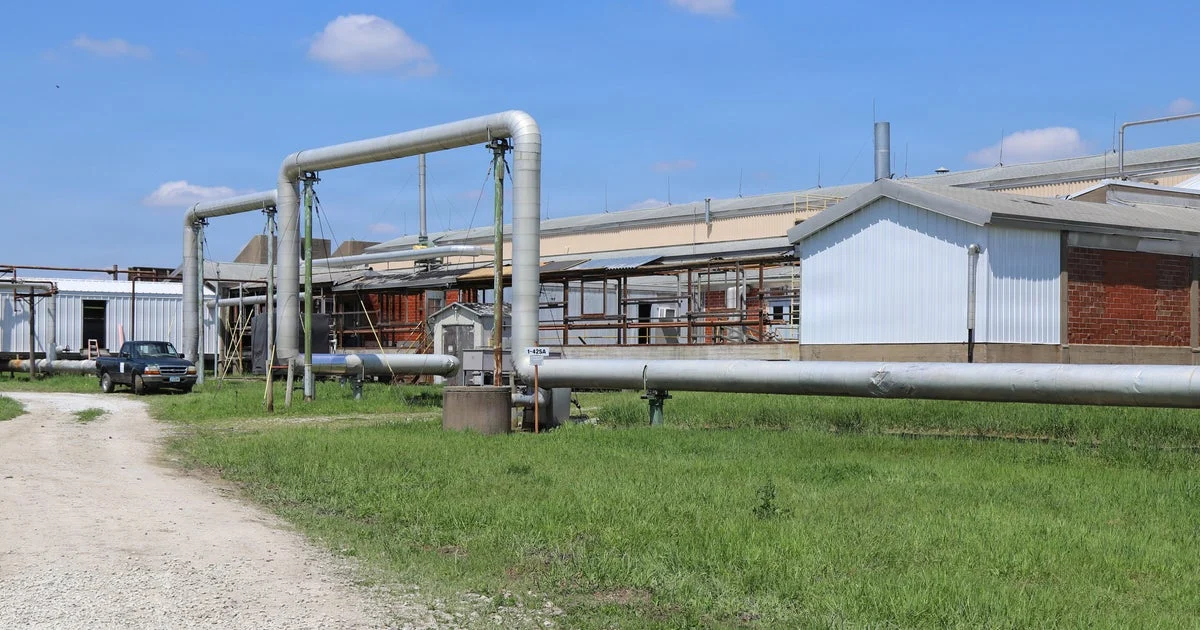
A high-stakes military operation is scheduled to take place at noon Central Time on Friday, Nov. 20, at the Iowa Army Ammunition Plant in Middletown, Iowa. The U.S. Army plans to conduct two controlled detonations involving 68 barrels of lead azide, a highly sensitive and toxic military explosive that has deteriorated significantly after decades in storage. The operation, which totals approximately 5 tons of hazardous material, is expected to generate a massive dust plume containing toxic lead particles. This plume could sweep across portions of eastern Iowa and into northwest Illinois, potentially settling on agricultural farmland, public playgrounds, residential properties, and local waterways.
The planned detonation has triggered a cascade of local alarm, school closures, emergency evacuations, and last-minute legal battles. Environmental groups, local officials, and residents are expressing deep concern over the transparency of the military’s emergency authorization, the potential health hazards of airborne lead dust, and the adequacy of post-detonation cleanup measures. While the Army insists that in-place detonation is the only viable method to prevent an accidental, catastrophic explosion during transport, critics argue that public safety and environmental health have been subordinated to military expediency.
Chronology and Background of the Deteriorated Explosives
The origins of this impending environmental and safety crisis trace back more than twenty years, during which time the 68 barrels of lead azide were stored at the Middletown facility. Lead azide has been a staple military explosive utilized in ammunition manufacturing since World War I. At the Iowa plant, the volatile substance was kept within earthen-covered containers and submerged in a stabilizing bath of water and ethanol to mitigate its extreme sensitivity to friction and shock.
However, during a routine facility inspection earlier this year, military personnel discovered that a portion of the stabilizing water had evaporated over time. This evaporation allowed the lead azide to recrystallize, rendering the compound dangerously unstable and prone to spontaneous detonation from even minor mechanical triggers.
The discovery prompted the Army to evaluate potential disposal options. Transporting the degraded material off-site was quickly ruled out, as military officials concluded that moving the barrels posed an unacceptable risk of accidental detonation during transit, which could result in fatalities among explosive ordnance disposal technicians. Furthermore, officials noted that the risk of accidental detonation increases significantly during cold weather conditions, raising fears that the compound might destabilize on its own. Consequently, the Army determined that detonating the explosives in place was the safest available tactical option.
Legal Maneuvers and Emergency Permitting Controversies
The path to Friday’s detonation has been heavily contested in the legal and regulatory arenas. On Thursday afternoon—less than 24 hours before the scheduled blast—environmental advocacy groups filed an emergency lawsuit in the 8th U.S. Circuit Court of Appeals to halt the operation. Earthjustice, a prominent nonprofit environmental law organization, filed the legal challenge on behalf of the Iowa Environmental Council and the Sierra Club Iowa Chapter, targeting the emergency permit issued by the U.S. Environmental Protection Agency (EPA).
"The EPA itself admits that there is no safe level of lead exposure for humans," stated Michael Schmidt, General Counsel at the Iowa Environmental Council, in a press release. "When our federal government makes decisions that result in a potentially toxic plume of lead dust that could cover much of southeastern Iowa, Iowans deserve to know that every available alternative was considered before choosing this method of disposal."
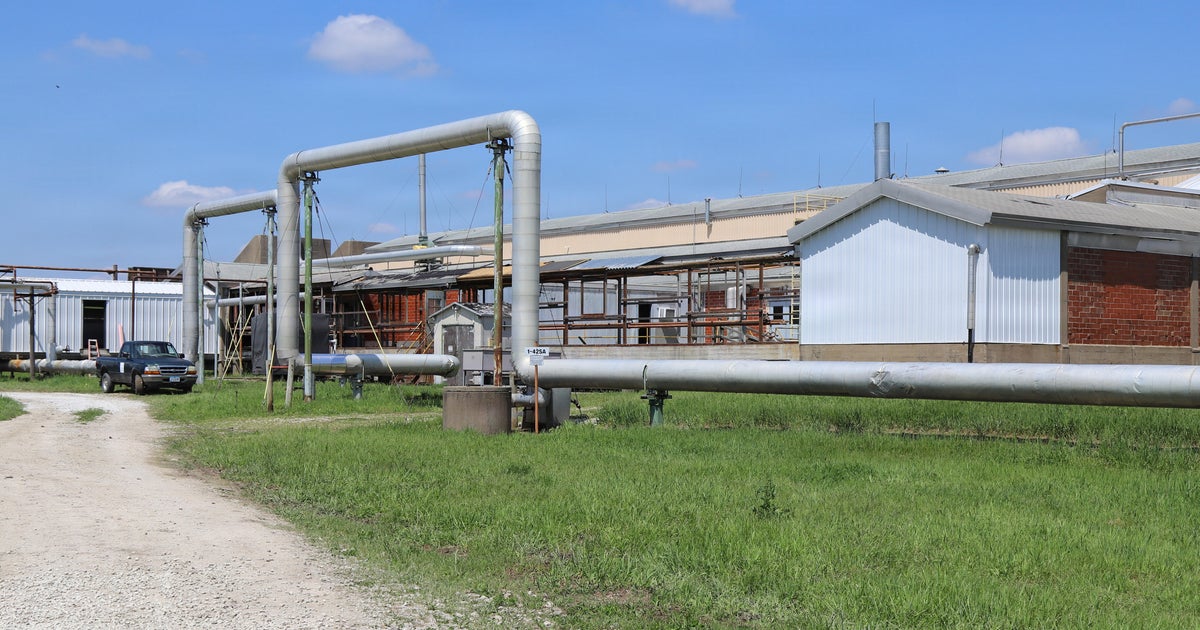
The EPA issued the emergency permit on Nov. 13, authorizing the Army to proceed with the detonation at a site not normally approved for such activities under the facility’s existing hazardous-waste permits. The authorization relies on the federal Resource Conservation and Recovery Act (RCRA), specifically emergency-permitting provisions under 40 CFR § 270.61, which grant regulatory flexibility during imminent threats to public safety. While the EPA’s permit incorporates federal hazardous-waste regulations and mandates environmental monitoring, critics point out that emergency designations bypass the rigorous public review processes typically required for major hazardous-waste treatments.
Community Impact, School Closures, and Evacuations
The immediate vicinity of the Iowa Army Ammunition Plant—located in Middletown, a small community of approximately 360 residents situated four hours west of Chicago near the Mississippi River—will bear the most direct brunt of the operation. The Army has warned that the detonations will be exceptionally powerful, carrying the potential to shatter windows and cause structural damage to nearby buildings.
Consequently, residents residing in Middletown’s City Park neighborhood have been formally requested to evacuate their homes between 8 a.m. and 2 p.m. Friday. Those unable to evacuate are instructed to shelter indoors with all windows and doors securely sealed. Temporary emergency accommodations have been established at the Armed Forces Reserve Center in Middletown.
Beyond the immediate blast zone, the broader regional impact has disrupted daily life across multiple counties. In Danville, located just a few miles from the plant, school district administrators decided to cancel classes for the day. Superintendent Pat Wallace explained that while he initially hoped to keep schools open, the pervasive uncertainties surrounding the plume’s trajectory made closure the most responsible course of action. "The reality is that we simply do not know exactly what conditions will look like Friday afternoon," Wallace noted.
Similarly, in Mediapolis, situated less than 20 miles northeast of the plant, city officials and school administrators learned belatedly on Sunday that their town sat directly in the center of the Army’s projected dust exposure map. The Mediapolis school district announced the cancellation of all classes, sports practices, and public library operations for Friday. The local fire department formulated plans to hose down public playgrounds following the blast, while city officials coordinated with the EPA to establish a local command center for air, soil, and water sampling.
"The biggest issue we’re having is the lack of information," remarked Deputy City Clerk Amy Stucker. The sentiment was echoed across agricultural sectors; the Iowa Department of Agriculture advised farmers to bring livestock, hay bales, and outdoor water supplies indoors. Extension offices in Des Moines County reported being inundated with calls from panicked residents concerned about garden contamination, with soil test kits completely selling out.
Plume Modeling and Meteorological Contingencies
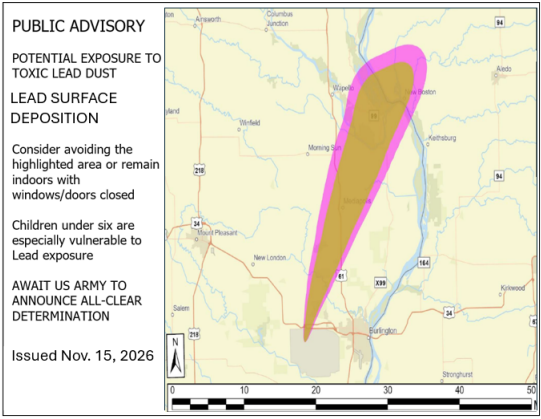
The primary environmental hazard stems not from the initial explosion, but from the resulting airborne dust plume. Preliminary forecasting maps generated by the Army indicate that the toxic cloud could stretch northward across eastern Iowa, cross the Mississippi River, and potentially reach far northwest Illinois. Thousands of residents live directly along the projected pathway.
Meteorological conditions will ultimately dictate the plume’s speed, direction, and dispersion pattern. Current forecasts for Friday call for gusty southerly winds ranging between 20 and 30 miles per hour. These winds are expected to drive the plume northward through eastern Iowa, maintaining a safe distance west of the Chicago metropolitan area while concentrating potential downwind exposure near the Mississippi River border. The Army’s predictive models suggest that the visible dust plume should dissipate within an hour of the detonation.
Strict environmental parameters govern the operation under the EPA permit. The detonation must be immediately postponed if unfavorable weather conditions arise, including surface wind speeds below 1 mph or above 15 mph, strong high-altitude winds, thunderstorms, precipitation, or atmospheric temperature inversions. The Army is mandated to provide updated plume forecasts six hours prior to the operation, followed by hourly updates until the explosions are completed.
Public Health Implications of Lead Exposure
The prospect of widespread lead deposition has alarmed public health professionals. Lead is a persistent toxic heavy metal that does not degrade naturally over time. Once deposited onto soil, agricultural fields, or residential surfaces, it can remain active for decades, posing long-term risks through physical contact, inhalation, or environmental runoff into local watersheds.
The Centers for Disease Control and Prevention (CDC) maintains that no safe blood lead level has been established for children. Even low-level lead exposure in pediatric populations is definitively linked to learning disabilities, behavioral disorders, and developmental delays. Pregnant women and toddlers—who frequently ingest dust particles through hand-to-mouth behaviors—face heightened physiological vulnerabilities.
Expert commentary highlights the inherent difficulties in predicting actual exposure outcomes. Patrick O’Shaughnessy, a professor in the University of Iowa’s Department of Occupational and Environmental Health, noted that while the Army and EPA’s dust-mitigation efforts are encouraging, the true volume of lead escaping into the atmosphere remains an unknown variable. Andrew Whelton, an environmental engineering professor at Purdue University, cautioned that acute exposure to elevated lead levels can induce immediate symptoms of lead poisoning.
Conversely, the Army maintains that its comprehensive modeling indicates ambient lead concentrations will remain well below the thresholds mandating mandatory protective interventions by the EPA. Protective engineering measures implemented at the site include burying the barrels beneath concrete and soil, surrounding them with two-story-tall sand barriers, spraying surrounding soil with water, and deploying misting systems to trap particulate matter on military property.
Official Commitments to Cleanup and Remediation
Under the binding terms of the emergency permit, the Army is legally obligated to initiate soil and surface-wipe sampling within 24 hours in accessible public areas and consenting private properties where modeled lead deposition exceeds specified regulatory thresholds. Furthermore, the military must submit comprehensive environmental findings and remediation strategies to the EPA for review.
For residents situated within the potential exposure zone, official safety guidelines recommend wet-cleaning frequently touched outdoor surfaces, including playground equipment, patio toys, and windowsills. Indoor recommendations mirror standard hazardous material protocols: avoiding outdoor activities, keeping all windows closed, and configuring home HVAC systems to recirculate indoor air until official all-clear notifications are issued.
As the noon hour approaches on Friday, the convergence of military necessity, regulatory speed, and community anxiety underscores the complex challenges of managing legacy hazardous waste in populated regions. While federal authorities emphasize that every precaution has been taken to secure the volatile compound and minimize environmental fallout, local communities remain vigilant, demanding transparency, rigorous independent testing, and accountability in the days and weeks following the blast.

