
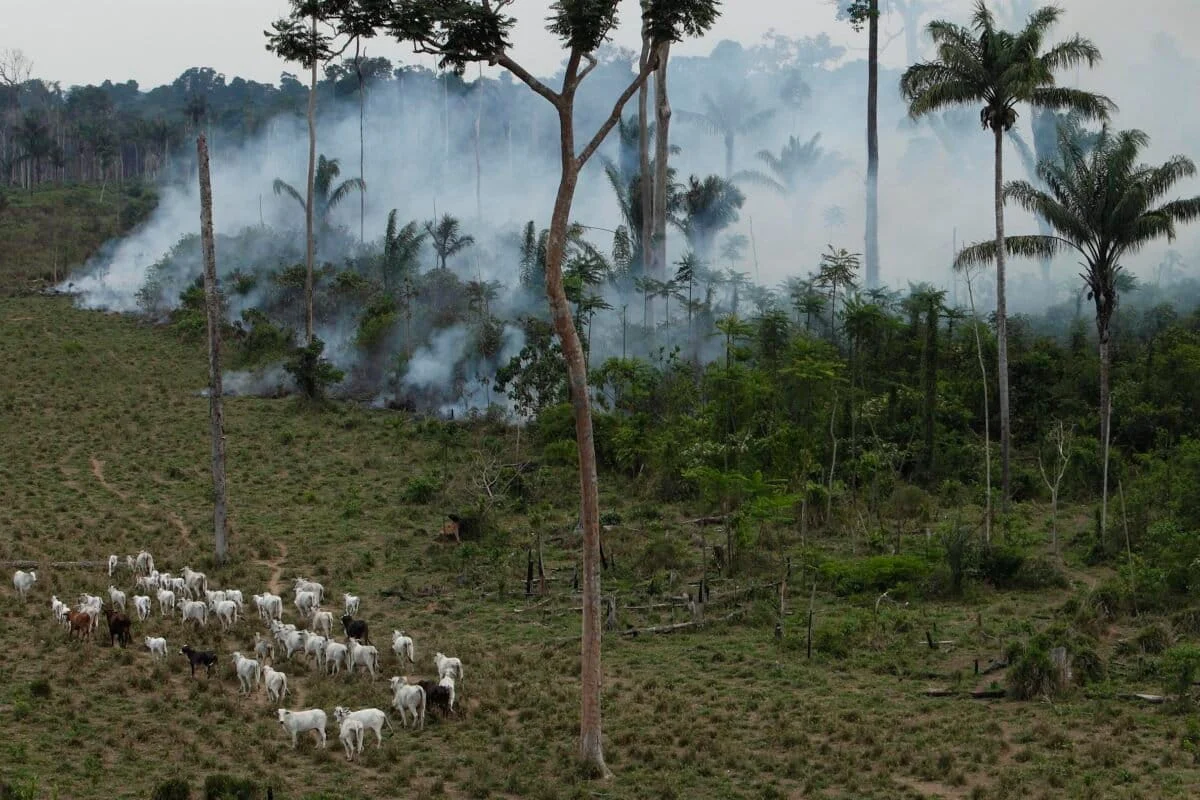
The Amazon rainforest, a critical bastion of global biodiversity and climate stability, is once again the theater of a high-stakes confrontation between state-sanctioned environmental protections and organized land-grabbing operations. More than 500 individuals have illegally stormed the Ituna/Itatá Indigenous Land in the Brazilian state of Pará, carving out clandestine roads, initiating large-scale deforestation through deliberate fires, and issuing direct threats against federal agents tasked with protecting the territory. This surge in unauthorized activity has prompted a legal standoff, with the Federal Public Prosecutor’s Office (MPF) demanding urgent intervention from the federal government, which has yet to deploy the requested security forces despite a clear judicial mandate.
The territory of Ituna/Itatá is not merely a parcel of land; it is a vital refuge for the Igarapé Ipiaçava people. These individuals live in voluntary isolation, maintaining no contact with the outside world—a status that makes them uniquely vulnerable to external pathogens, resource depletion, and direct violence. The current encroachment represents an existential threat to one of the last remaining groups of isolated humans in the Amazon basin.
A Chronology of Escalating Tensions
The current crisis did not emerge in a vacuum but is the culmination of months of friction, legislative ambiguity, and aggressive land-clearing campaigns.
- Mid-2026: The state of Pará enacts a new law establishing the Bacajá Environmental Protection Area (APA Bacajá), a move that permits private land ownership and livestock development within its borders.
- August 26, 2026: Recognizing the critical threat posed by the overlapping jurisdictions, a federal court issues a landmark order requiring the Brazilian government to deploy the National Public Security Force to the Ituna/Itatá territory within 48 hours to neutralize the invasion.
- Late August 2026: The Brazilian Institute of Environment and Renewable Natural Resources (IBAMA) conducts field inspections, successfully destroying heavy machinery and vehicles used by the invaders to clear the forest.
- Late August – Early September 2026: In direct retaliation for the IBAMA operation, the illegal settlers initiate a campaign of arson, setting large swaths of the forest ablaze.
- September 11, 2026: Despite the initial court order, the National Public Security Force remains absent from the territory, prompting the MPF to file for a daily fine of 50,000 Brazilian reais (approximately $9,000 USD) against the federal government for non-compliance.
The Legal Quagmire: Overlapping Jurisdictions
At the heart of the current crisis is a profound legal contradiction. The newly established APA Bacajá, a state-level initiative, creates a geographic overlap with the federally protected Ituna/Itatá Indigenous Land. While the federal government holds the ultimate authority over Indigenous territories—which are under a temporary land-use restriction order—the state’s legislation has provided a convenient, albeit legally dubious, shield for land-grabbers.
By promoting the APA as a zone for settlement and livestock ranching, local influencers have successfully misled land-seekers into believing their presence is sanctioned by law. This "weaponization of confusion" has allowed for the rapid development of illegal infrastructure. Satellite imagery and surveillance overflights conducted by the National Indigenous People Foundation (Funai) and the Federal Police have documented the clearing of more than 30 kilometers of clandestine roads. These trails are specifically designed to demarcate illegal plots for future cattle ranching, a primary driver of deforestation in the Amazon.
The Environmental and Human Cost
The situation is exacerbated by the broader climate conditions currently affecting the Amazon. According to Helena Palmquist, deputy coordinator of the Observatory of Isolated and Recently Contacted Indigenous Peoples (OPI), the timing of this invasion is particularly catastrophic.
"What worries us most right now is the fire situation," Palmquist noted. "We are experiencing an Amazonian dry season with the prospect of an El Niño event far more severe than previous ones. This makes the forest more volatile and prone to catching fire."
The use of fire as a weapon of intimidation and a tool for land clearing is a well-documented tactic in the region. By burning areas shortly after government inspections, invaders are signaling their intent to remain and their disregard for federal authority. The psychological impact on the Igarapé Ipiaçava people—who have no means to combat these blazes or defend their borders—is immeasurable.

Official Responses and Institutional Impasse
The failure to deploy security forces has led to a tense game of jurisdictional "ping-pong." The federal government has argued that it requires authorization from the government of Pará to operate in certain areas, citing administrative complexity. However, federal prosecutors have countered this claim sharply, asserting that the federal government possesses the constitutional authority to deploy forces on federal land regardless of state-level cooperation.
The MPF’s recent case filing includes alarming evidence of the invaders’ organization. Audio recordings obtained by investigators reveal a coordinated effort to resist law enforcement, with calls for groups of 100 to 200 people to surround and intimidate government officials, burn service vehicles, and force agents to retreat on foot. Perhaps most damning is the discovery of a state-government-owned cargo vehicle found supporting the infrastructure of the illegal settlement, a detail that further complicates the relationship between state and federal authorities.
As of the latest reports, both the office of the governor of Pará and relevant federal agencies have declined to comment on the specific logistics of the security force deployment, leaving local observers and human rights advocates in a state of deepening anxiety.
Broader Implications: The Future of Indigenous Rights
The situation in Ituna/Itatá serves as a bellwether for the wider struggle over land rights in Brazil. The ability of private interests to override federal environmental and human rights protections through state-level legislative maneuvers highlights a dangerous vulnerability in the rule of law.
If the government fails to uphold the court order and secure the territory, it sends a message of impunity to land-grabbers across the Amazon. This could trigger a domino effect, where other protected lands face similar "state-sanctioned" invasions, further accelerating the degradation of the rainforest and the potential loss of uncontacted cultures.
Furthermore, the economic incentive structure remains the primary driver. Cattle ranching, despite its environmental cost, remains a lucrative industry in Pará. Until the cost of illegal occupation—through swift law enforcement and heavy financial penalties—exceeds the potential profit of the land, these crises are likely to persist.
Conclusion
The crisis at Ituna/Itatá is a test of the Brazilian state’s commitment to its own laws and its obligations toward the most vulnerable inhabitants of the Amazon. The 50,000-reais daily fine sought by the MPF is an attempt to force the state’s hand, but the underlying issue remains the lack of political will to enforce the protection of Indigenous lands against powerful regional economic interests.
As the dry season continues and the threat of fire looms, the clock is ticking for the Igarapé Ipiaçava. Without an immediate and decisive intervention by the National Public Security Force, the delicate balance of the Ituna/Itatá region may be irreparably broken, and one of the world’s last uncontacted societies may face an irreversible catastrophe. The international community, observers, and human rights organizations remain focused on the region, waiting to see if the rule of law can prevail over the forces of unchecked development.

