
The landscape of American public education has undergone profound shifts over the past two decades, with states increasingly turning to data-driven accountability measures to bolster student achievement. Among the most ambitious state-level interventions was rolled out in Tennessee, where sweeping educational reforms fundamentally altered how teachers are evaluated, supported, and granted tenure. A comprehensive empirical analysis of Tennessee data spanning from the 2007-08 to the 2014-15 academic years sheds new light on the mechanics of these policies, offering a rare, data-backed look at how performance evaluations and high-stakes incentives actually impact educator effectiveness in real-world classrooms.
The study, which incorporates records from approximately 11,000 teachers and 720,000 students in grades four through eight, breaks down the monumental policy shift into two primary experimental treatments. The first treatment involves a complete overhaul of performance measurement systems, expanding annual evaluations to encompass every teacher across the board, rather than selectively targeting only pre-tenure or novice educators. Furthermore, this revamped system introduced significantly more comprehensive classroom observation rubrics and formalized the integration of student growth metrics—commonly referred to as value-added scores—into formal teacher evaluations.
The second treatment introduced structural performance incentives tied directly to these new metrics. Under revised state tenure rules, educators were required to achieve performance ratings of "above expectations" or "significantly above expectations" during both their fourth and fifth consecutive years on the job to secure lifetime tenure. By isolating these mechanisms, researchers have been able to map out the distinct trajectories of teacher improvement when faced with rigorous evaluations, future performance incentives, and the subsequent removal of those high-stakes pressures.
Background Context and the Evolution of Tennessee Policy
To understand the weight of these findings, one must examine the broader historical framework of educational reform in Tennessee. For years, critics argued that traditional tenure systems offered blanket job security without adequately measuring or rewarding instructional quality. In response to federal initiatives such as the Race to the Top competition launched in 2009, Tennessee positioned itself at the vanguard of educational accountability. The state introduced the Tennessee First to the Top Act of 2010, which mandated the inclusion of student growth data in teacher evaluations and raised the bar for professional permanence.
Before these sweeping changes took effect, teacher evaluations were often perfunctory, rarely resulting in differentiation among staff, and tenure was typically granted almost automatically after a brief probationary period—usually three years. The 2012 rollout of the new evaluation framework changed everything. For early-career teachers navigating their foundational years, the stakes became immediately higher. However, the timing of the policy implementation created a unique natural experiment within the workforce: novice teachers hired around 2009 or 2010 were subject to both the rigorous new evaluations and the high-stakes tenure incentives, while veteran teachers who were already in their fourth through seventh years of service experienced the new evaluation metrics without ever being subjected to the new tenure-earning incentives, as they had already secured tenure under legacy rules.
Decoding the Data: Anticipation Effects and Initial Gains
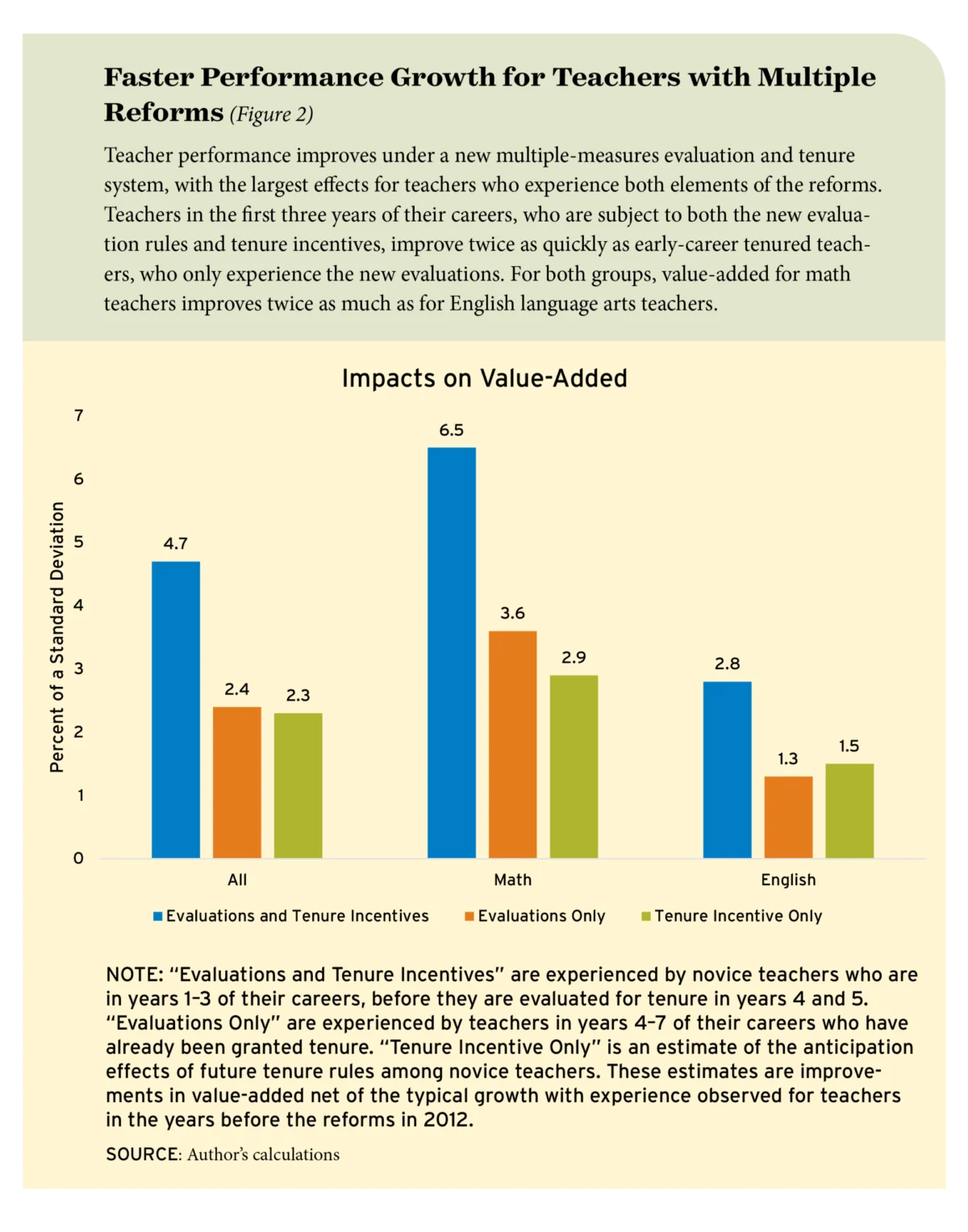
When analyzing the performance trajectories of novice teachers who faced both the evaluation and tenure treatments, the study reveals significant early gains. During the first year of Tennessee’s widespread reforms, value-added scores for novice instructors improved by an average of 4.7 percent of a standard deviation. Crucially, this notable upward shift occurred on top of the typical, expected performance growth naturally experienced by educators at the very outset of their careers.
A deeper dive into the subject-specific data reveals a pronounced disparity between disciplines. While educators in both mathematics and English language arts (ELA) registered performance improvements, math teachers experienced more than double the growth of their ELA counterparts. Specifically, value-added scores for math instructors surged by 6.5 percent of a standard deviation, compared to a 2.8 percent gain for English language arts teachers.
This empirical divergence raises critical economic and pedagogical questions regarding why math instruction appears more responsive to evaluation-driven reforms. Analysts suggest that the sequential, cumulative nature of mathematics curricula, alongside more standardized testing metrics, may make targeted skill acquisition and instructional adjustments more readily detectable through value-added modeling.
The Power of Anticipation Versus the Moment of Accountability
A central inquiry of the study is whether performance improvements are driven primarily by the supportive feedback loops of robust evaluations or by the looming carrot-and-stick of career-defining incentives like tenure. To parse this apart, the researcher examined the performance of tenured early-career teachers who underwent the new, rigorous evaluations but were entirely insulated from the new tenure-earning incentives because they were already tenured.
The data shows that these tenured early-career teachers improved at roughly half the rate of their non-tenured peers, registering a value-added gain of 2.4 percent of a standard deviation. Disaggregating by subject reveals a similar pattern: math teachers in this cohort improved by 3.6 percent of a standard deviation, while English language arts instructors saw a modest 1.3 percent gain.
Comparing these two groups illuminates a fascinating psychological and professional phenomenon known as the anticipation effect. Because novice teachers understood that their performance metrics in years four and five would directly dictate whether they earned tenure, they heavily invested in their professional skills before those high-stakes years arrived.
Consequently, when these novice teachers finally reached year four—the precise moment when their performance evaluations officially began counting toward tenure—the anticipated surge in productivity was surprisingly muted. The data indicates only a marginal, estimated increase of 1.3 percent of a standard deviation in teacher value-added between the third and fourth years. Because this specific estimate carries a relatively wide margin of statistical error, researchers cannot definitively rule out the possibility of zero change during that exact transition.
The primary takeaway from this timeline is profound: the overwhelming bulk of performance gains do not materialize at the moment the high-stakes evaluation hammer falls. Instead, these performance spikes occur early in a teacher’s career, fueled by the psychological and professional anticipation of future career security while their scores are still formative rather than punitive.
The Post-Tenure Phase: Persistence of Skills Over Decay
In high-stakes accountability models, policymakers frequently worry about moral hazard—the hypothesis that once an employee secures permanent status, their motivation to excel will evaporate. Under Tennessee’s reformed guidelines, approximately two-thirds of novice teachers successfully met the stringent scoring requirements and earned tenure by the conclusion of their fifth year on the job. For these educators, year six marked a definitive end to the tenure incentive structure; their ongoing evaluations no longer carried the existential weight of earning permanent status.
Traditional economic theories of performance incentives would logically predict a noticeable regression or decline in value-added scores once the incentive structure is removed. However, the empirical data from Tennessee defies this pessimistic assumption. The study finds robust, suggestive evidence that teachers continued to perform at high levels, allowing researchers to safely rule out any significant or notable decline in instructional quality post-tenure.
This persistence of elevated value-added scores strongly suggests that the Tennessee evaluation framework did more than temporarily coerce compliance; it fundamentally transformed professional capacity. By lowering the transaction costs associated with acquiring new pedagogical skills through comprehensive observation rubrics and actionable feedback, the evaluation system appears to have permanently upgraded the human capital of these educators. The investments they made in their instructional practices during their early, high-stakes years yielded dividends that persisted long after the tenure hurdle had been cleared.
Navigating Probation: Outcomes for Unsuccessful Candidates
While two-thirds of novice educators successfully navigated the rigorous hurdles to secure tenure by year five, the remaining one-third fell short of achieving consecutive "above expectations" performance marks. Rather than facing immediate termination, state policy provided a structured safety valve: these teachers were permitted to continue instructing students in year six and beyond under probationary contracts. Under the rules, these probationary educators retain a pathway to eventually secure tenure if they manage to surpass the required performance score cutoffs in any two consecutive years.
This structural flexibility acknowledges the reality of professional learning curves while maintaining an unyielding pressure on instructional quality. It provides educational administrators with the administrative discretion to retain promising educators who may simply require more time to master complex pedagogical competencies, while maintaining a clear, performance-based barrier to permanent employment.
Broader Implications for Educational Policy and Future Research
The findings emerging from Tennessee’s multi-year evaluation dataset carry profound implications for school districts, state education agencies, and policymakers nationwide as they grapple with teacher retention, recruitment, and quality control. For decades, the national debate surrounding teacher tenure was polarized between defenders of traditional job protections and proponents of aggressive market-driven reforms.
The Tennessee experiment demonstrates that a middle path—one that combines rigorous, multidimensional evaluations with clear, performance-based tenure milestones—can generate meaningful, lasting improvements in teacher effectiveness. Crucially, the research underscores that the most potent window for professional growth occurs during the pre-tenure phase, driven largely by anticipation and formative support rather than the mere punitive fear of negative evaluations.
As states continue to refine their accountability frameworks in the wake of post-pandemic learning disruptions, the lessons from Tennessee offer a valuable blueprint. By treating evaluations not merely as sorting mechanisms, but as developmental tools that permanently alter a teacher’s skill acquisition trajectory, school systems can foster an instructional workforce that continues to deliver high-value education to students long after the paperwork is signed and tenure is secured.

