
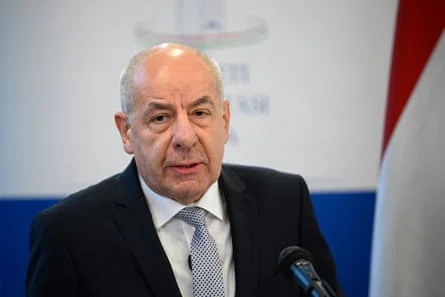
Péter Magyar, Hungary’s prime minister-elect, has declared his intention to suspend the news coverage of state media, labeling it a "propaganda machine," immediately upon his government taking office, anticipated around mid-May. This bold move follows his decisive landslide victory on Sunday, April 12, 2026, which marked a historic end to Viktor Orbán’s formidable 16-year tenure as prime minister. Magyar unveiled his ambitious plans during two charged interviews with public radio and television on Wednesday, marking his first invitation to appear on state media in 18 months—a stark contrast to the frequent appearances made by the outgoing leader, Orbán.
Confronting the ‘Propaganda Machine’
During these pivotal interviews, Magyar directly challenged the state-run outlets over what he described as their biased and manipulative coverage. He accused them of actively disseminating fear and falsehoods, drawing stark and severe parallels between their reporting and the propaganda machinery historically associated with regimes such as North Korea and Nazi-era Germany. "Every Hungarian deserves a public service media that broadcasts the truth," Magyar emphatically stated on Kossuth state radio, underscoring his core belief in media integrity.
His proposed reforms are comprehensive. The incoming government plans to enact a new press law and establish an independent media authority. The explicit aim of these measures is to fundamentally restructure state media, enabling it "to actually do what it is meant to do"—that is, to serve the public interest with objective reporting rather than acting as a governmental mouthpiece. Following his interviews, Magyar reinforced his commitment on social media, proclaiming, "We have just witnessed the last days of a propaganda machine. After the formation of the Tisza government, we will suspend the news services of the ‘public’ media until its public service character is restored."
The state media authority, however, swiftly pushed back against Magyar’s assertions of being excluded during the election campaign, claiming it had extended multiple invitations to both Magyar and his party. This rebuttal highlights the immediate friction and deep-seated institutional resistance Magyar is likely to face as he attempts to dismantle Orbán’s entrenched system.
Orbán’s Legacy: An ‘Illiberal Democracy’ and Media Control
The context for Magyar’s radical media reform agenda is rooted deeply in the political landscape shaped by Viktor Orbán’s 16 years in power. Orbán famously pioneered and championed the concept of "illiberal democracy," a system that, while maintaining formal democratic structures, systematically curtails independent institutions, civil liberties, and particularly, media freedom. Under Orbán’s Fidesz party, the Hungarian state underwent a profound transformation, with loyalists appointed to key positions across the judiciary, state administration, and crucially, the media sector.
Reporters Without Borders (RSF) has consistently voiced grave concerns regarding the deterioration of media freedom in Hungary. Year after year, the country’s ranking in the World Press Freedom Index has plummeted, reflecting a systematic erosion of pluralism and independence. RSF’s reports indicate that an estimated 80% of Hungary’s media landscape is controlled by entities or individuals loyal to Orbán’s Fidesz party. This extensive control includes both state-owned outlets, which have functioned as overt government mouthpieces, and a significant portion of the private media, acquired by oligarchs with close ties to Fidesz. This consolidation of media power allowed Orbán’s government to effectively control the national narrative, suppress dissenting voices, and propagate its political agenda largely unchallenged, thereby turning public discourse into what critics like Magyar describe as a "propaganda machine." The deliberate weakening of public service broadcasting, transforming it from an independent informational entity into a state-controlled instrument, has been a cornerstone of this strategy.
Magyar’s Ascendance and the Call for ‘Change of Regime’
Péter Magyar’s meteoric rise to power represents a seismic shift in Hungarian politics. A former insider within Orbán’s Fidesz party, Magyar dramatically broke away, becoming a vocal critic and ultimately forming the Tisza Party. His campaign resonated deeply with a populace increasingly weary of corruption, economic stagnation, and the erosion of democratic norms under Orbán. His landslide victory on April 12, 2026, was not merely an electoral win but a powerful expression of the Hungarian people’s desire for a fundamental "change of regime," as Magyar himself articulated.
Beyond media reform, Magyar has wasted no time in challenging other pillars of the Orbán-era establishment. On Wednesday, during a meeting with Hungarian President Tamás Sulyok, a known Orbán supporter, Magyar reiterated his call for Sulyok’s resignation. "I repeated to him that, in my eyes and in the eyes of the Hungarian people, he is unworthy of embodying the unity of the Hungarian nation, incapable of ensuring respect for the law," Magyar told reporters. He added that Sulyok had agreed to "consider" his arguments, a response that, while non-committal, indicates the immediate pressure on Orbán’s remaining allies. This move underscores Magyar’s strategy to systematically dismantle the "illiberal democracy" by targeting key loyalists and institutions that underpinned Orbán’s power structure. The demand for Sulyok’s resignation is a direct challenge to the legitimacy of the previous regime’s appointments and signals Magyar’s intent to sweep clean the upper echelons of state power.
Chronology of Transition and Government Formation

The political transition is set to unfold swiftly. Magyar announced that President Sulyok informed him that the new parliament would be convened around May 6 or 7. This timeline suggests that the new Tisza government could be officially sworn in by mid-May, or potentially even earlier, allowing Magyar to quickly implement his reform agenda. The rapid pace of these developments highlights the urgency with which Magyar is approaching his mandate to transform Hungarian governance.
International Reactions and Shifting Alliances
The outcome of the Hungarian election and Magyar’s subsequent declarations have sent ripples across international political circles, particularly concerning those leaders who had cultivated close ties with Viktor Orbán. Donald Trump, one of Orbán’s staunchest global allies and an open admirer of his "illiberal" policies, offered a surprisingly measured response to the Fidesz defeat. In comments to ABC News’ Jonathan Karl, Trump appeared to distance himself from Orbán, stating, "I think the new man’s going to do a good job – he’s a good man."
This reaction stands in stark contrast to Trump’s direct interventions and fervent endorsements of Orbán in the lead-up to the Hungarian campaign. Just two days before Hungarians cast their ballots, Trump had reiterated his support, even vowing to bring US "economic might" to the country if Orbán were re-elected. Previously, Trump and his inner circle had frequently cited Orbán as an inspiration, seemingly attempting to replicate elements of Orbán’s playbook: using state powers to target rivals, employing divisive rhetoric against political opponents, and purging institutions of perceived "wokeness."
Adding to the pre-election drama, JD Vance, a prominent figure within Trump’s orbit, traveled to Budapest the week before the election to rally support for Orbán. During his visit, Vance even placed a speakerphone call to Trump, who offered a glowing endorsement to the crowd, proclaiming, "I love Hungary and I love that Viktor. He’s done a fantastic job."
Despite these efforts, Trump now claims he "wasn’t that involved in this one" and mused whether his physical presence would have altered the outcome, noting Orbán "was behind substantially." He also highlighted that Magyar was a former Fidesz member with similar views on migration, concluding, "I think he’s going to be good." This shift suggests a pragmatic adaptation to the new political reality in Hungary, even if it means acknowledging the defeat of a close ideological ally.
Vance, reflecting on his two-day visit, framed it as a necessary show of support for a loyal ally. He told Fox News that they "certainly knew there was a very big chance that Viktor would lose that election." His presence, he argued, was "the right thing to do to stand behind a person who had stood by us for a very long time," portraying Orbán as one of the few European leaders who had actively sought to protect American interests within the European Union. Vance went further, describing Orbán’s legacy in Hungary as "transformational," despite numerous controversies during his final year in power. These included attempts to ban Pride events, accusations of sharing confidential EU information with Russia, and continued efforts to crack down on independent media and non-governmental organizations (NGOs). While expressing certainty that the US administration would work "very well" with the new prime minister, Vance conveyed personal regret, stating, "I’m sad that he lost," underscoring the deep personal and ideological ties between the American populist right and Orbán.
Broader Impact and Implications for Hungary’s Future
Péter Magyar’s victory and his immediate, decisive actions signal a profound turning point for Hungary. The challenges ahead are immense, reflecting the depth of Orbán’s "illiberal democracy" and its pervasive influence across state institutions. Magyar’s pledge to suspend state media news services and implement new press laws represents a direct assault on one of the most visible instruments of Orbán’s power. The success of these reforms will be a crucial test of his government’s ability to restore genuine media pluralism and freedom of expression in a country where independent journalism has been systematically stifled.
Dismantling a system built over 16 years, with Fidesz loyalists entrenched in the judiciary, public administration, and other key sectors, will require sustained political will and strategic acumen. The demand for President Sulyok’s resignation is just one example of the institutional resistance Magyar must overcome. His government will need to navigate potential opposition from a still-powerful Fidesz party and its allies, who will undoubtedly seek to protect their interests and legacy.
Beyond domestic reforms, Magyar’s government faces the task of redefining Hungary’s international standing, particularly within the European Union. Orbán’s confrontational stance, his frequent clashes with Brussels over rule of law, and his perceived alignment with Russia had isolated Hungary within the bloc. A new government committed to democratic principles and media freedom could pave the way for improved relations with the EU, potentially unlocking crucial funding and fostering greater cooperation.
The "change of regime" promised by Magyar encompasses not only a return to democratic norms but also a renewed focus on transparency and combating corruption, issues that resonated strongly with voters. His success will ultimately be measured by his ability to translate his electoral mandate into tangible reforms that strengthen democratic institutions, restore public trust, and genuinely empower the Hungarian people with access to unbiased information. The path ahead is fraught with obstacles, but Magyar’s initial pronouncements indicate a leader determined to embark on a radical transformation of Hungary’s political and media landscape.

