
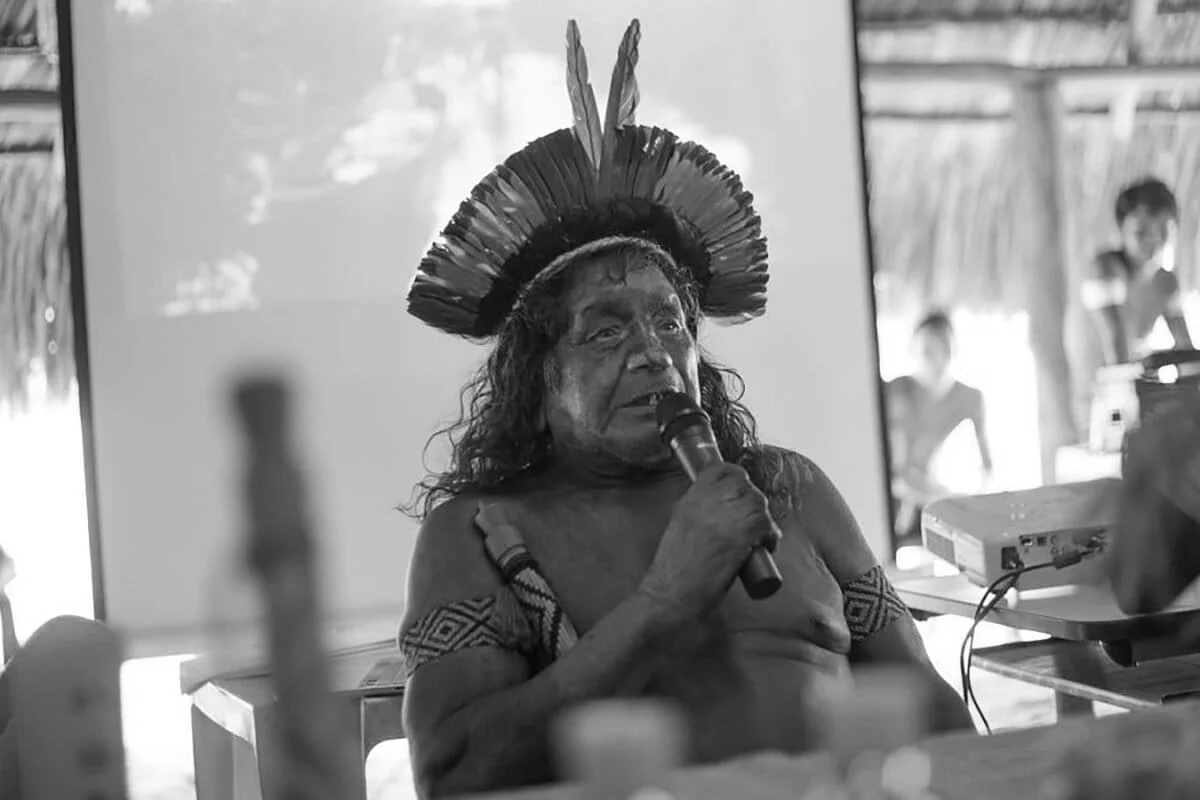
The death of Khuiusi Khisêtjê on July 3 in Goiânia, Brazil, marks the passing of a pivotal figure in the history of the Amazon’s indigenous resistance. At approximately 80 years old, Khuiusi was not only a witness to the near-extinction of his people but the primary architect of their demographic and territorial recovery. His life spanned the transition from isolated traditional living to a sophisticated, modern struggle for land rights and environmental protection against the encroaching agricultural frontier in the state of Mato Grosso.
Khuiusi’s final major act of leadership occurred in 2018, a decision that underscored the ongoing threats to indigenous sovereignty. As soy monocultures expanded to the very edge of the Wawi Indigenous Territory, the community of Khikatxi faced an invisible enemy: aerial pesticide spraying. Residents reported that single-engine aircraft would pass over their lands during every harvest, leaving a trail of chemical drift that poisoned their gardens, contaminated their water sources, and caused widespread illness, including chronic itching and diarrhea. In response, Khuiusi led the difficult relocation of the village, moving his people ten kilometers deeper into the forest to escape the toxic reach of industrial agriculture.
A Legacy of Survival and Demographic Recovery
To understand the weight of Khuiusi’s leadership, one must look back to the mid-20th century, a period of catastrophic loss for the Khisêtjê (formerly known as the Suyá). When Khuiusi was born, the Khisêtjê lived in the vast savanna and forest mosaics of central Brazil, relatively isolated from the "settled" frontiers. However, the push for westward expansion in Brazil brought outsiders, and with them, waves of infectious diseases to which indigenous populations had no immunity.
By the 1960s, the Khisêtjê population had plummeted to just 50 individuals. This demographic collapse did more than threaten the group’s physical existence; it nearly erased their culture. Epidemics claimed the lives of the elders, the keepers of oral history, ritual songs, and genealogical knowledge. Khuiusi himself lost his father and the mentors who would have guided his initiation into adulthood. Thrust into leadership at a young age out of necessity, he became responsible for a people on the brink of vanishing.
Under his guidance and the efforts of subsequent generations, the Khisêtjê underwent a remarkable recovery. Today, the population exceeds 700 people living in 11 different villages. This growth is a testament to the stability Khuiusi helped foster, providing a secure environment where families could thrive and traditional knowledge could once again be passed down to the youth.
The Struggle for the Wawi Territory
The central achievement of Khuiusi’s political life was the recovery of the Wawi Indigenous Territory. When the Xingu Indigenous Park (now the Xingu Indigenous Territory) was created in 1961—the first large-scale indigenous reserve in Brazil—significant portions of the Khisêtjê ancestral lands were left outside its official boundaries. These areas, known as Wawi, contained the graves of ancestors, sacred sites, and vital hunting grounds.
For decades, these lands were treated as "empty" by the Brazilian state and were sold or occupied by private landowners and settlers. Khuiusi refused to accept this displacement. He understood that without their ancestral territory, the Khisêtjê would be perpetually untethered from their history. He spearheaded a decades-long campaign that required navigating the complex and often hostile bureaucracy of the Brazilian government.
Through a combination of direct pressure, alliances with non-governmental organizations like the Instituto Socioambiental (ISA), and persistent legal advocacy, the Khisêtjê succeeded. The Wawi territory was officially demarcated in the 1990s and later integrated into the wider Xingu mosaic. During a 2008 meeting, Khuiusi succinctly summarized the motivation behind this struggle: "Many people thought the Khisêtjê wanted money. They wanted the land. The land is sacred because our relatives are buried there."
Diplomacy on the Soy Frontier
Khuiusi’s leadership style was characterized by a pragmatic, strategic approach to the outside world. Though he never became fluent in Portuguese and did not read or write the language, he was a formidable negotiator. He judged the "white world" not by its rhetoric, but by its actions.

As Mato Grosso became the powerhouse of Brazil’s soy industry, the Khisêtjê found themselves surrounded by an "arc of deforestation." The headwaters of the rivers that flow into the Xingu were increasingly compromised by forest clearing and agricultural runoff. Khuiusi maintained a delicate balance: he was firm in defending his people’s rights, yet he kept channels of communication open with neighboring farmers. He understood that in a landscape where the state often failed to provide protection, local diplomacy was a tool for survival.
Anthropologist Anthony Seeger, who worked with the Khisêtjê for over 50 years, noted that Khuiusi was a "strategic thinker" who recognized that the community had to evolve to survive. He supported the use of modern technology—cameras, radios, and GPS—to monitor their borders and document environmental crimes. He encouraged the youth to pursue formal education, provided it did not come at the expense of their indigenous identity.
Preserving the "True Songs"
For Khuiusi, the survival of the Khisêtjê was as much about culture as it was about land. He was a staunch advocate for the preservation of the "true songs"—complex oral compositions that serve as the repository of Khisêtjê history and social structure. He believed that if the songs were lost, the people’s connection to the land and each other would dissolve.
He worked extensively with researchers to record, transcribe, and translate these narratives, ensuring they would be available for future generations. Unlike some leaders who were wary of public performance, Khuiusi saw the political value in cultural visibility. He encouraged his people to present their ceremonies to non-indigenous audiences and politicians, arguing that by showing the world who they were, they made it harder for the state to ignore their rights. "Culture," he often demonstrated, "is a political shield."
Broader Implications and the Future of the Xingu
The passing of Khuiusi Khisêtjê comes at a time of renewed tension in the Brazilian Amazon. The "Xingu Mosaic," a massive corridor of protected areas, is increasingly under pressure from infrastructure projects, illegal logging, and the expansion of the "soy belt." The environmental degradation occurring outside the borders of indigenous lands—such as the alteration of microclimates and the drying of streams—poses a systemic threat that cannot be solved by demarcation alone.
Khuiusi’s life work provides a blueprint for indigenous resilience in the 21st century. His strategy involved:
- Territorial Integrity: Securing legal rights to ancestral lands as the foundation of all other rights.
- Institutional Engagement: Building long-term partnerships with scientific and advocacy organizations.
- Cultural Continuity: Ensuring that modern education is grounded in traditional knowledge.
- Generational Transition: Preparing younger leaders to operate in the political and legal systems of the dominant society.
Today, Khisêtjê filmmakers document their own ceremonies, and Khisêtjê teachers lead classrooms in their own villages. The community is no longer a small group of survivors; it is a vibrant, politically active society. However, the challenges remain immense. The "invisible" threats of pesticides and climate change require new forms of resistance that Khuiusi spent his final years contemplating.
Conclusion
Khuiusi Khisêtjê was the bridge between a world that nearly ended and a future that his people are now equipped to navigate. He led his community through the trauma of contact, the struggle for land restitution, and the modern crisis of environmental contamination. His decision to move the village in 2018 was a final, poignant reminder that the defense of indigenous life requires constant vigilance and the courage to start over when the land is poisoned.
As the Khisêtjê mourn their leader, they do so from a position of strength that would have been unimaginable 60 years ago. The "true songs" continue to be sung in the Wawi territory, echoing across a land that was reclaimed through the persistence of a man who understood that history is not just remembered—it is lived and defended. His legacy is the 700 Khisêtjê who today stand as guardians of one of the most vital ecological corridors on Earth.

