
A federal court in Virginia handed down a maximum 20-year prison sentence to Mohammad Sharifullah, a 28-year-old operative affiliated with the Islamic State’s Khorasan province, commonly known as ISIS-K. The sentencing marks a significant legal milestone in the ongoing accountability efforts stemming from the chaotic final days of the United States military presence in Afghanistan. Sharifullah’s conviction centers on his provision of material support to a designated foreign terrorist organization, a network that claimed responsibility for the devastating August 26, 2021, suicide bombing at Abbey Gate of the Hamid Karzai International Airport in Kabul. That catastrophic attack claimed the lives of 13 U.S. service members and approximately 160 Afghan civilians who were desperately trying to flee the Taliban takeover.
While a federal jury convicted Sharifullah of supporting the terrorist syndicate in April following a high-profile trial, the panel did not reach a unanimous verdict on whether his direct actions legally caused the deaths at the airport. Consequently, U.S. District Judge Anthony Trenga imposed the statutory maximum sentence of 20 years for the single-count conviction, addressing a courtroom filled with grieving families who traveled to witness the conclusion of a multi-year international counterterrorism investigation.
The Path to Justice: Capture and Extradition
The legal proceedings against Sharifullah represent a collaborative triumph for international intelligence and law enforcement agencies. Following years of tracking by counterterrorism analysts, Sharifullah was captured in early 2025 near the rugged borderlands between Pakistan and Afghanistan. The operation was executed through a joint effort involving Pakistani intelligence services and the U.S. Central Intelligence Agency (CIA).
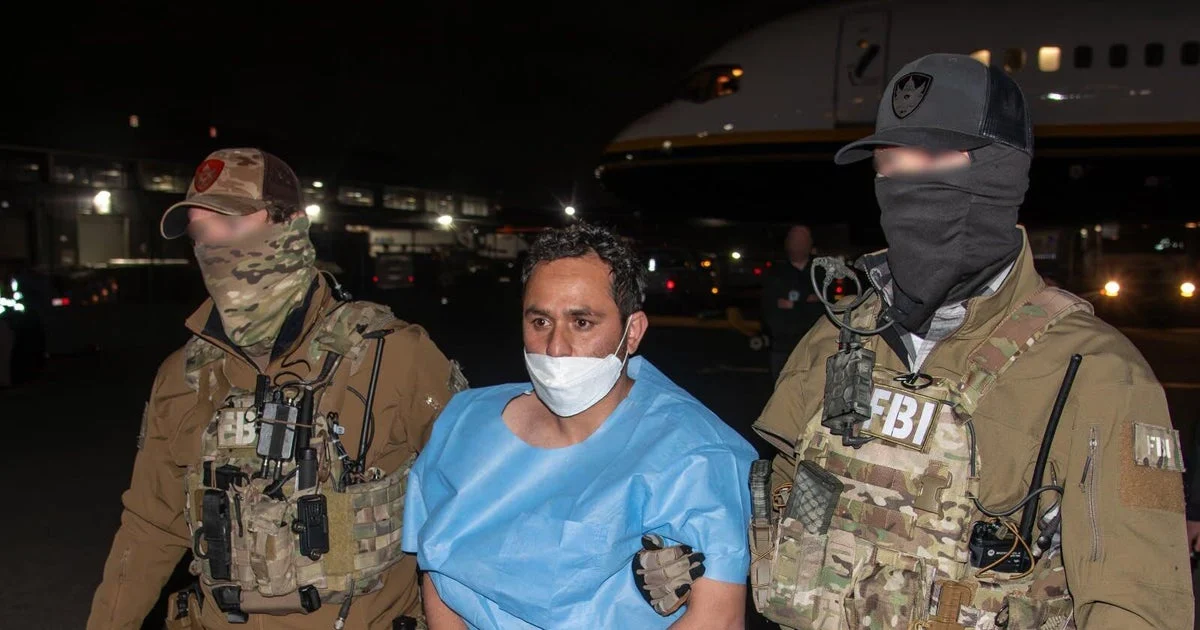
Shortly after his apprehension, Sharifullah was extradited to the United States to face federal terrorism charges in the Eastern District of Virginia. The case quickly garnered high-level political attention. President Donald Trump highlighted Sharifullah’s capture and impending prosecution during a subsequent address to a joint session of Congress, pointing to the operation as proof of the government’s unwavering commitment to hunting down those responsible for harming American service members, regardless of how much time passes.
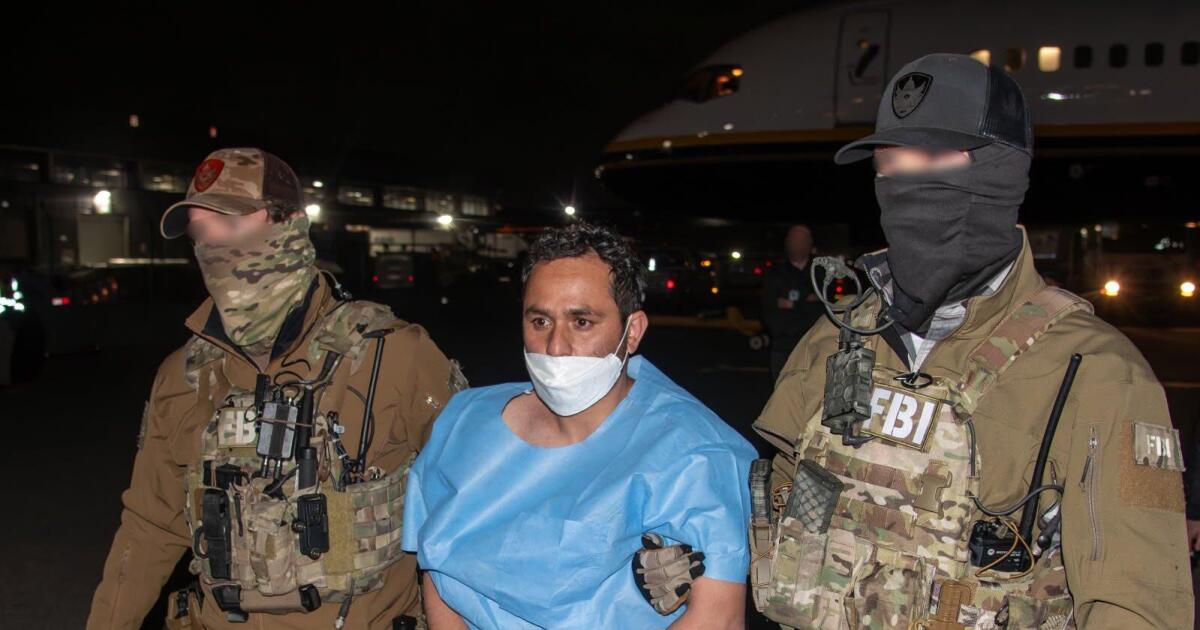
In March 2025, FBI Director Kash Patel drew widespread public attention to the case when he published a photograph on social media showing Sharifullah in federal custody following his arrival on American soil. The high-stakes prosecution tested the boundaries of extraterritorial counterterrorism laws, requiring federal prosecutors to piece together digital forensics, intelligence reports, and witness statements to establish the defendant’s intimate role within the upper echelons of ISIS-K logistics.
Chronology of Terror: From Regional Insurgency to Global Operations
To understand the gravity of Sharifullah’s conviction, federal prosecutors established a comprehensive timeline of his activities within ISIS-K, tracing his radicalization back to his teenage years when he first pledged allegiance to the terrorist group. According to court documents and Justice Department briefings, Sharifullah’s hatred toward Western nations—fueled by the post-9/11 U.S. military intervention in Afghanistan—morphed into an active operational role that spanned nearly a decade.
Court records indicate that Sharifullah did not merely hold passive ideological beliefs; rather, he functioned as a critical logistical conduit, communications facilitator, and scout for a wide array of high-profile international attacks. Prosecutors presented evidence linking his facilitation network to numerous catastrophic incidents beyond the Kabul airport bombing. Among these were the horrific March 2024 assault on the Crocus City Hall concert hall near Moscow, which left approximately 140 people dead, and a 2016 suicide bombing targeting security personnel stationed outside the Canadian Embassy in Kabul.
His duties within ISIS-K characteristically involved performing reconnaissance, scouting secure travel routes, transporting explosives and operatives, and bridging communication gaps between fragmented terrorist cells. Federal investigators revealed that Sharifullah had explicitly expressed a desire to target and kill American "crusaders" in retaliation for the protracted military campaign in his homeland.
The August 2021 Kabul Airport Crisis and Abbey Gate Reconnaissance
The focal point of the prosecution’s case involved the days leading up to the Abbey Gate bombing, which remains one of the darkest days in modern U.S. military history. In August 2021, as American forces raced against a strict withdrawal deadline set by the Biden administration, tens of thousands of Afghan citizens, dual nationals, and foreign residents swarmed Hamid Karzai International Airport in a desperate bid for evacuation.
Amid the security vacuum created by the rapid collapse of the Western-backed Afghan government, ISIS-K seized the opportunity to strike the vulnerable evacuation perimeter. Prosecutors established that in the hours preceding the attack, Sharifullah conducted vital reconnaissance on a specific transit route to the airport designed to bypass Taliban checkpoints.
After completing his surveillance, Sharifullah communicated directly with ISIS-K leadership, confirming that the route was secure for operational movement. Hours later, an operative identified as Abdul Rahman al-Logari approached the crowded Abbey Gate entry point and detonated a suicide vest packed with ball bearings to maximize casualties among the dense crowds of civilians and the U.S. Marines, soldiers, and Navy corpsmen screening them.
Legal Arguments: Material Support Versus Direct Causation
Throughout the trial and subsequent sentencing hearings, a distinct legal battle emerged concerning the scope of Sharifullah’s culpability. Federal prosecutors argued that his scouting report was an indispensable link in the chain of events that enabled the bomber to reach the gate undetected. They maintained that his actions directly contributed to the mass carnage and demanded the maximum 20-year sentence.
Conversely, defense attorneys vigorously contested the government’s narrative, emphasizing that the jury had acquitted or failed to reach consensus on whether Sharifullah’s specific actions directly "resulted in" the deaths at the airport. Defense counsel argued that Sharifullah was never a commander or decision-maker within ISIS-K, but merely an exploited messaging conduit whose statements to the FBI were coerced.
The defense submitted in sentencing memoranda that investigators failed to unearth concrete, independent physical evidence linking Sharifullah to the Abbey Gate blast. Instead, they argued that incriminating statements made by the defendant during rigorous FBI interrogations were the byproduct of fear—specifically, anxiety that he or his detained family members would face torture by Pakistani authorities before his extradition to the United States.
Despite these arguments, U.S. District Judge Anthony Trenga dismissed the defense’s downplaying of his role, characterizing Sharifullah during the sentencing hearing as a "dedicated terrorist" who displayed a chilling lack of remorse for the immense suffering he facilitated.
Courtroom Impact: Victim Statements and Emotional Testimony
The most poignant moments of the sentencing hearing unfolded when family members of the fallen service members took the podium to deliver victim impact statements just feet away from where the defendant sat. The testimonies laid bare the enduring psychological and emotional toll inflicted by the Abbey Gate tragedy.
Mark Schmitz, whose 20-year-old son, Marine Corps Lance Cpl. Jared Schmitz, was killed in the blast, directly addressed the convicted terrorist. Urging Sharifullah to look him in the eye, Schmitz delivered a powerful rebuke of the ideology that stole his son’s future.
"They may have taken his life, but they’ll never take his legacy," Schmitz told the court. "A bomb killed my son. It did not kill what he stood for."
Similarly, Paula Knauss-Selph, mother of Army Staff Sgt. Ryan Knauss, who also perished at Abbey Gate, spoke of the permanent fracture within her family unit. She articulated the inadequacy of any legal remedy to heal the wounds left in the wake of the attack, noting that no sentence could ever fully mend a broken heart.
The emotional weight of the courtroom underscored the reality that while the formal legal case concluded with a 20-year prison sentence, the human cost of the tragedy extends far beyond federal sentencing guidelines.
Official Responses and Strategic Implications
Following the conclusion of the sentencing hearing, high-ranking national security officials released statements emphasizing the enduring reach of American counterterrorism jurisdiction. Assistant Attorney General for National Security John Eisenberg praised the outcome, asserting that Sharifullah spent nearly a decade at the center of a transnational terror campaign. Eisenberg reiterated that individuals who provide logistical and material backing to extremist groups will ultimately be hunted down and brought to face American justice, regardless of geographical boundaries or the passage of time.
From a strategic standpoint, legal analysts suggest that the Sharifullah prosecution establishes a vital precedent for future extraterritorial terrorism cases involving the dismantling of ISIS-K networks. By successfully prosecuting a foreign national captured abroad for material support linked to an attack on U.S. military personnel, the Department of Justice demonstrated its capacity to utilize federal courts to address legacy crimes stemming from the Afghan war.
As Sharifullah begins his two-decade federal prison sentence, the case serves as a stark reminder of the complex, lingering security challenges left in the wake of the U.S. withdrawal from Afghanistan. It highlights the persistent threat posed by decentralized terrorist affiliates capable of orchestrating localized carnage with global implications, while simultaneously offering a measure of formal accountability to the families who bore the heaviest burden of that historic withdrawal.

