
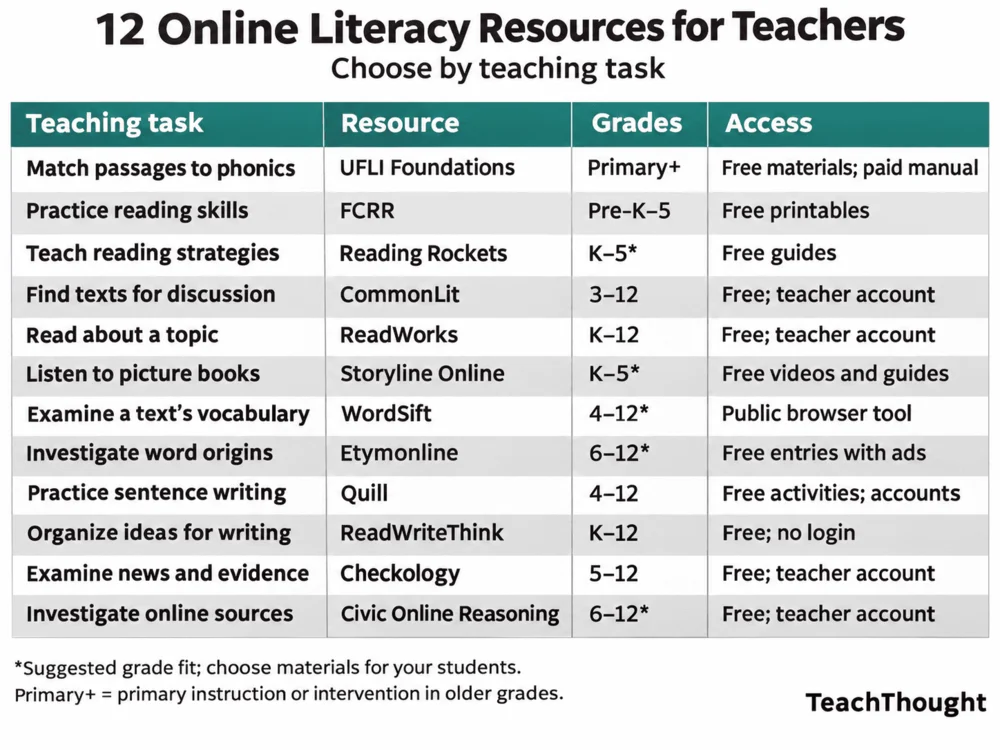
In an era defined by an overwhelming abundance of digital information, educators face a profound paradox: while the internet provides boundless educational content, the sheer volume of available resources often hinders effective lesson planning. Contemporary teachers are tasked not merely with locating reading materials, but with curating high-quality, targeted assets that foster genuine literacy, phonics mastery, vocabulary acquisition, and critical media evaluation. As digital platforms continue to proliferate, educators increasingly demand a balance between screen-based tools and structured, physical or low-friction resources that prevent cognitive overload and promote deep reading comprehension.
To address these challenges, schools and curriculum developers have introduced a wide array of curated platforms and physical intervention toolkits. These resources are designed to streamline instruction across primary, middle, and high school levels, ensuring that students develop robust decoding skills, advanced comprehension strategies, and the rigorous media literacy required to navigate contemporary digital ecosystems.
The Modern Literacy Landscape and the Push for Curation
The shift toward a heavily digital educational environment has fundamentally transformed how reading is taught, assessed, and practiced. Over the past decade, classrooms have rapidly integrated tablets, laptops, and web-based reading management systems. However, education experts note that this digital transition has introduced significant friction. Teachers often spend hours sorting through unvetted web pages, repetitive worksheets, and misaligned digital exercises that fail to match specific pedagogical frameworks, such as the Science of Reading.
Concurrently, there has been a notable resurgence in demand for targeted, offline, or hybrid instructional materials. Physical resources, hands-on partner activities, and decodable texts that align directly with explicit phonics instruction have re-emerged as essential components of effective reading intervention. By being more selective with online tools—utilizing digital environments only when they offer distinct interactive or accessibility advantages—educators can reclaim valuable instructional time and focus on evidence-based literacy practices.
Foundational Reading, Phonics, and Early Intervention
Developing strong foundational skills remains the primary objective for primary grade educators, as well as for teachers providing reading interventions to older students who struggle with decoding and word recognition.
UFLI Foundations Toolbox
Developed to support systematic phonics instruction, the University of Florida Literacy Institute (UFLI) Foundations Toolbox provides educators with decodable passages precisely matched to specific phonics patterns. In addition to reading passages, the toolbox includes lesson slides, home-practice sheets, and games designed to reinforce spelling patterns. While the comprehensive lesson manuals are sold separately, the companion downloads are freely accessible, making this an invaluable asset for schools implementing structured literacy programs.
FCRR Student Center Activities
The Florida Center for Reading Research (FCRR) offers an extensive collection of printable, hands-on activities for pre-kindergarten through fifth grade. Covering phonological awareness, phonics, fluency, vocabulary, and comprehension, these materials are structured for partner or independent student work. Although some preparation—such as cutting out activity cards—is required, the materials allow students to practice critical literacy skills without relying on digital device accounts.
Reading Rockets Classroom Strategy Library
For educators seeking evidence-based methodologies, the Reading Rockets Classroom Strategy Library provides comprehensive guides for teaching specific reading and writing strategies. Each entry includes detailed instructional steps, classroom examples, and research references, often supplemented by instructional videos and downloadable handouts that guide teachers through modeling and guided practice.
Enhancing Comprehension and Textual Analysis
Once foundational decoding skills are established, instruction shifts toward close reading, critical analysis, and cross-textual evaluation. Secondary and elementary educators alike rely on structured text libraries to engage students in rigorous literary and informational analysis.
CommonLit Text Library and ReadWorks
The CommonLit Text Library provides a vast, free catalog of short literary and informational texts tailored for grades 3 through 12. Designed for close reading and evidence-based discussion, CommonLit allows teachers to pair texts addressing common themes from diverse perspectives. Similarly, ReadWorks offers robust topical reading passages equipped with integrated question sets and optional audio support. Both platforms offer flexible deployment options, enabling teachers to assign materials digitally via educator accounts or distribute printed copies for offline reading.
Storyline Online
Targeting younger learners in grades K through 5, Storyline Online offers a unique multimedia approach to reading comprehension through recorded picture-book read-alouds. Sponsored by the SAG-AFTRA Foundation, the platform features prominent actors reading classic and contemporary children’s literature, accompanied by downloadable educator activity guides. While read-alouds are instrumental in building listening comprehension and vocabulary, literacy specialists emphasize that listening to recorded texts must be complemented by independent reading practice to ensure true decoding proficiency.
Vocabulary Acquisition and Etymological Investigation
Advanced literacy depends heavily on explicit vocabulary instruction and an understanding of word structures, morphemes, and etymologies.
WordSift and the Online Etymology Dictionary
WordSift serves as a dynamic web-based tool designed to help educators analyze the vocabulary load of upcoming texts. By pasting a passage into the browser interface, teachers can identify key terms, examine their contextual usage, and select appropriate vocabulary for pre-teaching. To deepen morphological understanding, the Online Etymology Dictionary allows students in upper grades to investigate the historical origins and evolution of words. Tracing a word’s etymology helps students decode unfamiliar technical or academic vocabulary by recognizing shared roots and historical shifts in meaning.
Writing, Revision, and Idea Organization
Writing instruction is an intrinsic component of comprehensive literacy curricula, requiring students to transition from conceptual planning to precise sentence construction and revision.
Quill and ReadWriteThink Interactives
Quill provides targeted, digital practice modules focused on sentence construction, combination, and grammatical revision for grades 4 through 12. By breaking writing mechanics down into manageable digital exercises, Quill enables students to refine their sentence-level syntax. To support pre-writing and structural organization, ReadWriteThink offers a suite of free student interactives—including plot diagrams, story maps, and compare-and-contrast matrices—that allow learners to visually organize their thoughts before drafting formal essays.
Confronting the Misinformation Age: News and Civic Literacy
In the modern media ecosystem, literacy extends far beyond traditional reading and writing. Students must be equipped to evaluate the credibility of online sources, recognize sponsored content, and critically analyze news reports.
Checkology and Civic Online Reasoning
Provided by the News Literacy Project, Checkology engages students in interactive lessons designed to teach news literacy, distinguish between journalism and opinion, and evaluate factual claims. Complementing this, the Digital Inquiry Group’s Civic Online Reasoning (COR) curriculum trains students in essential digital verification techniques, such as "lateral reading"—the practice of leaving an unfamiliar web page to investigate who is behind a source and what other credible outlets report about its claims. These tools have become indispensable as educators strive to cultivate critical thinking and digital citizenship among middle and high school students.
Implications and Future Outlook
The integration of these diverse literacy and media resources reflects a broader pedagogical evolution. As educational standards adapt to the realities of a digital society, the emphasis has shifted from mere technology adoption to intentional, evidence-based curation. By combining structured phonics toolkits, rigorous text libraries, and advanced media literacy programs, educators are better equipped to address post-pandemic learning recovery and prepare students for complex informational landscapes.
Ultimately, the success of these resources depends on teacher expertise and thoughtful implementation. Whether utilizing physical task cards from the FCRR, analyzing word origins via etymological databases, or conducting lateral reading exercises through Civic Online Reasoning, modern classrooms benefit most when digital efficiency and traditional pedagogical rigor work in tandem.

