
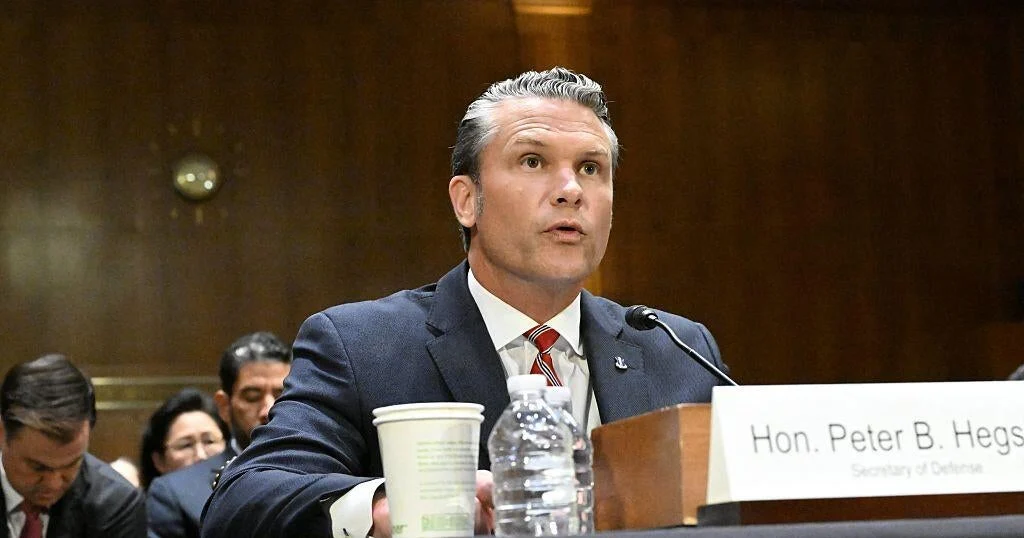
Washington, D.C. – Defense Secretary Pete Hegseth and Chairman of the Joint Chiefs of Staff Gen. Dan Caine appeared before the Senate Appropriations Committee on Tuesday, July 21, 2026, to present a stark assessment of the U.S.-Iran conflict’s financial toll, revealing that the war has already cost an estimated $37.5 billion. This figure, projected through the end of the fiscal year on September 30, underscores the escalating expenses as the Trump administration presses Congress for an additional $67 billion in supplemental funding directly tied to the conflict, alongside a monumental $1.5 trillion for the Pentagon’s base budget in the upcoming fiscal year. The hearing unfolded against a backdrop of intensified hostilities, renewed Iranian aggression in the Strait of Hormuz, and mounting casualties among U.S. service members, fueling fierce criticism from Senate Democrats regarding the administration’s strategic approach and the burgeoning financial burden on American taxpayers.
Mounting Costs and Urgent Funding Appeals
Secretary Hegseth’s testimony provided the most current public accounting of the conflict’s financial impact. The $37.5 billion estimate marks a significant increase from the approximately $29 billion reported by a Pentagon official in mid-May, reflecting the rapid pace of operations and the substantial resource commitment required in recent weeks. While the precise breakdown of the $37.5 billion remains somewhat opaque, officials indicated it encompasses a wide range of expenditures, including the deployment of additional forces, advanced munitions and missile defense systems, intelligence gathering operations, logistical support, and potentially the initial costs associated with repairing damage to U.S. bases subjected to Iranian attacks.
The administration’s request for a $67 billion supplemental appropriation is explicitly designed to address the immediate needs of the Iran conflict and facilitate the replenishment of critical military supplies that have been heavily utilized. This request is part of a broader package previously presented to Congress last month, which initially sought $88 billion. That earlier proposal allocated substantial sums, including $21 billion for munitions, $17.3 billion for operational costs, and $12.1 billion for classified programs. Beyond the direct war costs, the larger supplemental package also included funds for combating an Ebola outbreak in African countries and $11.1 billion for agricultural aid, a component for which Agriculture Secretary Brooke Rollins was also slated to testify on Tuesday, highlighting the diverse pressures on the national budget.
Concurrently, the Pentagon is seeking an unprecedented $1.5 trillion for its fiscal year 2027 budget. This colossal sum, combined with the supplemental requests, is championed by Hegseth and Caine as indispensable for maintaining U.S. military superiority globally and responding to an increasingly complex threat landscape. In his opening statement, Secretary Hegseth articulated the administration’s philosophy: "Rest assured that every dollar appropriated to the Department of War will be focused on building the lethality of our joint force, and reinforcing peace through strength." He emphasized that the supplemental request, particularly the $21 billion earmarked for readiness, would be crucial for replacing "much of the equipment utilized during recent operations," without directly naming Iran in his initial remarks.
Escalation and Casualties: A War Reignited
The Senate hearing occurred amid a significant resurgence of hostilities that had brought a precarious ceasefire between the U.S. and Iran to an abrupt and violent end. The "war," which officially began in February 2026 following a series of escalating provocations and retaliatory strikes, had seen periods of intense combat interspersed with fragile truces. The recent flare-up, marked by nightly exchanges of fire for over a week, signaled a dangerous new phase in the conflict.
A critical turning point came with Iran’s direct targeting of several commercial vessels in the strategically vital Strait of Hormuz. This act of aggression not only threatened global energy supplies, given that a significant portion of the world’s seaborne oil passes through this narrow choke point, but also served as a clear repudiation of any existing de-escalation efforts. The U.S. responded with a robust series of retaliatory strikes, with Monday marking the tenth consecutive night of American military action against Iranian infrastructure.
The human cost of this renewed aggression was starkly evident. Just days before the hearing, on Friday, at least two U.S. soldiers were killed in an Iranian attack. Adding to the grim tally, another service member perished in Iraq during a controlled explosion operation aimed at destroying an Iranian drone. These casualties brought the total number of U.S. service members killed since the war’s commencement in February to 17. Furthermore, officials confirmed to CBS News that nearly 100 American service members had sustained injuries in multiple Iranian strikes on U.S. bases across the Middle East throughout the month.
Committee Chair Republican Sen. Susan Collins of Maine opened the hearing by acknowledging the sacrifices of these service members, stating they had "made the ultimate sacrifice while serving our nation." General Caine also began his testimony by honoring the fallen, framing the administration’s funding request as an urgent necessity to counter global threats that extend beyond the immediate Iranian conflict, encompassing challenges in Europe and Asia. "I’ve come to you today to request the necessary funds while in the window of opportunity, while time is still on our side," Caine implored the senators, underscoring the perceived urgency of the situation.
Congressional Divide: Democrats Challenge Strategy, Republicans Express Reservations
The escalating costs and casualties have intensified the already partisan debate on Capitol Hill regarding the U.S. strategy in Iran. Senate Democrats, in particular, voiced vehement criticism, questioning the efficacy of the administration’s approach and the sustainability of its financial demands.
Sen. Patty Murray of Washington, the ranking Democrat on the committee, used her opening statement to highlight the economic burden on American families, expressing grave concerns that the conflict was "spiraling out of control again." She issued a firm warning to the administration: "My colleagues and I cannot and will not support rubber-stamping a request to bankroll this war and whatever other misadventures Trump wants to get us into next. The American people want to see a quick and strategic end to this war, not $70 billion of their tax dollars sent to keep it going."
Under questioning from Illinois Democratic Sen. Richard Durbin, Hegseth conceded that some of Iran’s ballistic missiles had evaded U.S. bombing campaigns, primarily due to their storage in deep underground facilities. Despite this, the Secretary maintained that Iran’s conventional military capabilities had been severely degraded. "The Iranian defense industrial base is effectively gone, but they do have underground facilities because they’re the world’s leading state sponsor of terrorism, and they’ve spent 47 years trying to hide their missiles under mountains, just like their nuclear capabilities," Hegseth asserted, seeking to justify the ongoing need for military action and funding.
The hearing reached a boiling point during a tense exchange between Secretary Hegseth and Democratic Sen. Gary Peters of Michigan. Peters characterized the administration’s Iran strategy as a "failure," a remark Hegseth vehemently denounced as "reckless," "irresponsible," and a "smear" against service members. "Shame on you and others who call this a quagmire and a failure, and then you want to turn around and say you support the warfighter. Either you do or you don’t," Hegseth retorted, raising his voice. An equally impassioned Peters shot back, "You, sir, are the failure. Not the men and women who are on that frontline… If there’s a lack of a winning strategy, they’re in harm’s way, their leaders have failed them." This heated interaction underscored the profound chasm between the administration and its critics regarding the war’s direction and ultimate objectives.
Even within Republican ranks, a degree of skepticism has emerged concerning the war’s conduct and the extent of presidential war powers. Notably, Sen. Collins, the committee chair, and Sen. Lisa Murkowski of Alaska, who also sits on the committee, have previously crossed the aisle to support resolutions aimed at reining in Mr. Trump’s authority in Iran. Collins, while acknowledging the "divergent views on this committee about the decision to use military force against Iran," emphasized the pragmatic necessity of funding. "But irrespective of our differing views about the military operations, the fact remains that there are must-pay bills and urgent requirements facing the department that affect the ability of our troops to be well-trained, and more broadly, of the U.S. military to deter and defend against potential aggressors worldwide," Collins stated, adding, "We should not undermine the readiness of our service members for any engagement, or refuse to rebuild critical capabilities."
The Budgetary Gauntlet: Reconciliation and Unspent Funds
The path for the administration’s funding requests through Congress appears fraught with challenges, particularly in the Senate. House Republicans have been attempting to advance the Pentagon’s funding needs through the budget reconciliation process. This legislative maneuver allows measures with direct budgetary implications to pass with a simple majority, bypassing the typical 60-vote threshold required to overcome a filibuster in the Senate.
However, several Democrats at the hearing highlighted a significant sticking point: the Pentagon reportedly has not spent approximately $75 billion from a previous reconciliation package. They questioned why the department was requesting more funds while previous allocations remained unutilized. Hegseth countered that 95% of that reconciliation money would be allocated by the end of September, suggesting a pipeline of spending rather than an absence of need.
The prospects for a third reconciliation bill in the Senate, which would be necessary to push through the latest funding requests without Democratic support, remain uncertain. Key Republican senators, including Collins and Murkowski, have publicly expressed doubts. Senate Majority Leader John Thune (R-SD) has also remained noncommittal, indicating the significant hurdles ahead. Thune noted last week that reconciliation "is very different in the House than it is in the Senate," emphasizing that GOP members in the upper chamber would demand input. He cited the overall figures for the Defense and Agriculture departments, the necessity of identifying possible offsets for the funds, and the Senate’s stringent restrictions on what can be included in a reconciliation package as potential obstacles. "I’ve said all along… that it’s an option," Thune concluded, "But it’s not, certainly, the only option." His remarks underscore the lack of a clear, unified Republican strategy for securing the desired funding.
Broader Implications: Regional Stability, Economic Strain, and U.S. Stance
The ongoing U.S.-Iran conflict carries profound implications that extend far beyond the immediate battlefield and the halls of Congress. Regionally, the conflict has destabilized an already volatile Middle East, exacerbating existing tensions and potentially drawing in other state and non-state actors. The Iranian attacks on commercial shipping in the Strait of Hormuz represent a direct threat to global economic stability, potentially disrupting oil supplies and driving up energy prices worldwide, with downstream effects on inflation and consumer costs in the U.S. and beyond. The international community watches anxiously, concerned about the potential for wider regional conflagration and the impact on global trade routes.
Domestically, the war’s spiraling costs pose a substantial burden on American taxpayers, raising questions about fiscal responsibility and the allocation of national resources. Critics argue that diverting tens of billions of dollars to an open-ended conflict could detract from vital domestic investments in infrastructure, healthcare, education, or other pressing societal needs. The deepening political divide in Washington over the war’s strategy and funding also risks further polarizing American politics, potentially impacting the upcoming electoral cycles and the administration’s broader legislative agenda.
Furthermore, the conflict challenges the long-term posture of U.S. foreign policy. It tests the limits of military intervention, the effectiveness of "peace through strength" doctrines, and the ability of the U.S. to achieve stated objectives against an adversary with asymmetric capabilities and deeply entrenched assets. The administration’s argument that Iran’s "defense industrial base is effectively gone" is tempered by the acknowledgment of formidable underground facilities, suggesting a protracted and complex struggle ahead. The debate on Capitol Hill, therefore, is not merely about appropriations; it is a fundamental discussion about the nation’s strategic priorities, its role in global security, and the ultimate price of its engagements abroad. As the conflict rages and the financial demands mount, the nation grapples with the difficult choices that will shape its future for years to come.

