
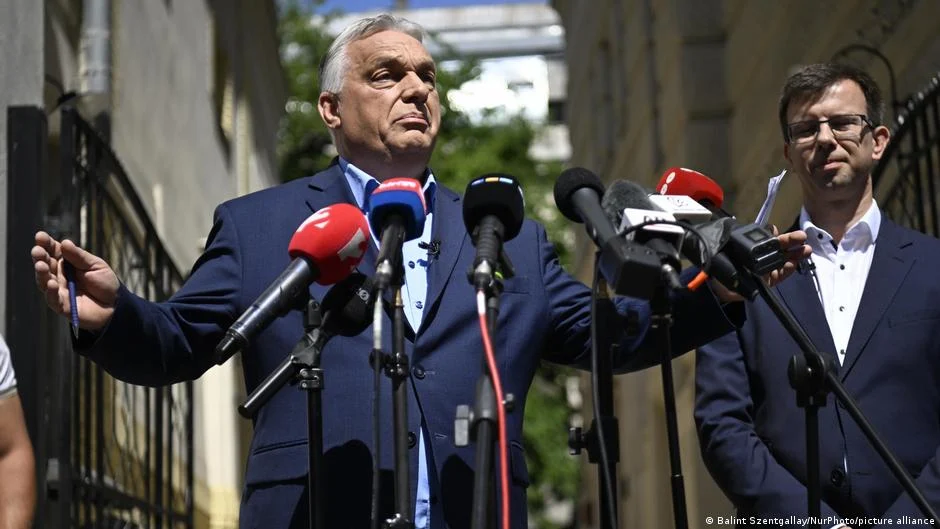
Former Hungarian Prime Minister Viktor Orban, leader of the opposition Fidesz party, launched a scathing attack on prosecutors and the newly installed government on Wednesday, alleging a campaign of "sham investigations" designed to cripple his party. His accusations followed a dramatic raid a day earlier by investigators on Fidesz’s Budapest headquarters, where computer equipment was seized as part of an ongoing corruption probe into the National Culture Fund. This escalation marks a significant turning point in Hungarian politics, coming barely three months after Orban’s unexpected landslide defeat in April’s general elections to his conservative rival, Peter Magyar, himself a former Fidesz insider turned fierce critic.
The End of an Era: Magyar’s Ascendancy and Orban’s Defeat
For 16 years, Viktor Orban dominated Hungarian politics, steering the nation with a conservative-nationalist agenda that often put him at odds with the European Union but cemented his control domestically. His Fidesz party enjoyed successive supermajorities, allowing him to reshape the country’s constitution, judiciary, and media landscape. This era, characterized by what critics termed "illiberal democracy," appeared unassailable until the sudden emergence of Peter Magyar in early 2024. Magyar, a lawyer and former diplomat married to a senior Fidesz minister, broke ranks with the party, citing pervasive corruption and a system he described as a "mafia state." His candid critiques resonated deeply with a disillusioned electorate, rapidly transforming him into the most potent opposition figure Hungary had seen in years.
The April 12 general elections delivered a seismic shock. Magyar’s newly formed Tisza (Respect and Freedom) party, campaigning on an anti-corruption platform and promising a return to democratic norms, secured a stunning 55% of the vote. This contrasted sharply with Fidesz’s nearly 37%, a historic low for Orban. Due to Hungary’s first-past-the-post electoral system, Tisza translated this majority into 141 of the 199 parliamentary seats, replicating the two-thirds supermajority that Orban had often wielded. Fidesz, by comparison, was relegated to a mere 52 seats. The result was widely celebrated across Europe, where Orban’s government had long been a source of rule-of-law concerns, though it reportedly drew disappointment from the Trump White House, which had cultivated closer ties with the Hungarian leader.
A Swift and Sweeping Reform Agenda
Since taking office on May 9, Prime Minister Peter Magyar has moved with unprecedented speed and determination to dismantle what he alleges is a deeply entrenched system of corruption and patronage established during the Orban era. His administration’s actions have been swift and multifaceted, aimed at reforming state institutions and signaling a clear break from the past.
One of Magyar’s first targets was the state media. The national public broadcaster M1, widely criticized under Orban for operating as a Fidesz mouthpiece, was briefly taken off air this month. Its return to broadcast was marked by a full-screen apology, signaling the commencement of a comprehensive reform process aimed at restoring journalistic independence and impartiality. This move was hailed by media freedom advocates as a crucial step towards de-politicizing public information.
Magyar also wasted no time in addressing key political appointments deemed loyal to Orban. Through a constitutional amendment passed with Tisza’s supermajority, the mandates of both President Tamas Sulyok and Constitutional Court President Peter Polt were terminated. Both officials were widely considered Orban allies, and their removal underscores Magyar’s commitment to swiftly replace figures seen as integral to the previous administration’s power structure. The new government even floated the name of celebrated chess grandmaster Judit Polgar for the largely ceremonial presidential role, though she later indicated she was flattered but not interested. Further demonstrating his intent, Prosecutor General Gabor Balint Nagy, appointed only last year, agreed to step down on Tuesday, after Magyar publicly labeled him an "Orban puppet."
Beyond personnel changes, Tisza has introduced significant legislative reforms. A landmark proposal includes term limits of 12 years for all lawmakers, including the prime minister and government ministers. This measure, if enacted, would effectively exclude many long-serving Fidesz veterans, including Orban himself, from future elections, profoundly reshaping the political landscape for decades to come.
Magyar has also taken symbolic steps to underscore his anti-corruption message. He opened former government facilities to the public, showcasing what he described as the opulent lifestyle of the previous administration’s inner circle, presenting it as tangible evidence of systemic corruption. On the international front, his government has signaled a clear intent to mend strained ties with Brussels, moving to address the rule-of-law concerns that led to the freezing of significant EU funds under Orban. Concurrently, Hungary under Magyar has begun to free up assistance for Ukraine, reversing Orban’s often obstructionist stance on the issue.
The National Culture Fund Probe and Orban’s "Resistance"
The latest development in this political maelstrom occurred on Tuesday, July 21, 2026, when prosecutors raided the Fidesz party headquarters in Budapest. Investigators seized computer servers and other materials as part of a corruption probe into the National Culture Fund (NKA). This state-run institution is alleged to have functioned as a payment center for Orban’s inner circle and a shadow fund for Fidesz election campaigns, channeling public money to politically connected individuals and entities.
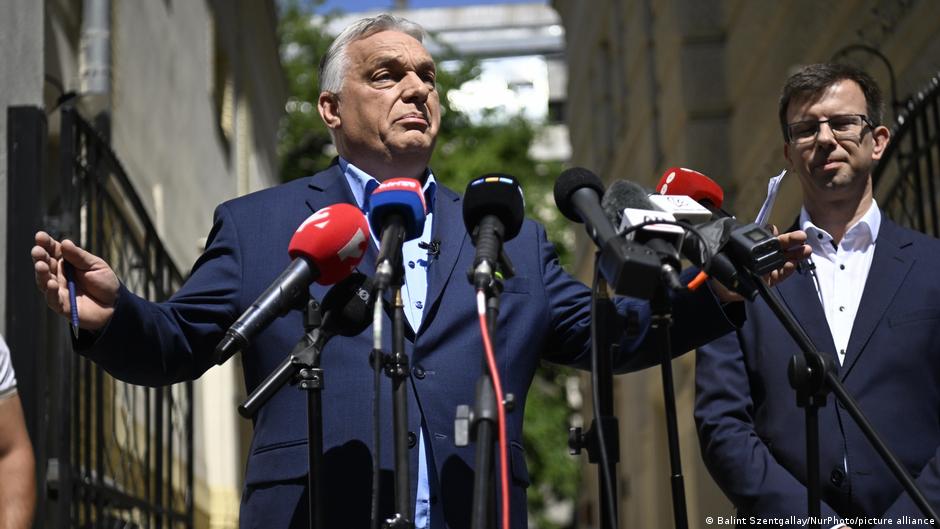
Viktor Orban’s response was swift and defiant. Late on Tuesday night, he issued a "statement of resistance" on Facebook, followed by a combative press conference outside the Fidesz HQ on Wednesday. These were his strongest political statements since transitioning back to opposition leadership in early May. Orban vehemently denied any wrongdoing related to the NKA, dismissing the investigation as a mere "pretext" for a politically motivated attack.
"The National Culture Fund issue was just a pretext for this [search of the party headquarters]," Orban asserted. He characterized Magyar’s government as "tyrannical," claiming that Hungary had "ceased to be a democratic state" after the new administration used its parliamentary supermajority to remove the President and the head of the Constitutional Court. Orban vowed that he and Fidesz would "employ all peaceful means" to oppose what he termed an "illegitimate" political system.
During his press conference, Orban elaborated on his suspicions, stating, "By yesterday, I had come to realize what this was all about. What happened was that this served as a pretext to seize Fidesz’s servers… This is a politically motivated legal proceeding designed to render Fidesz — which has clearly survived even this heavy political defeat and is growing stronger — legally unviable." He drew parallels to the late 1980s, the twilight years of Hungary’s Communist dictatorship, lamenting a perceived erosion of democracy and the rule of law.

Fidesz in Freefall? Political Fallout and Future Implications
The raid and Orban’s strong reaction underscore the escalating political tensions in Hungary. Beyond the legal challenges, Fidesz appears to be grappling with significant internal and external pressures. Surveys conducted since the election suggest a dramatic decline in public support for Orban’s party. A recent poll by Median, for instance, indicated that Tisza now enjoys approximately 60% support, while Fidesz’s backing has plummeted to a mere 18%. This represents a stark reversal of fortunes and suggests that Magyar’s anti-corruption crusade is resonating with a broad segment of the population.
The political shifts have also led to several high-profile departures from Fidesz’s ranks. Last week, parliamentary caucus leader Gergely Gulyas stepped down, a notable move given his longstanding prominence within the party. Similarly, Peter Szijjarto, Orban’s long-serving Foreign Minister, left politics to take up an executive position with Chinese electric carmaker BYD. While these departures may be framed as personal career decisions, they contribute to an impression of Fidesz losing key figures and struggling to adapt to its new role in opposition.
The term limits introduced by Tisza, if they withstand legal challenges, represent an existential threat to Fidesz’s veteran leadership. Orban himself, along with many of his long-time allies, would be ineligible to stand in future elections, potentially forcing a complete generational overhaul of the party. This move, combined with the ongoing corruption investigations, creates an uncertain future for the party that dominated Hungarian politics for so long.
International Scrutiny and Hungary’s Path Forward
The developments in Hungary are being closely watched by the international community, particularly the European Union. Orban’s long tenure was marked by frequent clashes with Brussels over rule-of-law issues, judicial independence, and media freedom. Magyar’s victory and his subsequent reforms have been met with cautious optimism in EU circles, hopeful for a recalibration of Hungary’s democratic trajectory and its relationship with the bloc. The speed and scope of his changes, however, also raise questions about due process and the potential for a new government to overreach, even in the pursuit of legitimate reforms.
The current corruption probes, including the one targeting the National Culture Fund, are seen as crucial tests of Hungary’s commitment to accountability and the rule of law. Should these investigations uncover substantial evidence of malfeasance and lead to prosecutions, it would significantly bolster Magyar’s narrative of systemic corruption under Orban. Conversely, any perceived irregularities or politically motivated interference in these investigations could undermine the credibility of the new government and its reform agenda.
As Hungary navigates this turbulent period, the clash between Orban’s defiant "resistance" and Magyar’s relentless pursuit of systemic change will define the nation’s political future. The coming months will determine whether Magyar can solidify his reforms, restore trust in state institutions, and steer Hungary onto a new democratic path, or if Orban, despite his electoral defeat, can rally his base and mount a formidable opposition to what he perceives as a new form of tyranny. The stakes are high, not just for Hungary, but for the broader democratic landscape of Central Europe.

