
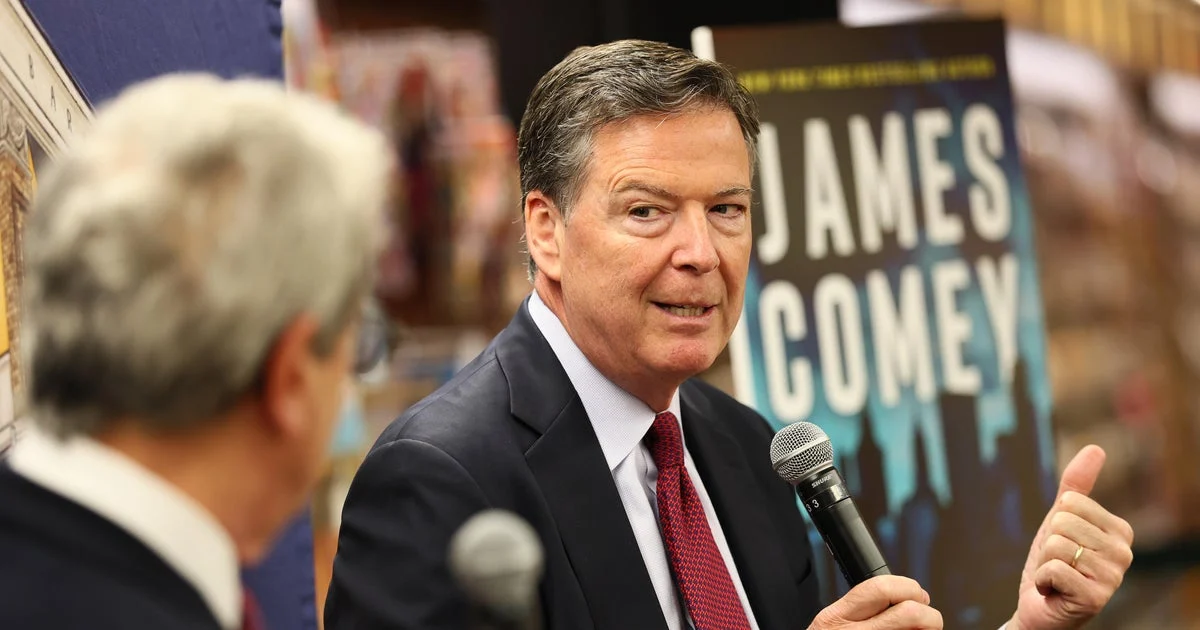
The United States Department of Justice has initiated formal legal steps to bring criminal charges against former Federal Bureau of Investigation Director James Comey, filing a criminal information alleging violations of the Espionage Act. The court records, which were unsealed by a federal judge following an intense behind-the-scenes legal battle, mark the third distinct attempt by federal prosecutors to secure a criminal indictment against Comey, a prominent and frequently targeted critic of President Donald Trump.
According to the newly public court documents, prosecutors are seeking to charge Comey with two felony counts under the Espionage Act for allegedly transmitting national defense information to unauthorized individuals. Specifically, the Justice Department alleges that in October 2016, Comey directed subordinate officials to leak sensitive government information to a reporter at The New York Times in an effort to correct media reporting stemming from a competing news outlet, Reuters.
Despite the gravity of the allegations, Comey has not yet been formally indicted by a grand jury or arrested via a criminal complaint. Instead, prosecutors utilized a criminal information filing—a rare procedural maneuver in felony cases—designed primarily to pause or "toll" the 10-year statute of limitations before it expired.
Legal Defense and Immediate Reactions
Comey’s defense team, led by veteran attorney Patrick Fitzgerald, has forcefully rejected the allegations, maintaining that his client is entirely innocent of any wrongdoing. Fitzgerald underscored that investigators scrutinized the exact same set of facts twice during the first Trump administration, ultimately concluding that no criminal charges were warranted against anyone involved.
In a video statement addressing the new filing, Comey did not mince words regarding the persistent legal scrutiny he has faced from the executive branch. "Well, they’re back again," Comey said, referencing two prior, separate legal actions brought against him by the Justice Department. Those prior efforts include a dismissed indictment alleging that he lied to Congress, as well as a still-pending indictment stemming from an Instagram social media post featuring seashells arranged to spell out "86 47"—a case prosecutors argue constituted a veiled threat against the president.
"It would almost be funny if it weren’t such an appalling abuse of the Department of Justice, one that we cannot become numb to," Comey remarked in his public statement. "Nothing’s changed with me. I’m still innocent, I’m still not afraid of these people and I still believe in the independent federal judiciary."
The Justice Department defended its procedural approach in a public statement released on social media, asserting that "filing a criminal information to toll the statute of limitations is a widely recognized practice in federal court and has been approved by multiple Circuit Courts of Appeals."
A Highly Unusual Procedural Maneuver
The decision by federal prosecutors to bypass a traditional grand jury and utilize a criminal information solely to stop the clock on the statute of limitations has drawn widespread skepticism and astonishment from legal experts, former prosecutors, and defense attorneys.
Typically, a criminal information is filed when a defendant voluntarily waives their constitutional right to a grand jury indictment, almost always as part of a negotiated plea agreement. Legal professionals told reporters that they had never before encountered the use of an information as a tactical tool to preserve felony charges against an unwilling target.
Michael Bromwich, a former Justice Department inspector general who now practices as a defense attorney, sharply criticized the government’s strategy. "I have never heard of proceeding by information to toll the statute of limitations. Most prosecutors you have ever dealt with have never heard of that," Bromwich said. "This seems to be a way to do an end-run around the statute of limitations and keep a case alive that deserved to die 9 years ago. This is just absolutely bizarro world stuff."
Behind-the-Scenes Legal Warfare
The conflict between Comey and federal prosecutors has been brewing under strict confidentiality for weeks. The charging documents were initially filed under seal in early October. However, U.S. District Judge Trevor McFadden ordered the docket unsealed following an aggressive legal push by Comey’s defense team.
Throughout October, attorneys for both sides engaged in intense, confidential negotiations and emergency court filings. On October 9, Comey’s legal team filed a motion arguing that the government had submitted a "faulty information under seal" improperly attempting to extend a 10-year statute of limitations that was set to expire that very month.
Furthermore, Comey’s lawyers expressed grave concern over potential law enforcement overreach during the Columbus Day holiday weekend. In court papers, they wrote that Comey had reason to believe federal law enforcement agents were actively surveilling his home and tracking his travel to visit family members. His legal team warned the court that the government appeared poised to execute an after-hours arrest designed to keep the former FBI director detained over a holiday weekend.
During an emergency hearing, prosecutors agreed to temporarily hold off on seeking an immediate arrest warrant or grand jury indictment for 30 days. The Justice Department subsequently argued that Comey’s attempts to dismiss the filing were premature, maintaining that defendants must submit to the court’s jurisdiction before launching pre-trial challenges.
The criminal information itself bore notable signatures, including acting Deputy Attorney General Trent McCotter, Principal Associate Deputy Attorney General Aakash Singh, and several special assistant U.S. attorneys brought in from outside the standard Washington, D.C., prosecution pool—details that legal observers say highlight the direct involvement of high-ranking political leadership at DOJ headquarters.
Historical Context: The 2016 Leaks Investigation
The genesis of the current legal battle dates back nearly a decade to October 2016, during the final, tumultuous weeks of the presidential election cycle. On October 5, 2016, The New York Times published an article titled, "Yahoo Said to Have Aided U.S. Email Surveillance By Adapting Spam Filter," which relied on information provided by unnamed government sources.
According to current court filings, the Justice Department now alleges that Comey directed subordinates to leak this information to the press to correct public reporting published the day prior by Reuters.
This specific leak has already been the subject of two extensive internal federal investigations. In 2017, John Durham—then a U.S. Attorney in Connecticut who was later appointed as a special counsel by Attorney General William Barr—examined the matter. According to Comey’s defense filings, Durham’s investigation identified James Baker, then the FBI general counsel, as one of the sources for the article. Baker reportedly informed investigators that he spoke with the reporter under direct instructions from Comey’s chief of staff, believing he was acting on Comey’s explicit orders. Ultimately, Durham declined to recommend criminal charges against Baker or any other official.
The matter was investigated a second time under an inquiry code-named "Tropic Vortex" by the U.S. Attorney’s Office for the District of Columbia. That probe was formally closed in February 2020, once again resulting in zero criminal charges.
The Path Forward
U.S. District Judge Trevor McFadden ultimately ordered the case unsealed on Monday, writing in his memorandum that "criminal charges against a former FBI director for his conduct while in office are of significant public interest." The judge noted that because Comey had voluntarily offered to self-surrender if necessary, maintaining the secrecy of the docket was no longer justifiable for law enforcement purposes.
Judge McFadden has not yet ruled on the underlying legal merits of the case, leaving open questions regarding whether a criminal information can legally serve to toll a statute of limitations for a felony Espionage Act charge without a grand jury’s involvement. As the 30-day standstill agreement approaches its expiration, the case stands as an unprecedented clash between a former top law enforcement official and the department he once led, carrying profound implications for federal prosecutorial standards and the separation of powers.

