
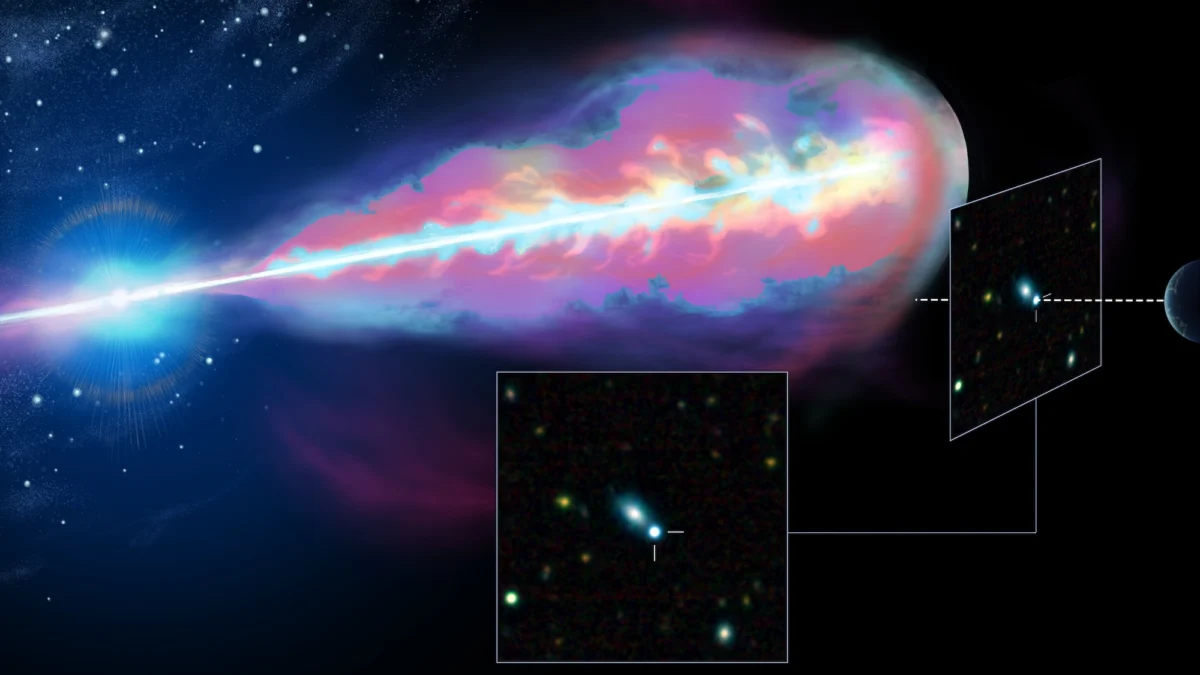
The universe periodically unveils cataclysmic events that challenge the fundamental understanding of stellar evolution, and the recent analysis of GRB 260310A stands as a primary example of this phenomenon. Detected on March 10, 2026, by NASA’s Fermi Gamma-ray Space Telescope, this event was initially categorized as an unremarkable, low-energy gamma-ray burst (GRB). However, subsequent multi-wavelength observations revealed that the event was, in fact, one of the most luminous cosmic displays recorded in the last two decades. By channeling the equivalent of a billion years of solar energy through a beam as narrow as a pencil, this stellar collapse provided astronomers with an unprecedented "side-angle" view of how massive stars end their lives.
The Anatomy of a Cosmic Catastrophe
Gamma-ray bursts are the most powerful explosions in the known universe, typically occurring when a massive star exhausts its nuclear fuel and collapses into a black hole or a neutron star. During this gravitational collapse, the star’s core ejects ultra-relativistic jets of plasma that pierce through its outer layers, traveling at speeds approaching the velocity of light. As these jets slam into the surrounding interstellar medium, they create a shockwave that produces a multi-spectrum afterglow, emitting energy across the electromagnetic range from high-energy X-rays to radio waves.
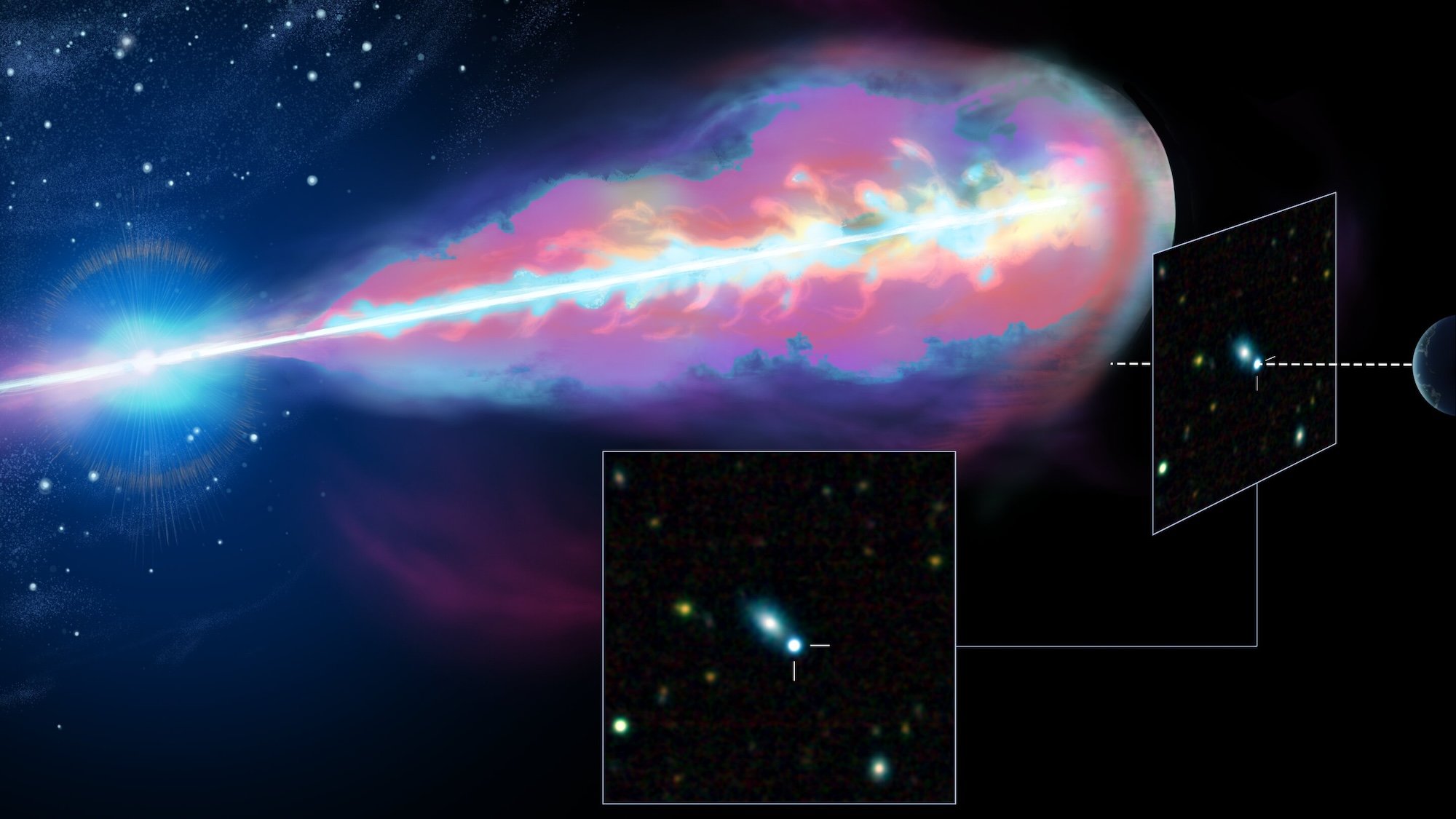
While standard models assume a uniform jet structure, GRB 260310A suggests a much more complex internal geometry. Researchers now propose that the jet was not a monolithic beam but rather a sophisticated structure featuring a narrow, highly energetic core wrapped in a broader, lower-velocity "sheath" or outflow. The key to the confusion surrounding this event lay in the observer’s perspective: because the jet was pointed away from Earth, the early readings captured by space-based instruments only detected the "wings" of the jet—the slower, less energetic exterior—rather than the intense, focused core.
A Chronology of Discovery
The scientific investigation into GRB 260310A followed a rapidly evolving timeline that kept the international astrophysical community on high alert throughout the spring of 2026.
March 10, 2026: NASA’s Fermi Gamma-ray Space Telescope triggered an alert for GRB 260310A. Initial data showed a short-lived flash lasting less than 60 seconds. The burst appeared statistically weak, leading to initial skepticism about its potential for long-term study.
March 10–12, 2026: Within hours of the initial detection, ground-based observatories noted a significant discrepancy. While the gamma-ray signature remained modest, the optical afterglow began to brighten unexpectedly, eventually outshining the host galaxy. This prompted a surge in observational requests across the global network of telescope arrays.
Late March to April 2026: Astronomers, including the team led by Roberto Ricci at Italy’s National Institute of Astrophysics, conducted deep-space imaging. The Large Binocular Telescope (LBT) provided critical imagery of the event, confirming the presence of an incredibly bright optical afterglow adjacent to a distant host galaxy.
May 2026: Follow-up observations in the X-ray spectrum revealed a second, unexpected brightening. This phase lasted for several months, contradicting the standard decay curves associated with typical GRBs. It was during this period that researchers began to formulate the hypothesis of a dual-structure jet.
Data Analysis and Statistical Significance
The data gathered from GRB 260310A has placed it in an elite tier of cosmic events. Despite its weak initial gamma-ray signature, the event’s visible-light brightness placed it within the top one percent of all recorded GRB afterglows. Its radio-frequency emission was similarly anomalous, landing in the top five percent of all recorded bursts.
For researchers like Yu-Han Yang, these figures were initially confusing. "At first, I thought another X-ray source was contaminating our observations," Yang noted in the official study published in The Astrophysical Journal Letters. "But the brightening really came from the afterglow." The team’s rigorous data scrubbing eventually confirmed that the light curves were not artifacts of sensor noise or external interference, but rather a reflection of the jet’s internal dynamics as it decelerated and shifted its relative position toward Earth’s line of sight.
The "Side-Angle" Perspective
In traditional GRB modeling, scientists rely on "on-axis" observations, where the jet is pointed directly toward Earth. This is analogous to looking directly into a high-powered flashlight; the light is intense, but the observer sees little of the beam’s internal structure or the composition of its outer edges.
GRB 260310A provided a unique "off-axis" vantage point. As the jet’s forward momentum slowed over time, its relativistic beaming effect—which normally keeps the light concentrated in a narrow cone—began to broaden. This widening allowed terrestrial telescopes to effectively "scan" the jet from its outer, slower wings toward its inner, ultra-fast core. This transition explains why the X-ray emissions remained observable and even intensified weeks after the initial explosion. It was, in effect, a rare opportunity to map the internal architecture of a stellar death.
Implications for Modern Astrophysics
The study of GRB 260310A carries significant weight for the future of time-domain astronomy. It highlights the potential limitations of current detection methods that prioritize the initial, high-energy gamma-ray "trigger." If astronomers only focus on the most intense, on-axis events, they risk missing a vast population of "hidden" jets that could be just as energetic but are currently oriented away from our instruments.
"We could explain individual features of this burst, but fitting them all into the same picture proved much harder," said Roberto Ricci. The complexity of the event underscores the necessity for multi-messenger astronomy, where radio, optical, and X-ray data are synthesized to create a holistic view of an event.
The scientific community is now looking toward the Vera Rubin Observatory—a facility designed to perform a 10-year survey of the sky—to identify similar "oddball" events. By monitoring the sky with greater sensitivity and frequency, researchers hope to determine if the structured jet model of GRB 260310A is a common feature of stellar collapse or a rare anomaly.
A New Chapter in Stellar Evolution
The implications of this discovery extend beyond the study of bursts themselves; they inform our understanding of how heavy elements are distributed in the universe. Massive star collapses are the primary engines for synthesizing elements heavier than iron, and the geometry of the jet dictates how these elements are ejected into the surrounding interstellar medium. If many GRBs possess this structured, core-sheath design, it may change current models of galactic chemical evolution.
As the data from the 2026 campaign continues to be analyzed, GRB 260310A stands as a masterclass in the value of persistent observation. It serves as a reminder that in the vast, dark canvas of space, the most unassuming flickers of light can sometimes hold the secrets to the most energetic processes in the universe. The "pencil beam" of 260310A has effectively broadened the horizons of high-energy physics, ensuring that future surveys will look at "weak" bursts with newfound curiosity rather than immediate dismissal.

