
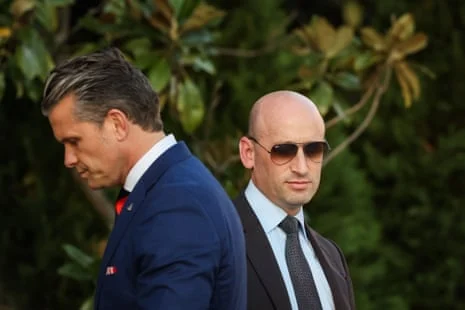
The political landscape of the United States has entered a turbulent new phase following a historic "blue wave" in the midterm elections that dealt a severe blow to Donald Trump’s administration. In the immediate aftermath of the elections, which handed Democrats control of both chambers of Congress for the first time during either of Trump’s presidential terms, the White House announced a major staff shakeup. Susie Wiles, who served as chief of staff and managed Trump’s 2024 presidential campaign, has stepped down from her governmental role to transition into the president’s external political operations, including the MAGA Inc. super PAC. Stepping into the critical role of White House chief of staff is Stephen Miller, a long-serving adviser and the primary architect of the administration’s hardline immigration policies.
The appointment has triggered an immediate and ferocious backlash from congressional Democrats, independent watchdogs, and even some members of the Republican party. Critics argue that elevating Miller signals a doubling down on divisive, polarizing strategies at a moment when voters have clearly demanded a change in course. Meanwhile, financial markets have reeled from the electoral outcome, and major administration figures have mobilized on social media to defend the new appointment as political battles line up for the final two years of Trump’s term.
Chronology of the Shakeup and Immediate Aftermath
The restructuring of the White House unfolded rapidly as the final tallies from the midterm elections confirmed a sweeping rebuke of the Republican legislative agenda.
On Friday, November 6, 2026, Susie Wiles officially announced her departure via social media, calling her service "the honor of a lifetime" and pointing to accomplishments such as border security enforcement and tax cuts. However, insiders and former administration officials suggest that internal friction over strategic priorities contributed to the shift. Calley Means, a former senior adviser to Health Secretary Robert F. Kennedy Jr. who resigned prior to the midterms, alleged on a podcast appearance that Wiles maintained a tight grip on policy decisions driven heavily by fundraising goals for the midterms rather than long-term voter engagement.
Hours after Wiles’s departure, Donald Trump announced via Truth Social that Stephen Miller would assume the chief of staff position effective Monday, November 9. Speaking to reporters while traveling to Cape Canaveral, Florida, Trump defended the decision by stating that he "wanted to make a change" and praised Miller as a loyal manager who had been by his side from the beginning.
The announcement was met with a barrage of condemnation from Democratic leadership. Representative Hakeem Jeffries, poised to become the next House speaker, labeled Miller a "dangerous xenophobe and reckless extremist" and demanded his immediate removal. Similarly, incoming House Oversight Committee Chair Robert Garcia warned Miller to "lawyer up," signaling that congressional committees will aggressively probe administration conduct when the new legislative session begins in January.
Financial Fallout and Tech Sector Tremors
Beyond Washington, the political earthquake of the midterms sent severe shockwaves through the global financial markets. Wall Street experienced a broad sell-off, particularly impacting technology stocks and companies heavily tied to artificial intelligence initiatives. Investors expressed growing concern that a newly empowered Democratic majority in Congress would pursue aggressive regulatory oversight of the tech sector, curbing the multi-trillion-dollar buildout of energy-intensive datacenters.

The Nasdaq composite index suffered its worst single-day performance in 19 months, tumbling 5.5% in the wake of the election results. Elon Musk, the world’s richest individual and a heavy financial backer of Republican campaigns, absorbing over $440 million in political spending, bore the brunt of the market downturn. Musk’s primary holdings—Tesla and SpaceX—experienced sharp declines over a two-day period, erasing approximately $113 billion from his net worth according to Bloomberg’s Billionaires Index. Tesla shares plummeted over 10% following investor reactions to the political shift, highlighting the deep financial entanglement between high-tech industry leaders and the shifting fortunes of federal policy.
Amid the economic jitters, the broader macroeconomic picture offered mixed signals. The Bureau of Labor Statistics released its monthly jobs report, revealing that U.S. employers added 165,000 jobs in October, beating analyst expectations, while the unemployment rate ticked down to 4.1%. Despite the resilient labor market, the political narrative remained dominated by the electoral losses suffered by the incumbent administration.
Regional Shifts and Local Resistance
The electoral wave reshaping Washington is already prompting significant policy realignments at the state and municipal levels. In Texas, where Democrats secured historic statewide victories, Houston Mayor John Whitmire announced an executive order limiting local police cooperation with Immigration and Customs Enforcement (ICE) during routine traffic stops. Under the new directive, officers in the nation’s fourth-largest city will no longer alert federal immigration authorities unless a suspect poses a clear public danger or is involved in violent, jailable offenses. The policy change marks a direct pushback against the federal immigration crackdown that had previously sparked intense community protests following high-profile incidents involving ICE agents.
In parallel, legislative and Senate races across the country continued to narrow. In Mississippi, Democratic district attorney Scott Colom maintained a razor-thin lead over Republican incumbent Cindy Hyde-Smith in a contest that could result in the state’s first Black senator since the Reconstruction era. State election officials noted that thousands of affidavit and mail-in ballots remained to be processed, with the final outcome expected to be decided days later.
Official Responses and Ideological Polarization
The elevation of Stephen Miller has crystallized ideological divisions within American politics. Proponents of the administration rallied around the appointment as a signal of unyielding commitment to the conservative base. Health Secretary Robert F. Kennedy Jr. strongly endorsed Miller on social media, writing that Miller is the strongest supporter of the "Make America Healthy Again" movement within the administration and declaring that "it’s time to unleash the Kraken." Defense Secretary Pete Hegseth also praised Miller online, sharing a supportive graphic featuring the motto "Stand. Fight. Defend the Republic."
Conversely, critics viewed the move as an escalation of confrontational politics. Civil rights organizations, including the NAACP, condemned the appointment, with President Derrick Johnson stating that Miller "belongs nowhere near the Oval Office" and characterizing him as the architect of an authoritarian policy agenda. Congressional Democrats, including Maryland Senator Chris Van Hollen and Virginia Representative Don Beyer, echoed these sentiments, arguing that the administration has failed to learn the lessons of the midterm defeat and is setting the stage for institutional gridlock.
Implications for the Remainder of the Presidential Term
As Washington prepares for a divided government and an adversarial relationship between the executive branch and a Democratic-controlled Congress, the implications of Stephen Miller’s appointment are profound. The final two years of Donald Trump’s presidency will likely be defined by intense legislative standoffs, aggressive congressional oversight hearings into federal agencies and the Department of Justice, and legal battles over executive authority.
The combination of a newly energized legislative opposition, a rattled corporate and technology sector facing increased regulatory scrutiny, and a White House doubling down on its core populist figures ensures that the political instability following the midterms will persist. With key Senate races still uncalled and institutional flashpoints multiplying across the country, the U.S. political system faces a high-stakes test of governance and institutional resilience.

