
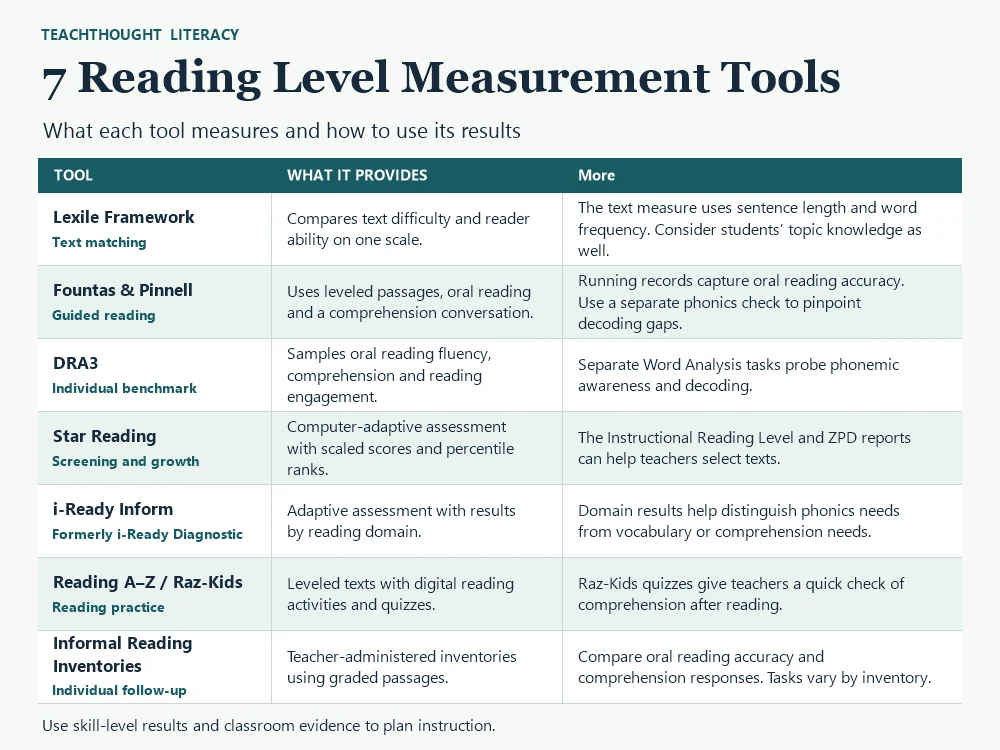
Navigating the complex landscape of childhood literacy requires educators to look far beyond simple grading metrics to understand the intricate cognitive processes behind how students learn to read. Recent educational research underscores a vital distinction in literacy instruction: a student who decodes and reads a passage with mechanical accuracy may still completely misunderstand its underlying meaning. Modern literacy science divides word recognition from the broader linguistic abilities and background knowledge required for true reading comprehension. Consequently, educational specialists emphasize that choosing the correct reading assessment tool depends entirely on the precise diagnostic question an instructor needs to answer. As schools nationwide continue to address post-pandemic achievement gaps, the demand for reliable, versatile, and empirically validated assessment instruments has reached an all-time high. Educational administrators, reading specialists, and classroom teachers are increasingly tasked with curating a balanced toolkit that evaluates both oral fluency and deep comprehension.
The Evolution of Reading Assessment Methodologies
The history of reading assessment dates back to early 20th-century standardized testing, where silent reading speed and basic multiple-choice comprehension questions dominated classrooms. However, mid-century shifts toward whole-language approaches, followed by the rigorous cognitive science movements of the late 1990s and 2000s, transformed how educators diagnose reading challenges. The publication of landmark studies, such as the 2018 comprehensive analysis by Anne Castles, Kathleen Rastle, and Kate Nation, permanently altered the educational consensus by mapping out the cognitive trajectory of reading acquisition from novice to expert. These studies highlighted that word recognition and language comprehension operate through partially distinct cognitive systems.
Building upon this foundational research, contemporary assessment frameworks have evolved to isolate specific variables. For instance, curriculum-based measurement (CBM), pioneered in the 1970s and 1980s, introduced systematic monitoring of student progress through brief, repeatable tasks. Over the past two decades, digital integration has further revolutionized these tools, shifting many traditional paper-and-pencil inventories into cloud-based platforms capable of generating real-time longitudinal data graphs. Despite these technological leaps, the core pedagogical challenge remains unchanged: matching the diagnostic instrument to the specific learning barrier a student encounters.
Comprehensive Breakdown of Student Assessment Instruments
To effectively monitor and screen student performance across kindergarten through high school, educators rely on a diverse array of standardized and curriculum-embedded instruments. Each tool serves a distinct diagnostic purpose within the educational ecosystem.
DIBELS 8th Edition
Designed primarily for kindergarten through eighth grade, the Dynamic Indicators of Basic Early Literacy Skills (DIBELS) serves as a premier screening and progress-monitoring instrument. Its oral reading fluency component requires students in grades one through eight to read a standardized text aloud for precisely one minute, while the examiner records errors on a duplicate protocol.
The scoring mechanics are exact: skipped words, mispronunciations, and hesitations lasting longer than three seconds are marked as errors, whereas self-corrections made within three seconds are scored as correct. The resulting metric—words correct per minute—provides a rapid snapshot of mechanical fluency. However, educational researchers caution that oral reading fluency scores do not directly measure text comprehension. Seminal research by Lynn Fuchs and colleagues in 2001 established oral reading fluency as a robust indicator of broader reading competence, validating its use as a screening metric while reinforcing the necessity of complementary comprehension checks. DIBELS materials, including student passages and benchmark guidelines, are openly accessible via the University of Oregon.
easyCBM
Developed as a scalable curriculum-based measurement system, easyCBM offers educators in grades K through 8 a streamlined method for tracking reading performance over extended periods. The platform features tasks ranging from isolated word reading to passage fluency and multiple-choice comprehension checks.
A key operational requirement for easyCBM is consistency: teachers must utilize designated progress-monitoring forms at identical difficulty levels during successive checks to ensure longitudinal data remains comparable. The platform operates on a tiered access model, providing a free Lite tier that includes individual student progress graphs and item-level reporting, while comprehensive benchmark assessments and risk-status reports require district-level paid subscriptions.
Qualitative Reading Inventory, Seventh Edition (QRI-7)
For a deeply individualized diagnostic profile, the Qualitative Reading Inventory, Seventh Edition (QRI-7), offers graded word lists alongside narrative and informational texts spanning pre-primer through high school reading levels. Unlike automated digital screeners, QRI-7 requires a one-on-one administration format where teachers meticulously record oral reading miscues and subsequently evaluate comprehension through structured questioning and student retellings.
The inventory establishes three distinct performance thresholds: independent, instructional, and frustration levels. These qualitative markers help educators tailor daily reading materials to an optimal zone of proximal development, though publishers note that these diagnostic categories are structurally distinct from, and non-interchangeable with, proprietary metrics like Lexile measures.
Star Reading
Utilizing computer-adaptive technology, Star Reading dynamically adjusts question difficulty in real-time based on the accuracy of the student’s previous responses. Typically requiring approximately 20 minutes to complete on a digital device, the assessment generates scaled scores and percentile ranks that allow educators to benchmark student achievement against national cohorts.
While highly efficient for screening large student bodies across grades one through 12, Star Reading does not evaluate oral reading mechanics, meaning educators must look elsewhere to diagnose specific phonological or decoding errors. Access requires an active institutional subscription through Renaissance.
Evaluating Text Difficulty: Beyond Student Scores
Assessing a student’s reading ability is only half the equation; educators must also accurately gauge the linguistic and structural complexity of the texts placed in front of them. Mismatching reader ability and text difficulty often leads to unwarranted frustration and disengagement.
Lexile Find a Book and Text Analyzer
The Lexile framework provides standardized measures for both reader ability and text difficulty. The Find a Book utility enables educators to cross-reference student Lexile scores with millions of titles categorized by subject and interest. Meanwhile, the classroom Text Analyzer allows teachers to input prose passages of up to 500 words to generate an estimated Lexile range.
Industry experts emphasize that the Text Analyzer is calibrated specifically for continuous prose and does not yield valid measurements for alternative formats such as poetry, song lyrics, or recipes. Basic search functionalities are publicly available, while advanced premium analytics are frequently subsidized for educators through state-level educational partnerships.
Microsoft Word Readability Statistics
For day-to-day document creation and instructional material design, educators can leverage built-in software analytics such as Microsoft Word’s readability statistics. By calculating metrics like the Flesch Reading Ease score and the Flesch-Kincaid Grade Level based on average sentence length and syllable count, teachers can quickly evaluate whether assignment prompts or drafted passages align with their students’ developmental stages.
Data-Driven Instructional Implications and Future Outlook
The practical application of these assessment tools directly dictates classroom intervention strategies. When diagnostic data reveals a student reading slowly with high error rates, educators must pivot toward targeted decoding and fluency interventions. Conversely, if a student reads with mechanical precision but fails to summarize or explain the passage, the instructional focus must immediately shift toward comprehension-monitoring strategies, such as vocabulary acquisition, mental imagery, and guided questioning.
Educational analysts project that the future of reading assessment will increasingly rely on artificial intelligence-driven diagnostic platforms capable of simultaneously evaluating decoding accuracy, prosody, and real-time comprehension through natural language processing. However, literacy advocates maintain that technology should serve to augment, rather than replace, the nuanced clinical judgment of trained educators. By maintaining meticulous longitudinal records—documenting specific testing dates, instruments utilized, and precise score thresholds—schools can ensure that every student receives evidence-based, equitable reading instruction tailored precisely to their developmental needs.

