
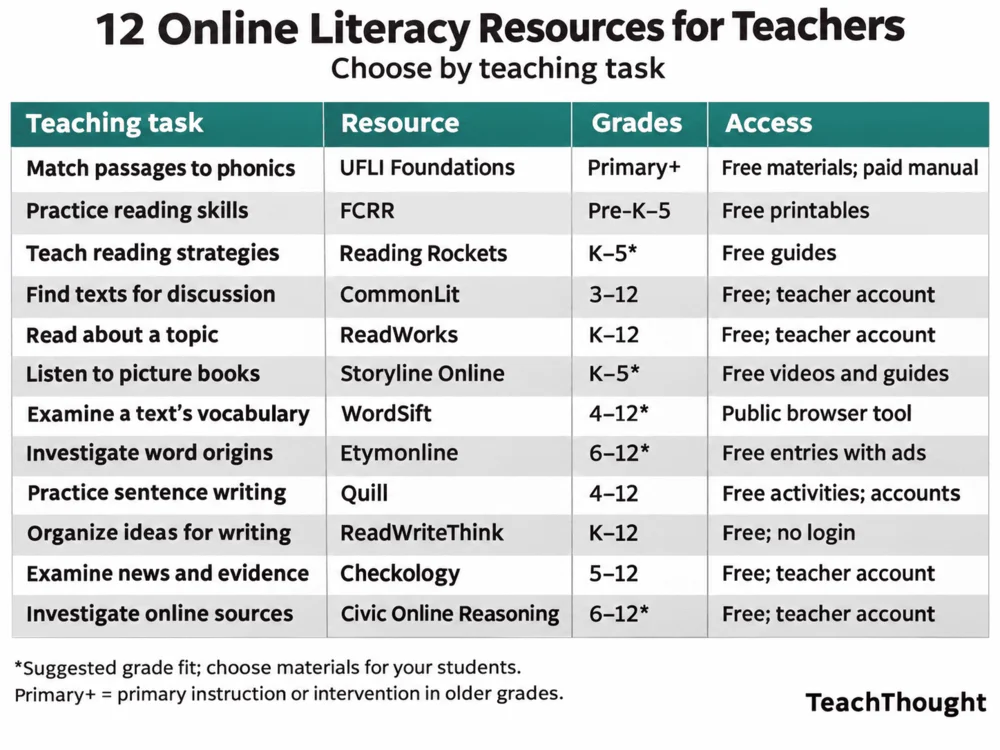
In an era dominated by screens, algorithms, and an overwhelming deluge of digital information, educators face a profound paradox: while digital accessibility has never been higher, the demand for structured, reliable, and tactile pedagogical resources has surged to unprecedented levels. Modern classrooms are tasked not only with teaching foundational reading and vocabulary skills, but also with equipping students to critically evaluate the vast ecosystem of online media. To address these complex challenges, teachers are increasingly turning to curated repositories that bridge the gap between traditional literacy instruction and 21st-century information literacy.
The Digital Paradox: Balancing Abundance and Curation in Modern Classrooms
The contemporary educational landscape is defined by an overabundance of accessible content. From sprawling databases of digital texts to interactive multimedia learning tools, teachers and students are routinely exposed to more information than they can efficiently process. Far from signaling a rejection of online tools, this digital saturation has underscored the necessity of selective curation. Educators require precise, high-utility instruments that target specific cognitive and linguistic milestones—ranging from foundational phonics and decoding to complex news literacy and source verification.
This imperative has prompted educational developers, non-profit organizations, and university research centers to design comprehensive, often free, toolkits tailored to distinct pedagogical needs. Rather than adopting a monolithic curriculum, schools are leveraging targeted resources that integrate seamlessly into existing instructional frameworks. A comprehensive examination of these tools reveals a diverse array of assets designed to enhance literacy across primary, middle, and secondary grade levels.
Foundational Reading, Decoding, and Phonics Practice
Building a robust literacy foundation begins in the earliest grades, where students master phonological awareness, phonics, and word recognition. Among the most prominent resources utilized by reading specialists is the UFLI Foundations Toolbox. Developed by the University of Florida Literacy Institute, the toolbox provides decodable passages that directly correspond to specific phonics patterns introduced during explicit instruction. Alongside decodable texts, the resource supplies lesson slides, home-practice sheets, and interactive games designed to reinforce decoding skills. While the comprehensive lesson manuals are commercially distributed, the companion downloads offer critical, cost-effective support for primary classrooms and upper-grade intervention settings.
Complementing structured phonics programs are the Florida Center for Reading Research (FCRR) Student Center Activities. Spanning pre-kindergarten through fifth grade, these materials provide printable resources for independent and partner-led literacy stations. Covering phonological awareness, fluency, vocabulary, and comprehension, the FCRR materials require minimal digital infrastructure, allowing students to engage directly with physical cards, boards, and manipulatives. Although recent technical updates have required educators to navigate the center’s broader resource database due to legacy link migrations, the utility of these non-commercial, printable activities remains a cornerstone for differentiated reading centers.
For educators seeking theoretical backing and step-by-step methodological guidance, the Reading Rockets Classroom Strategy Library serves as an essential repository. Designed primarily for kindergarten through fifth-grade teachers, the platform catalogs explicit directions for executing diverse reading and writing strategies. Each entry is anchored in empirical research and accompanied by classroom examples, instructional videos, and downloadable handouts, empowering educators to model complex comprehension techniques—such as summarization, visualization, and inferencing—without requiring student accounts or digital logins.
Expanding Comprehension Through Diverse Texts and Digital Libraries
Once foundational decoding is established, instructional focus shifts heavily toward text complexity, close reading, and thematic exploration. The CommonLit Text Library has emerged as an industry standard for middle and high school classrooms, offering a vast, free catalog of short literary and informational texts. Designed for close reading, text-dependent questioning, and analytical writing, CommonLit enables teachers to construct rigorous comparative reading units. While advanced tracking and digital assignment features require educator and student accounts, the core text repository remains freely accessible, making rigorous textual analysis attainable for districts operating under tight budgetary constraints.
Similarly, ReadWorks provides an expansive, topic-driven library of reading passages spanning kindergarten through twelfth grade. Equipped with integrated question sets and optional audio supports, ReadWorks allows educators to build thematic science and social studies units that reinforce literacy skills across content areas. The platform’s flexibility—supporting both digital assignments and printable packets—ensures equitable access for classrooms with varying degrees of technological integration.
For younger demographics, Storyline Online offers a unique intersection of literacy and auditory engagement. Administered by the SAG-AFTRA Foundation, the platform features celebrated actors reading children’s picture books aloud, accompanied by professional activity guides. While educational researchers note that listening to read-alouds does not replace independent decoding practice, Storyline Online provides a powerful medium for developing listening comprehension, vocabulary, and predictive reasoning skills in early elementary grades without the barrier of student account creation.
Vocabulary Acquisition and Etymological Investigation
Advanced literacy relies heavily on deep vocabulary knowledge and an understanding of word structures. WordSift addresses this need by functioning as an interactive browser tool designed to analyze the lexical profile of any pasted text. By identifying frequently occurring words and mapping their contextual appearances within a passage, WordSift allows teachers in grades four through twelve to proactively scaffold vocabulary instruction prior to reading complex literature.
To deepen lexical inquiry, the Online Etymology Dictionary offers students in middle and high school an exhaustive historical window into the English language. By investigating the origins, morphological shifts, and historical evolution of words, students move beyond rote memorization to understand the structural DNA of language. Although the platform features standard web advertising, its core database remains freely accessible, fostering etymological curiosity and structural word analysis.
Writing, Sentence Revision, and Idea Generation
Writing instruction remains an integral pillar of comprehensive literacy programs. Quill provides targeted, gamified digital practice for students in grades four through twelve, focusing specifically on sentence construction, combination, and grammatical revision. By breaking writing mechanics down into manageable digital modules, Quill allows teachers to assign customized practice routines that reinforce classroom writing objectives. While premium tiers offer advanced analytics and professional development, the core platform provides robust free access for classrooms of any size.
For pre-writing ideation and structural organization, ReadWriteThink’s Student Interactives offer a suite of web-based tools, including graphic organizers, story maps, and plot diagrams. These platforms guide students through the foundational stages of the writing process, enabling them to visually structure comparisons, arguments, and narratives before drafting prose. Because many of these interactives operate without student logins, they offer frictionless integration into daily writing workshops, provided educators plan appropriately for student work-saving protocols.
The Imperative of News Literacy and Civic Online Reasoning
In the contemporary information ecosystem, traditional literacy has expanded to encompass digital and news literacy. The News Literacy Project’s Checkology platform addresses this vital need for students in grades five through twelve. Through interactive lessons, simulated social media environments, and primary source analysis, Checkology trains students to differentiate between news reports, opinion pieces, advertising, and misinformation. While teacher-led resources are freely accessible via educator accounts, assigned interactive tracking requires student registration, providing a comprehensive framework for media evaluation.
Complementing this mission, the Digital Inquiry Group’s Civic Online Reasoning (COR) curriculum equips middle and high school students with the evaluative habits utilized by professional fact-checkers. Central to COR’s pedagogical approach is "lateral reading"—the practice of leaving an unfamiliar website to investigate its credibility through independent, external sources. By providing free, downloadable lesson plans and assessment tasks via teacher accounts, COR addresses the urgent societal need for empirical, skeptical evaluation of online claims.
Broader Implications and Future Outlook
The continued reliance on these diverse literacy and digital evaluation tools highlights a profound evolution in modern education. As artificial intelligence and digital content generation accelerate, the ability to decode text, evaluate sources, and articulate complex thoughts remains paramount.
Educational analysts observe that the integration of these targeted resources reflects a pragmatic consensus among teachers: technology is most effective when it serves explicit, evidence-based pedagogical goals rather than replacing fundamental human instruction. By carefully selecting tools that balance digital engagement with cognitive rigor, educators are uniquely positioned to navigate the complexities of the modern information age, ensuring that the next generation of students possesses not only the ability to read, but the critical discernment to understand the world around them.

