
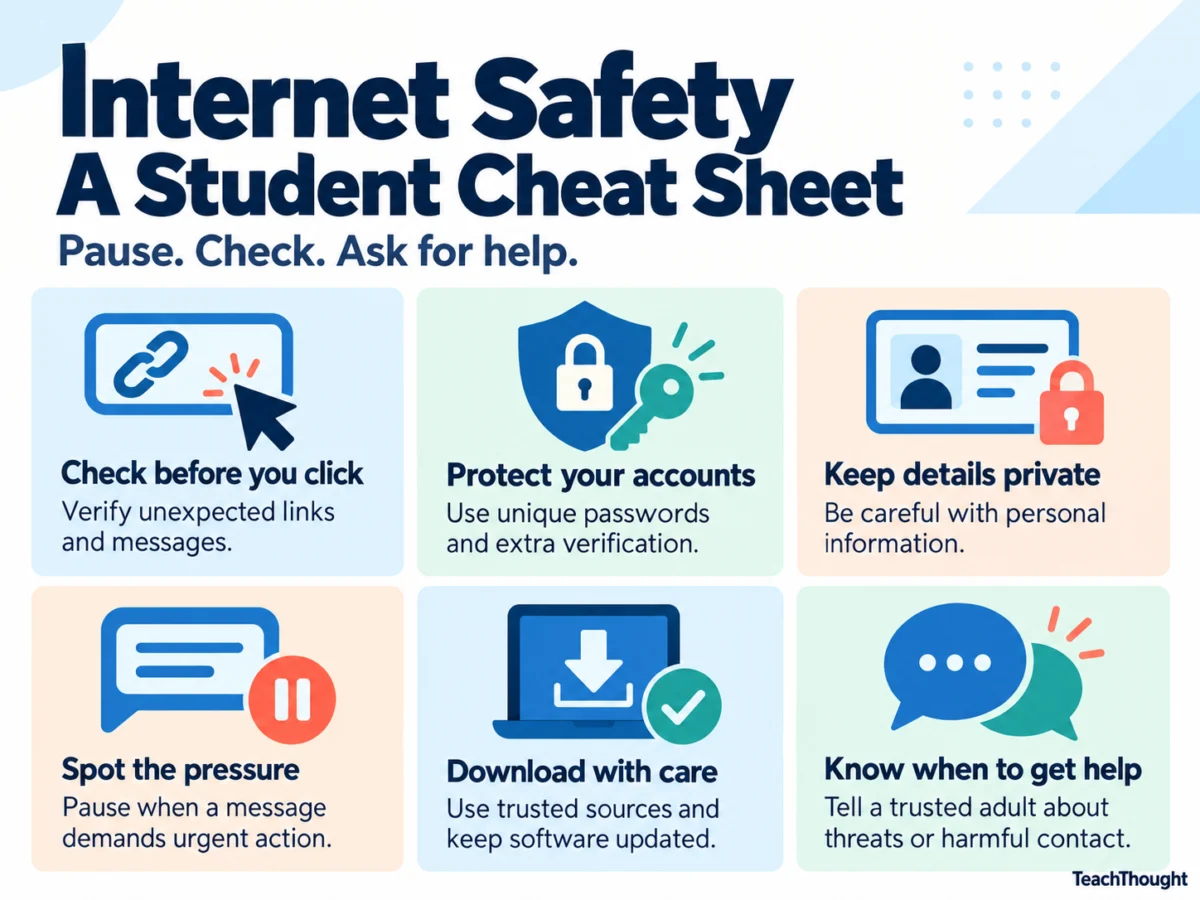
The contemporary educational environment has fundamentally shifted from physical classrooms to a hybrid ecosystem where students navigate a complex web of school accounts, multiplayer gaming platforms, encrypted group chats, search engines, and generative artificial intelligence tools. While technological literacy has skyrocketed among youth, the ability to critically assess online interactions has not kept pace. Internet safety is no longer merely about restricting access or teaching basic computer skills; it is the vital, active ability to recognize a risky situation, make a safer choice, and secure help when something goes wrong. Today, knowing how to operate an application does not translate to knowing when to trust a person, message, or automated request inside it. This dynamic forms the core of modern digital citizenship, a multidimensional practice encompassing how students participate, communicate, and contribute safely and ethically online.
Background Context and the Evolution of Digital Risk
To understand the urgency surrounding student internet safety, one must examine the evolution of the digital landscape over the past two decades. In the early days of the consumer internet, online threats were largely external and easily identifiable—malware masquerading as downloadable games or unfamiliar adults lurking in open chat rooms. Schools responded with rigid content filtering and rudimentary "stranger danger" lectures.
However, the proliferation of smartphones, cloud-based learning management systems, and social media platforms has decentralized the digital experience. Threats are no longer confined to the periphery; they are integrated directly into everyday academic and social tools. Phishing attacks, account takeovers, peer harassment via group chats, and the manipulation of synthetic media via artificial intelligence now threaten students within the very environments designed for their education and socialization. According to recent cybersecurity data from federal agencies, juvenile accounts have become prime targets for credential harvesting and social engineering, necessitating a pivot from reactive filtering to proactive critical thinking education.
Anatomy of Deception: Scrutinizing Requests Over Senders
One of the most persistent vulnerabilities students face is the sophisticated nature of modern social engineering. Cybercriminals and malicious actors routinely spoof institutional identities, making fraudulent messages appear as though they originate from a teacher, a trusted classmate, a game platform, or a school administration service. The presence of correct spelling, familiar institutional logos, and plausible urgency no longer serves as a reliable indicator of authenticity.
In classrooms and homes alike, students must be trained to look past the superficial markers of trust and evaluate the nature of the request itself. Whether a phishing attempt arrives via email, SMS, direct message, or a rogue QR code, it typically demands immediate action: entering a password, sharing a multifactor authentication code, downloading an unverified file, purchasing an item, or acting before a fabricated deadline.
To counter this, educators advocate for a standard protocol of independent verification. If a message warns that a school account is about to be terminated unless a link is clicked, the student must be instructed to open the service through its official, bookmarked application or navigate to it independently, rather than utilizing the contact information or links provided within the suspicious message. Classroom exercises that present these hypothetical scenarios help bridge the gap between theoretical knowledge and practical execution.
Hardening the Perimeter: Account Protection and Hygiene
Securing digital infrastructure requires moving beyond elementary password habits. The Cybersecurity and Infrastructure Security Agency (CISA), through its "Secure Our World" initiative, emphasizes that robust digital defense rests on core protective actions: rigorous phishing awareness, strong and unique passwords, multifactor authentication (MFA), and prompt software updates.
For students, this means abandoning the common practice of reusing passwords across gaming sites, social networks, and educational portals. The implementation of password managers can drastically reduce the friction of maintaining complex credentials. Furthermore, students must understand that sharing a password—even with a close friend—compromises account integrity and is not a metric of interpersonal loyalty. Establishing clear protocols for account recovery ensures that students know how to seek administrative assistance without inadvertently surrendering their credentials to peers. MFA acts as a critical secondary barrier, ensuring that even if a password is exposed, unauthorized sign-in attempts are blocked unless explicitly approved by the legitimate account holder through a trusted device.
Redefining Personal Information Sharing in the Age of EdTech
The historical directive to "never share anything online" is no longer practical or pedagogically sound in an era where students are required to use legitimate educational software and digital learning management systems. A prohibition of that magnitude fails to prepare students for the nuanced decisions required in modern digital spaces.
Instead, educators and policy experts urge a shift toward contextual evaluation: Does this person or service actually need this specific information to achieve the intended, legitimate purpose? Practical applications of this principle involve scrutinizing mobile games that demand home access or precise location data, quizzes that harvest security-question answers, and public social media posts that inadvertently reveal daily routines or student identification badges.
Educational institutions bear a corresponding responsibility. Before introducing a new digital tool into the curriculum, instructional staff must audit what data students are required to provide and determine whether the learning objective can be accomplished with minimal identifying information.
The Spectrum of Manipulation: Recognizing Coercion and Pressure
Unsafe contact in the digital age rarely begins with an overt threat. More frequently, exploitation initiates through grooming behaviors characterized by unwarranted compliments, special attention, digital gifts, in-game currency rewards, or calculated offers of assistance. Consequently, relying on the traditional definition of a "stranger" is insufficient for protecting youth.
For older students, digital safety frameworks must address severe forms of coercion, such as sextortion—the threat to release intimate images to extract money or additional media. Organizations such as the National Center for Missing & Exploited Children (NCMEC) emphasize that students must be empowered to seek immediate adult intervention if they find themselves trapped in such a scenario, regardless of whether they previously trusted the perpetrator or shared the initial material voluntarily. Clear institutional reporting pathways ensure that victims receive psychological and structural support without facing punitive measures that might deter them from coming forward.
Mitigating Harassment and the Spread of Toxic Content
Digital conflicts rarely remain isolated. Private disagreements among students frequently migrate into group chats, where peer pressure can transform a localized dispute into widespread harassment. Actions such as forwarding humiliating screenshots, joining a digital pile-on, or sharing a classmate’s physical location exponentially amplify harm.
Training students to disrupt this cycle involves teaching them to refrain from retaliation, halt the redistribution of harmful media, utilize native platform reporting tools, and immediately involve a trusted adult. While blocking a user can limit direct contact, it often fails to resolve harassment that persists across alternative channels. When documenting incidents for administrative or legal review, students and staff must preserve objective metadata—such as usernames, timestamps, and message links—while strictly avoiding the collection or downloading of illicit imagery involving minors, in accordance with child safeguarding laws.
Evaluating Downloads, Permissions, and Device Integrity
The acquisition of digital tools—ranging from game modifications and browser extensions to study aids and purported system updates—carries inherent risks regarding device security and data privacy. A utility application that appears benign may harbor requests for excessive system permissions, such as access to microphones, cameras, local file directories, or continuous location tracking.
Students must be instructed to utilize approved institutional installation routes, keep their operating systems and applications updated, and consult IT professionals when unexpected permission prompts appear. Crucially, students should be explicitly prohibited from bypassing school device management protections or firewalls to complete assignments or access restricted entertainment content, as these workarounds strip away essential network-level safeguards.
Integrating Artificial Intelligence Responsibly
The rapid integration of artificial intelligence into daily life introduces unprecedented challenges to internet safety and digital citizenship. Beyond traditional phishing and harassment, students now encounter sophisticated deepfakes, automated conversational companions, and synthetic media generation tools.
The creation and dissemination of fabricated, altered, or inappropriate images of classmates can inflict severe psychological and social damage. Institutional policies must ensure that a student targeted by synthetic media is supported immediately, rather than being forced to bear the burden of proving the image’s falsity before receiving intervention. Educational resources, such as those provided by regulatory bodies like the eSafety Commissioner, offer valuable frameworks for understanding the privacy implications and psychological impacts of AI companions and simulated interpersonal relationships.
Protocol for Incident Response: Navigating Post-Crisis Actions
Comprehensive safety education is incomplete without an actionable response plan for when security measures fail or exploitation occurs. Students must be fully aware of the immediate steps to take and the specific information required by adults or IT personnel to remediate the situation effectively.
| Situation | First Response Protocol |
|---|---|
| Entered a password on a suspicious page | Notify a trusted adult or school IT staff promptly; initiate the legitimate service’s official recovery process to secure the account. |
| Downloaded an unverified or suspicious file | Immediately cease using the file or installer; consult IT staff or a trusted adult; avoid downloading secondary advertised "fixes." |
| Received threats or coercive messages | Secure adult help immediately; refuse to send money or additional images; utilize official platform reporting channels. |
| Encountered disturbing or explicit content | Navigate away from the content immediately and inform a trusted adult; ongoing viewing is unnecessary to establish its harmful nature. |
When incidents involve suspected child sexual exploitation or abuse, institutional authorities must adhere to mandatory reporting laws, leveraging channels such as NCMEC’s CyberTipline in the United States. Situations involving imminent physical danger require immediate contact with emergency services.
Shifting from Passive Rules to Active Decision-Making
Ultimately, fostering true digital citizenship requires moving away from passive rule memorization and toward active, scenario-based practice. Educators can utilize brief, five-minute discussions centered on fictionalized messages, permission requests, or group-chat dilemmas to build critical thinking muscles. By asking students to identify the core request, articulate the underlying risk, formulate a safe response, and identify an appropriate support figure, schools can normalize safety as an ongoing cognitive habit.
By emphasizing independent verification, robust account hygiene, the recognition of psychological pressure, and clear incident-response pathways, educational institutions can equip students to navigate an increasingly complex digital world with confidence, resilience, and responsibility.

