
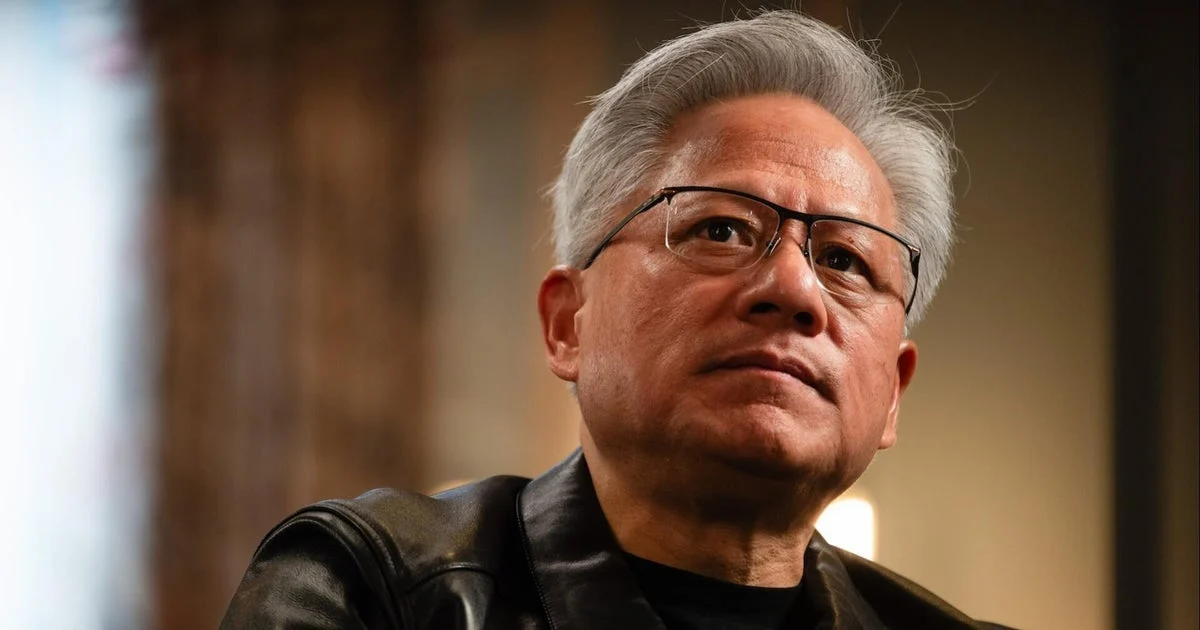
The resignation of Jensen Huang, the long-standing architect of Nvidia’s rise to global prominence, has sent shockwaves through the technology sector, wiping nearly $500 billion from the company’s market capitalization in a matter of days. The sudden departure, announced by the chipmaker on Thursday morning, marks a tumultuous turning point for the firm that has become the bedrock of the artificial intelligence revolution. Chief Financial Officer Colette Kress has been appointed interim CEO as the board navigates what analysts describe as the most significant leadership crisis in the company’s history.
The company’s shares, which have been the primary engine of growth for the S&P 500 over the past three years, tumbled $7.54, or 4.3%, to close at $166.19 on Thursday. While the stock recovered slightly from a session low of 14.3%, the erosion of shareholder value has been historic. This decline follows a punishing start to the week, during which the stock shed 9.6% of its value following reports that Huang had engaged in an extramarital affair with a woman believed by U.S. intelligence agencies to be a Chinese asset.
A Chronology of the Crisis
The unraveling of Huang’s tenure began last weekend with the disclosure of a relationship with Alice Huang, a Chinese business executive. The nature of this association triggered immediate alarm in Washington and within Nvidia’s board, given the company’s pivotal role in the U.S.-China technology race. Nvidia’s semiconductors, particularly the H100 and the newer H20 chips, are essential for training large-scale AI models. Because of their dual-use potential in military and surveillance applications, these chips are subject to stringent U.S. export controls.
Huang had been an outspoken advocate for loosening these restrictions, frequently arguing that the exclusion of the Chinese market would harm American innovation. His personal connection to an individual scrutinized by intelligence officials has now cast a shadow over those lobbying efforts, leading to a swift loss of confidence from institutional investors.
The situation was further compounded on Thursday when The New York Times reported that Huang had maintained a separate, concurrent affair with Kimberly Powell, Nvidia’s vice president of healthcare. The revelation of internal romantic entanglements—coupled with the high-stakes national security implications of his other relationship—created an untenable position for the board of directors.
Market Volatility and Investor Sentiment
The market reaction has been visceral. Dan Ives, a prominent analyst at Yorkville Ives, described the resignation as a "band-aid being ripped off," noting that the company’s valuation has been fundamentally repriced. Before the scandals broke, Nvidia was trading at a premium that reflected its unique position as the monopoly provider of AI infrastructure. With Huang’s departure, analysts are struggling to calculate the "key man risk" associated with the company’s future growth.
"There is no credible way to put a precise revenue loss on his departure," noted Ipek Ozkardeskaya, a senior analyst at Swissquote. "Customers buy Nvidia’s computing power, software, and networking ecosystem—the CUDA platform and the proprietary architecture—and those advantages wouldn’t disappear with its CEO. However, the loss of the visionary leader who steered the company through the transition from a gaming graphics firm to an AI powerhouse creates a leadership vacuum that is difficult to quantify."
Prior to the scandal, Ives had estimated that Nvidia’s stock would hold a value of approximately $300 per share under Huang’s leadership. Following the resignation, that target has been slashed, reflecting the uncertainty regarding whether the company can maintain its strategic momentum in the face of increased regulatory scrutiny and a potential internal restructuring.
The Regulatory and Geopolitical Context
Nvidia’s success has always been inextricably linked to its relationship with the U.S. government. As a key supplier to the global AI industry, Nvidia has been forced to walk a tightrope between its commercial interests and national security mandates. The Trump administration, which had been in discussions with Huang regarding the H20 export permits, is now likely to conduct a comprehensive audit of Nvidia’s supply chain and decision-making processes.
This scrutiny comes at an already delicate time. The global AI industry is facing a "reality check" regarding the return on investment for massive infrastructure spending. Analysts have been debating for months whether the billions of dollars being poured into data centers and GPUs will yield profitable software applications or if the industry is currently in an unsustainable bubble. The leadership crisis at Nvidia threatens to exacerbate these fears, potentially leading to a broader correction in the technology sector.
Implications for the Future of AI
With Colette Kress stepping into the interim role, the focus of the market will now shift to the company’s upcoming quarterly earnings and its ability to maintain its technological lead. Kress, who has served as CFO since 2013, is a steady hand, but she faces the daunting task of stabilizing a company that has been defined by Huang’s aggressive and often singular vision.
The broader AI sector is bracing for further volatility. The highly anticipated IPO of Anthropic, the developer of the Claude AI model, is expected to serve as a bellwether for the industry next week. Investors will be watching closely to see if the malaise affecting Nvidia spreads to other AI-native companies.
The resignation of Jensen Huang is not merely a corporate governance event; it is a structural shift for the artificial intelligence landscape. For three decades, Huang has been the face of the company, and his departure leaves Nvidia at a crossroads. The firm must now prove that its success is built on the strength of its engineering and the depth of its ecosystem, rather than the personal influence of its founder.
Corporate Governance and Board Accountability
The decision by Nvidia’s board to accept Huang’s resignation has been met with both criticism and approval from market observers. Some argue that the board should have acted sooner to address concerns regarding the CEO’s personal conduct, while others believe that the swift, decisive action was necessary to preserve the company’s standing with the U.S. government.
As the company prepares for a transition, institutional investors are demanding transparency regarding the board’s oversight of executive conduct. The emergence of reports regarding the relationship with a high-level internal executive, Kimberly Powell, suggests that the board may have been unaware of, or failed to adequately mitigate, conflicts of interest that could have compromised the company’s internal integrity.
Summary of Financial Impact
The loss of $500 billion in market value represents one of the largest single-week capital losses in the history of the S&P 500. While Nvidia’s fundamental business—the production of high-performance GPUs—remains intact, the "Huang premium" has been entirely erased.
Investors are now looking toward the upcoming earnings call to see if the interim leadership can provide a clear roadmap for the post-Huang era. The company’s long-term success will likely depend on its ability to navigate the complex geopolitical landscape of the AI era without the direct, high-level advocacy that characterized Huang’s tenure. As the dust settles, the tech industry is left to grapple with the reality that even the most indispensable leaders are subject to the same risks and accountability as any other executive, particularly when their personal actions intersect with the highest levels of global geopolitical security.

