
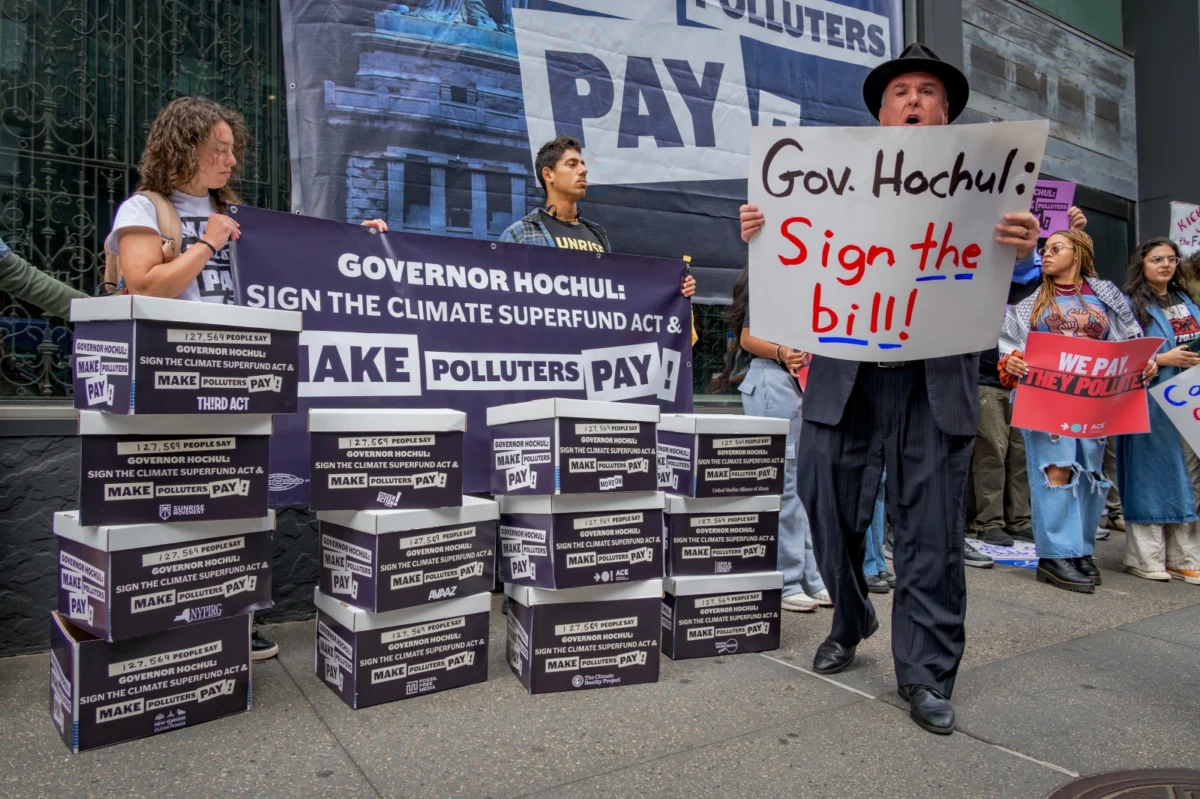
The movement to force fossil fuel companies to pay for the mounting costs of climate change has hit a significant legal roadblock in New York, yet the momentum behind state-level "climate superfund" legislation remains remarkably resilient. Last week, a federal judge issued a ruling blocking New York’s landmark climate superfund law, which sought to extract $75 billion from major oil and gas producers to finance climate-related infrastructure and disaster recovery. This decision, following a similar ruling shortly before, represents a victory for the fossil fuel industry and a coalition of 22 Republican state attorneys general who argue that such state-level mandates are unconstitutional and preempted by federal authority.
Despite these judicial setbacks in the Empire State, a cross-country coalition of lawmakers from states including Connecticut, Hawaii, Rhode Island, and New Jersey has signaled that they are not abandoning their legislative agendas. For many of these officials, the New York rulings are viewed as a temporary hurdle rather than a definitive end to the effort to assign fiscal responsibility for global warming to the corporations that historically fueled it.
A Legislative Evolution: From Industrial Cleanup to Climate Liability
The concept of a climate superfund is rooted in the legacy of the federal Comprehensive Environmental Response, Compensation, and Liability Act (CERCLA) of 1980. Commonly known as the Superfund Act, that legislation established a "polluter pays" framework that forced chemical and petroleum companies to foot the bill for cleaning up abandoned, toxic industrial sites. Proponents of climate superfund laws argue that the environmental damage caused by greenhouse gas emissions—ranging from sea-level rise and flooding to intensified heatwaves—is a modern, global version of the industrial pollution that necessitated the 1980 law.
New York’s 2024 legislation was the most ambitious of these efforts, designed to generate a $75 billion fund over several decades. The funds were earmarked for essential resilience projects, such as upgrading aging stormwater drainage systems, retrofitting public buildings with cooling infrastructure, and managing the recovery costs of extreme weather events.
The Chronology of Legal Contention
The path to these laws has been marked by a series of intense legal maneuvers:
- 1980: The passage of the federal Superfund Act establishes the legal precedent for holding industry accountable for environmental cleanup costs.
- 2018: Boulder County and the City of Boulder, Colorado, initiate a lawsuit against Suncor and ExxonMobil, seeking damages for climate-related costs. This case becomes a bellwether for state-level litigation.
- 2024: New York signs its Climate Superfund Act into law, sparking a wave of interest in similar measures across the U.S.
- 2025-2026: A series of legal challenges are filed by industry groups and Republican attorneys general, arguing that the Clean Air Act and federal constitutional law preempt state-level climate regulation.
- Late 2026: Federal courts in New York issue dual rulings, siding with fossil fuel companies and finding the state law to be an overreach beyond the limits of state authority.
The Looming Shadow of the Supreme Court
While state-level setbacks in New York and the ongoing legal battles in Vermont capture headlines, the most existential threat to the climate accountability movement is currently before the U.S. Supreme Court. The case of Suncor v. Boulder County, scheduled for oral arguments next week, represents a high-stakes test of the "preemption doctrine."
Fossil fuel interests argue that climate policy is an inherently federal matter. If the Supreme Court rules in favor of the defendants, it could effectively nullify state-level climate accountability efforts nationwide. Legal experts like Pat Parenteau, an emeritus professor at the Vermont Law School, warn that such a ruling could have a domino effect. "Worst case, they rule that federal law—both statutory and constitutional federal law—preempts all of these cases, throwing them all out," Parenteau noted. The impact would not be limited to superfund laws; it could potentially gut consumer rights litigation, racketeering claims, and antitrust cases targeting the energy sector, leaving states with billions of dollars in climate-related damages and no legal recourse to recoup costs from the entities that contributed to the crisis.
Perspectives from the Statehouses
Despite the legal risks, lawmakers in several states are doubling down on their commitments. The sentiment among proponents is that the judicial challenges are being used as a scare tactic to deter policy innovation.
"I’m full speed ahead," said Rhode Island Representative Jennifer Boylan, who plans to reintroduce her version of the legislation in the coming session. Her perspective is shared by many of her peers, who argue that the specific legal reasoning used in New York—which relies heavily on the Clean Air Act—does not necessarily translate to every jurisdiction.
In New Jersey, where a climate superfund bill sponsored by Democratic Senator John McKeon stalled during the summer, supporters remain optimistic. McKeon has publicly stated that he is unconcerned by the New York rulings, noting that New Jersey operates within a different judicial circuit and under distinct state-level statutes. Meanwhile, legislators in California, Illinois, and Massachusetts have expressed similar resolve, indicating that the desire for climate accountability has become a pillar of progressive state-level environmental policy.
Conversely, the opposition remains equally determined. West Virginia Attorney General JB McCuskey has taken a hardline stance, warning that any state attempting to pass similar legislation will face immediate litigation. This "lawfare" has created a climate of uncertainty for legislators, forcing some, like New Hampshire’s Tony Caplan, to pivot toward alternative strategies like broad-based decarbonization efforts rather than direct litigation-focused superfund laws.

Expert Analysis: Implications for Future Policy
The legal landscape is complex and highly dependent on the outcome of the Supreme Court’s pending decision in the Suncor case. Rachel Rothschild, an assistant professor at the University of Michigan Law School, emphasizes that states are not currently bound by the district-level decisions coming out of New York. However, she notes that the potential for "bad law" to become entrenched is a significant risk.
"My fear is that this is going to be another notch in a long list of decisions that are threatening to our broader country and democracy, leaving states without the ability to do much on very flimsy and poorly reasoned legal grounds," Rothschild observed.
If the Supreme Court decides to "punt" on the Suncor case—by refusing to issue a broad ruling until the case has fully traveled through the lower courts—it could offer a temporary reprieve. This would allow state-level efforts to continue, albeit under a cloud of ongoing legal risk. Conversely, a ruling that provides a "yardstick" for what constitutes acceptable state action—such as limiting claims to damages from pollution emitted within a state’s own borders—could provide a roadmap for future, more narrowly tailored legislation.
The Path Forward
The debate over climate superfunds is effectively a conflict over the division of power between federal and state governments, overlaid on the urgent necessity of addressing a global environmental crisis. As the climate becomes more volatile, the pressure on state budgets to pay for sea walls, disaster relief, and infrastructure hardening will only intensify.
For now, the legal battlefront remains active. Whether these laws are ultimately upheld as valid exercises of state police power or struck down as federal preemption, the sheer persistence of the movement suggests that the question of who pays for the damages of the fossil fuel era will remain at the center of American politics for years to come. As legal scholars like Jonathan Adler suggest, the nation will have to pay close attention to the upcoming Supreme Court docket, as its outcome will define the boundaries of the "polluter pays" principle in the 21st century.

