
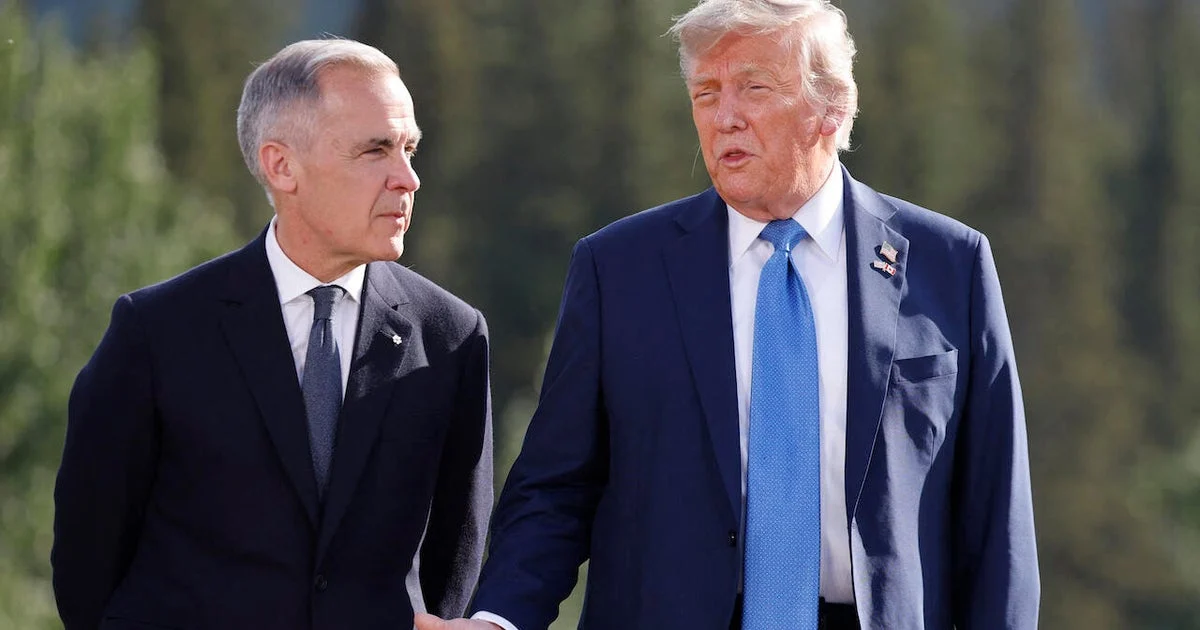
President Trump is imposing 50% tariffs on a wide array of Canadian goods, ranging from essential hockey equipment to popular alcoholic beverages, marking a significant escalation in the ongoing and increasingly contentious trade dispute between the United States and Canada. These new duties, unveiled in a series of presidential proclamations signed on Monday, July 20, 2026, are slated to take effect on August 19, 2026, deepening the economic rift between two historically close allies and major trading partners. The White House has characterized Canada’s trade actions as "unreasonable, unequal, and discriminatory," asserting that these measures, some of which were initiated following Mr. Trump’s initial imposition of tariffs on Canada last year, necessitate a firm response to safeguard American commercial interests.
Deepening the Trade Chasm: A Chronology of Escalation
The current round of tariffs represents a critical juncture in a trade relationship that has been increasingly fraught with tension since the early days of Mr. Trump’s second term. The seeds of this latest escalation were sown last year when Canada responded to previous U.S. tariffs by implementing its own duties on certain American auto imports. In retaliation, the Trump administration has now levied tariffs on a diverse range of Canadian products. These include not only specific electronics, sporting goods like hockey equipment, and agricultural products such as honey and flower bulbs, but also industrial materials like down feathers and plywood, along with animal products like cowhides and luxury items such as jewelry. Furthermore, the White House has specifically targeted Canadian beer, wine, liquor, and milk. This move is a direct response to reported Canadian boycotts of U.S. alcohol — a retaliatory measure by some provinces following last year’s tariffs — and longstanding Canadian quotas on dairy imports, which have been a persistent point of contention for U.S. dairy producers.
A senior administration official, speaking to reporters on Monday, confirmed that goods currently flowing across the border under the U.S.-Mexico-Canada Agreement (USMCA) will not be exempt from these new tariffs. The USMCA, a trade deal brokered and signed during Mr. Trump’s first term, was intended to modernize and stabilize North American trade relations, replacing the decades-old NAFTA. The official emphasized that despite the imposition of these significant new duties, the administration does not view this as entering a full-blown trade war with Canada, and remains open to negotiations. However, the U.S. insists on its right to respond to what it perceives as Canada’s discriminatory trade practices, framing Canada and China as unique among trading partners in their sustained retaliation against Mr. Trump’s tariff-heavy trade strategy.
U.S. Trade Representative Jamieson Greer articulated the administration’s stance in a statement: "While the Administration continues to secure fair and reciprocal trade deals with our trading partners, Canada, unlike other partners and allies, continues to retaliate against the United States for its efforts to rebalance trade and protect U.S. industry in national-security sensitive sectors." This statement underscores the administration’s framing of the tariffs as a defensive measure aimed at achieving "fair and reciprocal" trade.
Legal Framework and Presidential Authority
The legal basis for these new levies is Section 338 of the Tariff Act of 1930. This provision grants the President the authority to impose duties of up to 50% on any country deemed to be "discriminating" against U.S. commerce. The senior administration official acknowledged the unprecedented nature of this specific application of Section 338, noting that it has not been utilized in this manner before. Nevertheless, the administration expresses confidence in its legal authority to implement these tariffs. This assertion comes in the wake of a significant legal challenge earlier this year, when the Supreme Court constrained Mr. Trump’s tariff-imposing powers by ruling that he could not use a separate emergency powers law to levy import duties. The reliance on Section 338, therefore, appears to be a strategic pivot in the administration’s approach to trade enforcement, aiming to operate within parameters that have not been explicitly challenged by recent judicial rulings.
Canada’s Stance and Anticipated Reaction
CBS News has reached out to the office of Canadian Prime Minister Mark Carney for official comment. While an immediate response was not available, Canada’s historical responses to U.S. trade actions provide a strong indication of their likely reaction. Given past retaliatory measures, including tariffs on U.S. goods and provincial boycotts of American products, it is highly probable that Prime Minister Carney’s government will condemn these new tariffs as unwarranted and detrimental to bilateral relations. Canada has consistently advocated for open trade and has often viewed U.S. protectionist measures as violations of existing trade agreements and principles. It is plausible that Canada will consider its own counter-retaliatory tariffs, further deepening the cycle of trade protectionism, or seek diplomatic avenues for de-escalation, though the latter has proven difficult in previous instances. Canadian industry groups, particularly those in the affected sectors like dairy, alcohol, and sporting goods, are also expected to voice strong opposition and concern over the potential economic fallout.
Economic Interdependence and Impact
Canada is an indispensable trading partner for the United States, ranking as the second-largest after Mexico. Federal data highlights the immense scale of this economic relationship, with over $300 billion worth of goods flowing across the U.S.-Canada border in just the first five months of the current year. This figure underscores the profound interdependence of the two economies and the significant disruption that widespread tariffs can inflict.
The economic implications of these 50% tariffs are multifaceted and potentially severe for businesses and consumers on both sides of the border. For U.S. importers and retailers of Canadian goods, the tariffs will translate directly into higher costs, which are likely to be passed on to consumers. This could lead to increased prices for popular items such as Canadian beer and spirits, specialty dairy products, and even essential sporting equipment. American industries reliant on Canadian components or raw materials may face supply chain disruptions and increased operational costs.
Conversely, Canadian exporters will experience a significant reduction in demand from the U.S. market, potentially leading to job losses in affected sectors and a downturn in export revenues. Industries such as the Canadian dairy sector, already operating under a supply management system that the U.S. has criticized, will face additional pressure. The automotive sector, though not directly targeted in this specific round for direct tariffs on vehicles (unlike the previous Canadian retaliation), remains a critical and highly integrated industry that could feel indirect effects or become a future target if tensions continue to mount.
A History of Rocky Relations and Unresolved Tensions
The trade relationship between the U.S. and Canada has been characterized by persistent turbulence since the early weeks of Mr. Trump’s second term. Initially, the President threatened substantial tariffs on both Canada and Mexico, citing what he perceived as insufficient efforts to curb drug trafficking and migrant flows across their respective borders. Canada’s response included the rollout of its own tariffs on U.S. goods, and certain Canadian provinces went further, implementing retaliatory measures such as removing American alcohol products from store shelves.
While the Trump administration later engaged in trade talks with Canada, which ultimately led to the negotiation and implementation of the USMCA, and subsequently rolled back some of its more stringent tariffs by exempting goods compliant with the agreement, underlying tensions have never fully dissipated. Mr. Trump has periodically threatened to hike tariffs again and notably chose not to renew the USMCA past its 2036 expiration, signaling a potential return to trade uncertainty. Beyond trade, the relationship has also been strained by disagreements over NATO funding and Mr. Trump’s recurrent, though often jocular, musings about annexing Canada.
More recently, the issue of Canadian wildfires added another layer of complexity to the bilateral relationship. Late last week, Mr. Trump publicly threatened additional tariffs on Canada, attributing the widespread smoke that blanketed the eastern and midwestern U.S. to Canada’s handling of the fires, arguing the country had been "invaded by filthy, polluted, and unhealthy air." While Canada has defended its fire management efforts, the senior administration official clarified that Monday’s newly announced levies "are not the so-called wildfire tariffs." However, the official confirmed that presidential advisers are actively sharing options with Mr. Trump regarding potential additional measures related to the wildfire issue, indicating that this particular grievance could still lead to further economic action.
Broader Implications and the Future of North American Trade
The imposition of these new tariffs carries significant implications beyond the immediate economic impact. Diplomatically, it further strains a crucial alliance, potentially undermining cooperation on other shared challenges, from continental security to environmental issues. Politically, it sends a strong signal about the Trump administration’s unwavering commitment to its "America First" trade agenda, even at the cost of alienating close partners.
The decision to apply tariffs even to goods covered by the USMCA raises questions about the long-term stability and effectiveness of the agreement itself. While the USMCA remains in effect, its spirit of free and fair trade is clearly being tested by these unilateral actions. The precedent set by using Section 338 in this manner could also embolden future administrations to employ similar tactics, potentially leading to a more volatile global trade environment.
For global markets, the ongoing U.S.-Canada trade dispute contributes to broader uncertainty, particularly as the global economy navigates post-pandemic recovery and geopolitical shifts. It reinforces a perception of increased protectionism among major economies, which could deter investment and hinder global economic growth. The situation with Canada, a G7 ally, also contrasts with the more widely accepted premise of trade disputes with geopolitical rivals like China, highlighting the unique challenges faced when trade tensions arise between traditionally friendly nations.
As the August 19 effective date approaches, businesses in both countries will be scrambling to assess the full impact and adjust their supply chains and pricing strategies. The coming weeks are likely to see intense lobbying efforts from affected industries and renewed diplomatic pressure. The trajectory of this dispute will depend heavily on Canada’s official response and whether both nations can find a path back to the negotiating table to de-escalate what has become a deeply entrenched and economically damaging trade conflict.

