
The visual cues of a successful classroom are often deceptive. To an outside observer, a classroom where every student is quietly working, materials are organized, and instructions are followed to the letter appears to be a model of pedagogical excellence. However, educational experts and researchers are increasingly identifying a phenomenon known as the "engagement trap," where high levels of student compliance mask a profound lack of cognitive development. Dr. Christopher Feiler and other leading voices in STEM education argue that when a lesson runs too smoothly, it may indicate that the task is devoid of the intellectual friction necessary for genuine learning. The distinction between a student being "busy" and a student "thinking" has become a focal point in the national conversation regarding Science, Technology, Engineering, and Mathematics (STEM) curriculum reform.
The fundamental challenge in modern STEM education is the over-scaffolding of tasks. In an effort to ensure student success and maintain classroom order, many educators provide what is colloquially known as "bowling with bumpers." By removing all obstacles and providing step-by-step instructions that lead to a guaranteed result, the educational process is reduced to a series of checkboxes. While this approach results in high completion rates and visually impressive projects, it often bypasses the critical thinking, trial-and-error, and decision-making processes that define the scientific method and engineering design.
The Landscape of STEM Achievement and the Scaffolding Paradox
The push for more rigorous STEM standards comes at a time when global assessments, such as the Programme for International Student Assessment (PISA), suggest a stagnation in the application of scientific knowledge among students in several developed nations. While students may perform well on standardized tests that measure rote memorization, they frequently struggle when faced with novel problems that require the integration of multiple concepts. This "application gap" is often traced back to the daily classroom experience.
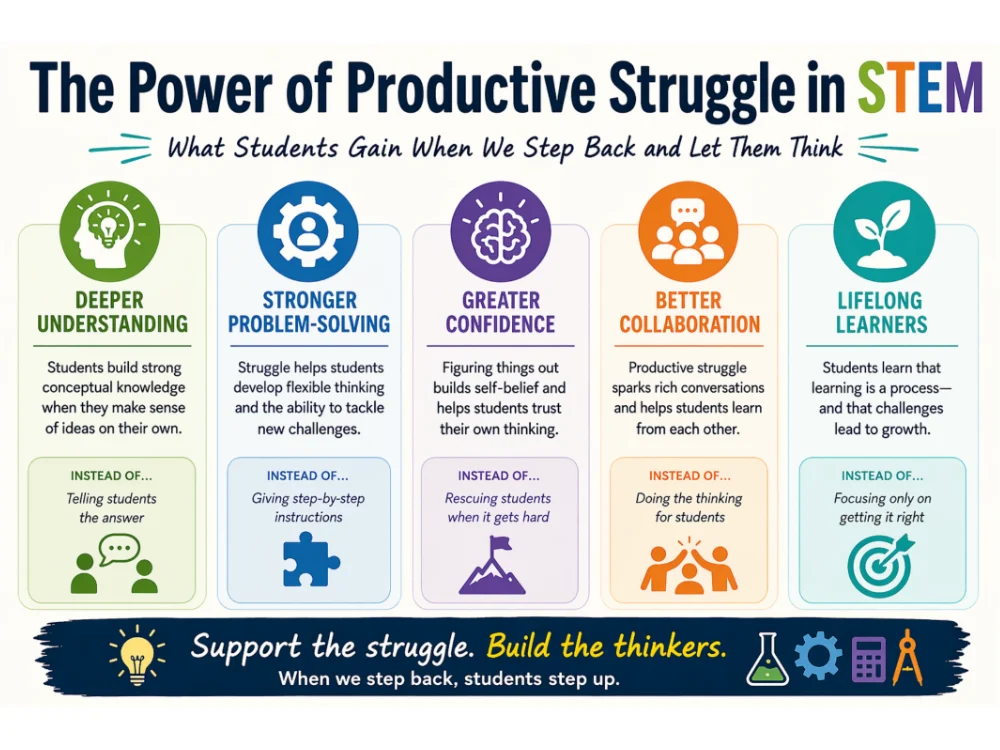
The scaffolding paradox suggests that the more support a teacher provides to ensure a "correct" outcome, the less the student actually learns about the underlying mechanics of the problem. Educational psychologists point to the "Zone of Proximal Development," a concept introduced by Lev Vygotsky, which posits that learning occurs when students are challenged just beyond their current independent capability. When a task is too easy, the student remains in their comfort zone; when it is too hard, they experience shut-down. The "just right" middle ground—often referred to as productive struggle—is where neuroplasticity and long-term retention occur.
Five Indicators of Low-Cognitive Demand in STEM Lessons
To address the prevalence of low-rigor tasks, researchers have identified five specific red flags that suggest a lesson may be too easy for the intended learning outcomes.
-
High Velocity Without Friction: When students finish a complex task significantly faster than anticipated without encountering any roadblocks, it is rarely a sign of mastery. Instead, it suggests the task was a procedural exercise rather than a conceptual one. Speed, in this context, replaces the slow, deliberate processing required to synthesize new information.
-
Uniformity of Output: In a true engineering or scientific inquiry, variables and individual perspectives should lead to a variety of results. If every student in a class of thirty produces an identical model or arrives at the same conclusion using the exact same steps, the lesson has likely moved from creativity to mimicry. This "copying with confidence" creates a false sense of achievement.
-
The Prevalence of Validation-Seeking: One of the most telling signs of a lack of thinking is the frequency of the question, "Is this right?" This inquiry indicates that the student is not evaluating their own logic or testing their hypothesis against the evidence; rather, they are seeking confirmation that they have followed the teacher’s "recipe" correctly. Authentic learning shifts the question from "Is this right?" to "Why did this happen?" or "What if I tried this?"
-
Absence of Decision Points: A lesson that follows a strictly linear path (e.g., Step 1 through Step 10) eliminates the need for student agency. Without "forks in the road," students are essentially passengers in their own education. If a task can be completed without a student having to choose between two or more viable paths, the cognitive load is insufficient.
-
Premature Intervention: Educators often feel a natural urge to "rescue" a student who is hesitating. However, jumping in too early to explain or guide removes the opportunity for the student to process the confusion. Silence and hesitation are not signs of failure; they are the physical manifestations of cognitive processing.
The Chronology of Instructional Shift: A Case Study in Wind Power
The transition from a high-compliance/low-rigor environment to a high-rigor environment can be seen in the evolution of a common STEM activity: building a wind-powered car.
In the traditional "easy" version of the lesson, students are given a kit with pre-cut materials and a manual. They follow the instructions, the car moves when placed in front of a fan, and the lesson is deemed a success. However, post-activity assessments usually show that students cannot explain the relationship between sail surface area and torque, or why the car’s center of gravity matters.
In an enriched version of the same lesson, the instructions are intentionally "broken." Students might be given the materials but no specific directions on how to attach the sail or where to place the axles. The immediate result is often perceived as "chaos" or "failure": some cars do not move, others spin in circles, and many students express frustration.
Data collected from such shifts show that this is the point where real learning begins. Forced to make decisions, students begin to argue over design choices, test multiple configurations, and analyze why their peers’ designs are succeeding or failing. This iterative process mirrors the real-world work of engineers and leads to a much deeper understanding of the physics involved.
Strategies for Increasing Cognitive Demand
Education experts suggest that teachers do not need to discard their existing curriculum to increase rigor. Instead, small, strategic adjustments can transform a passive activity into an active one.
- Strategic Omission: By removing a single step from a set of instructions, a teacher creates a "gap" that the student must bridge. This requires the student to infer the next logical move based on the objective.
- Introducing Decision Points: Teachers can provide students with a choice of materials or methods, requiring them to justify their selection. This shifts the ownership of the process from the teacher to the learner.
- Extended Wait Times: Increasing the "wait time" after asking a question or after a student encounters a problem has been shown to increase the complexity of student responses.
- Shifting Questioning Techniques: Replacing evaluative questions ("Is it correct?") with metacognitive questions ("Why did you choose that approach?") forces students to articulate their thinking process.
Economic and Global Implications
The stakes for improving STEM rigor extend beyond the classroom. The modern global economy increasingly demands a workforce capable of "non-routine cognitive" tasks. According to reports from the World Economic Forum, critical thinking and complex problem-solving are the top skills requested by employers across all sectors.
If the education system continues to reward compliance and the ability to follow directions over the ability to make decisions under uncertainty, it risks producing a workforce that is easily replaced by automation. The "Thinking Test"—asking whether a task can be completed without making a decision—serves as a benchmark for whether schools are preparing students for the complexities of the 21st century or merely training them for roles that no longer exist.
Final Analysis
The goal of increasing the difficulty of STEM tasks is not to make school more punishing, but to make thinking unavoidable. When everything is scaffolded, nothing is truly "figured out" by the student. The transition from being a passenger in the learning process to being the driver requires a willingness from both teachers and students to embrace friction, error, and ambiguity.
As the educational landscape continues to evolve, the metric for a successful lesson must shift from the smoothness of the delivery to the depth of the decisions made by the students. In the words of Dr. Feiler, "Nobody gets better by sitting in the passenger seat." Authentic STEM learning requires that students take the wheel, navigate the obstacles, and occasionally get lost—because it is in finding the way back that the most profound learning occurs.

