
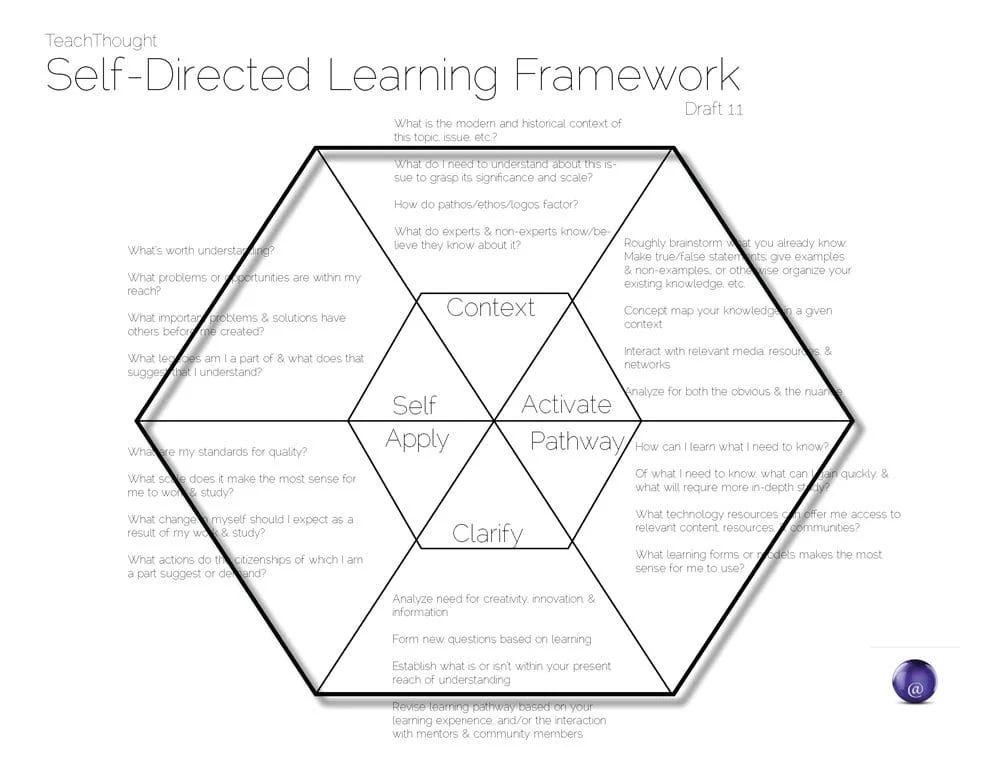
The shift from a traditional, answer-oriented educational model toward one centered on student-led inquiry is fundamentally redefining the landscape of modern instruction. While the historical objective of schooling was often the mastery of specific content and the ability to produce correct responses, contemporary pedagogical research suggests that the ability to formulate high-quality questions is a more accurate indicator of cognitive development and authentic understanding. This transition emphasizes that while answers often represent the end of a thought process, questions serve as the engine of continuous learning, reflecting a student’s ability to synthesize known information while identifying gaps in their own knowledge.
The Cognitive Mechanics of Inquiry
In the context of educational psychology, a question is far more than a request for information; it is a sophisticated artifact of critical thinking. To ask a "piercing" question requires a student to first possess a baseline of knowledge and then apply a meta-cognitive layer to see beyond the immediate facts. This process, often described as seeing the "conceptual ecology" of a subject, allows a learner to look both backward at what has been established and forward toward what remains to be discovered.
For example, in a biological study of a water droplet, a student operating at a high level of inquiry does not merely see H2O. They perceive a vessel for life, a chemical solvent, a symbol of environmental health, and a tool for scientific measurement. When a student asks what lies within that droplet or how its composition reflects broader ecological trends, they are demonstrating a "spring-loaded" form of curiosity. This internal drive is what educational theorists describe as the catalyst for deep learning, moving the student from a passive recipient of data to an active participant in the scientific process.
Historical Timeline and the Evolution of Questioning Frameworks
The prioritization of questioning has evolved through several distinct phases in educational history:
- The Socratic Era (c. 400 BC): The foundation of Western inquiry, where the "Socratic Method" used a series of questions to expose contradictions in logic and lead students toward deeper truths.
- The Rise of Standardized Instruction (Late 19th – Early 20th Century): The industrial model of education prioritized the "correct answer" to facilitate mass assessment and workforce readiness for repetitive tasks.
- Bloom’s Taxonomy (1956): Benjamin Bloom and his colleagues developed a classification of educational goals. While often misinterpreted as a hierarchy where "lower-level" recall is inferior, the framework actually intended to show how simple cognitive behaviors integrate to form complex ones.
- The Inquiry-Based Learning Movement (1990s-Present): Educational reformers began advocating for "Essential Questions"—broad, timeless, and arguable queries that guide entire units of study.
- Self-Directed Learning Models (2010s-Present): Contemporary frameworks now emphasize students creating their own curriculum through personal inquiry, reflecting the needs of a 21st-century economy that prizes innovation over rote memorization.
Analyzing the "Bottleneck" of Teacher-Led Questioning
A critical challenge in the modern classroom is the "efficiency bottleneck" created by teacher-led questioning. In a typical classroom of 25 to 30 students, a teacher often feels pressured by an aggressively paced curriculum to "cut to the chase." This often results in universal, broad-sweeping questions designed to keep the group on track, rather than addressing the specific cognitive needs of the individual.
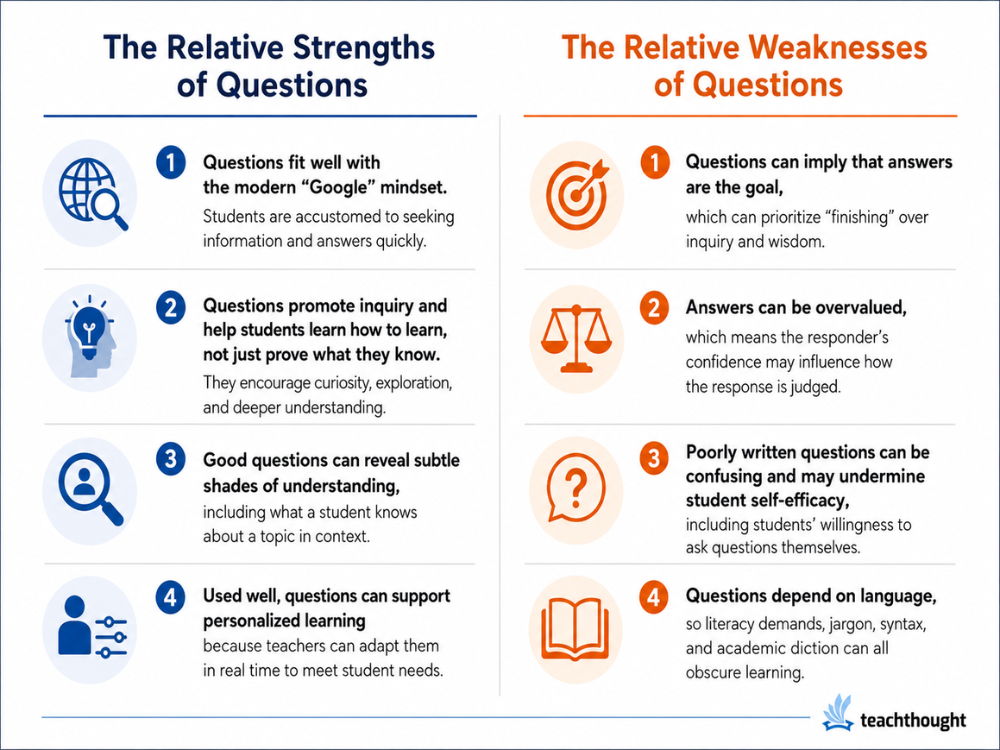
Data from educational observations suggest that when teachers dominate the questioning process, student engagement often takes a "guess-what-the-teacher-is-thinking" form. Conversely, when the pattern is reversed and students are encouraged to ask the questions, the learning becomes automatically personalized. An authentic student question is a reflection of their unique fascinations and gaps in understanding. By shifting the responsibility of inquiry to the learner, educators can gain a much clearer view of a student’s actual progress, as questions often reveal far more about the depth of a person’s thinking than a standardized answer ever could.
The Spectrum of Questioning Purposes
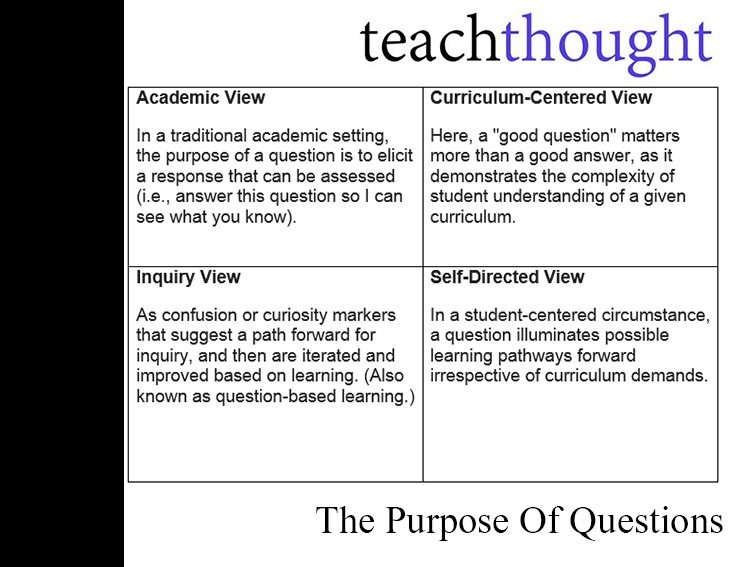
Educational theorists, including TeachThought founder Terry Heick, categorize the purpose of questions along a spectrum ranging from traditional to progressive:
The Academic View (Traditional)
In this setting, the question is a tool for assessment. The goal is to elicit a response that can be graded to verify that the student has retained specific information.
The Curriculum-Centered View
Here, the value of a "good question" begins to outweigh the "good answer." The question is used to demonstrate the complexity of a student’s understanding of a pre-defined set of standards.
The Inquiry-Based View (Progressive)
Questions are treated as markers of curiosity. They are used to suggest a path forward for investigation and are iterated upon as the student gains more knowledge. This is often referred to as "question-based learning."
The Self-Directed View (Advanced Progressive)
In this model, the student’s own questions center and catalyze the entire learning experience. The curriculum is not a fixed path but a series of potential pathways illuminated by the student’s internal demand for knowledge.
Supporting Data and the Impact of Cognitive Dissonance
Research into cognitive science highlights the role of "cognitive dissonance" in the learning process. This occurs when a student holds two competing beliefs or is presented with information that challenges their existing worldview. Strategic questioning—particularly the Socratic style—is the primary tool used by educators to induce this state.
When a student is forced to confront a question that they cannot answer with their current mental model, they arrive at a cognitive crossroads. They must either adjust their belief system or evaluate the validity of the question. This friction is where significant intellectual growth occurs. Studies indicate that students who are regularly exposed to questions that promote cognitive dissonance show higher rates of retention and a more robust ability to apply critical thinking skills in non-academic contexts.
Tactical Implementation: Strategies for the Modern Classroom
To move beyond theoretical benefits, educators have developed several high-impact strategies to foster a culture of inquiry:
The Question Formation Technique (QFT)
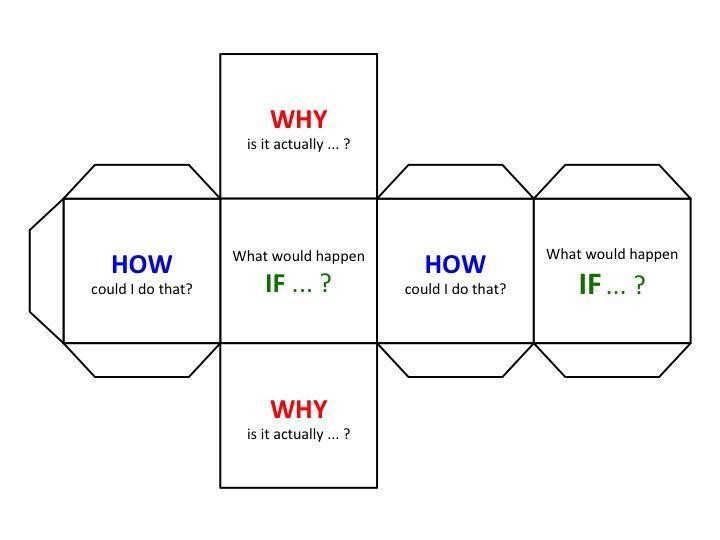
Developed by the Right Question Institute, this strategy involves providing a "Question Focus" (a statement, image, or video) and requiring students to generate as many questions as possible without judging or answering them. This de-emphasizes the "correctness" of the inquiry and encourages volume and divergent thinking.
Think-Pair-Share
This collaborative strategy allows students to process a thought-provoking prompt individually before discussing it with a peer. This "low-stakes" environment encourages students who might be hesitant to ask questions in front of a large group to refine their inquiries with a partner first.
The Wonder Wall
A "Wonder Wall" is a dedicated physical or digital space where students post questions that arise during lessons. By making inquiry visible, the classroom environment validates curiosity as a core component of the learning process. Teachers can then pull from this "wall" to guide future research projects or class discussions, ensuring the curriculum remains responsive to student interests.
The Role of "Lower-Level" Questions in Foundation Building
While modern pedagogy emphasizes "higher-order" thinking—such as analysis and evaluation—experts caution against dismissing "lower-level" questions. Recall-based questions involving dates, names, and definitions provide the necessary "foothold" for more complex thought.
As noted by the late educational researcher Grant Wiggins, the phrases "higher-order" and "lower-order" do not actually appear in Bloom’s original taxonomy. Instead, the framework suggests that simple behaviors (like defining a term) must be integrated to perform complex behaviors (like evaluating a theory). Without a foundation of factual knowledge established through lower-level inquiry, higher-level strategies such as "critical analysis" lack the necessary substance to be effective.
Broader Implications for 21st-Century Literacy
The transition toward a question-centric education system has profound implications for the future workforce. In an era dominated by Artificial Intelligence and rapid information access, the ability to find answers is becoming commodified. Conversely, the ability to ask the right questions—to frame problems, identify ethical nuances, and imagine new possibilities—is becoming the most valuable human skill.
Educational institutions that prioritize inquiry are essentially "future-proofing" their students. By teaching learners to navigate ambiguity and use questions as a compass, educators are preparing them for a world where the ability to learn, unlearn, and relearn is more important than the temporary mastery of any single dataset. The ultimate goal of education, therefore, is not to fill a bucket with answers, but to ignite a fire of inquiry that continues to burn long after the student has left the classroom.

