
In the rolling hills of rural North Carolina, a middle school program is defying traditional educational tropes by integrating artificial intelligence into daily study and tasking students with the management of an Airbnb to learn the nuances of entrepreneurship. Simultaneously, in rural Indiana, a public school district has launched a nature-based microschool, a direct response to local families who had begun looking toward homeschooling as a more suitable alternative for their children. These are no longer isolated incidents of experimental pedagogy; they represent a fundamental shift in how public school leaders across the United States are responding to the rise of school choice. For decades, the prevailing strategy among district administrators was to resist the expansion of charters, vouchers, and homeschooling through legislative lobbying and legal challenges. However, a new generation of forward-thinking leaders is beginning to view the exercise of school choice not as a terminal threat to be eliminated, but as a critical source of market data regarding what modern families demand from the educational system.
The Post-Pandemic Landscape and the Rise of Homeschooling
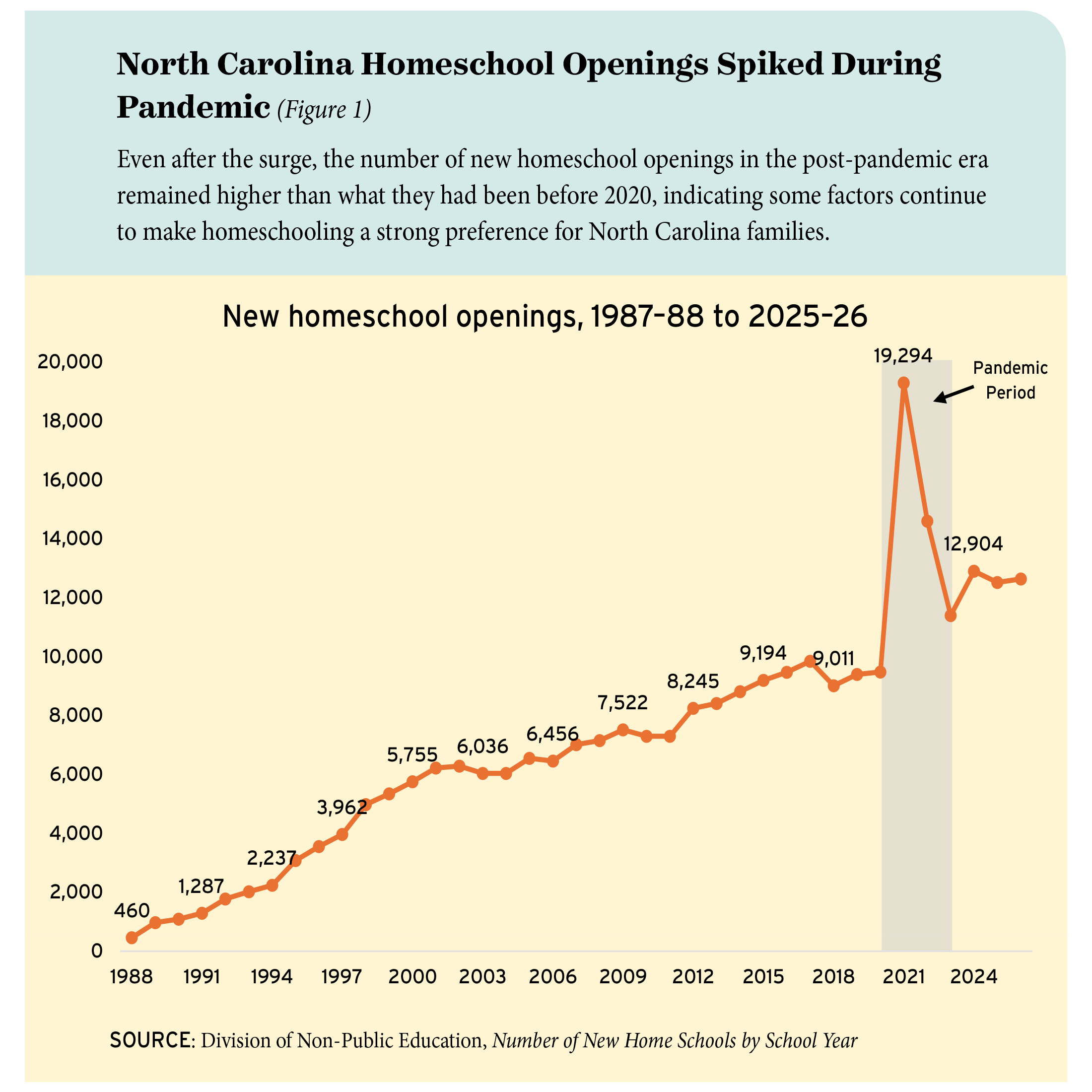
The catalyst for this shift was undoubtedly the COVID-19 pandemic, which served as a massive, involuntary pilot program for alternative education. In North Carolina, a state often cited as a bellwether for educational trends, the data reveals a permanent change in the educational landscape. During the 2019–20 school year, the state recorded 9,481 new homeschool openings. By the 2020–21 school year, that number spiked to 19,294 as families sought to avoid remote learning or health risks. While many analysts predicted a return to "normalcy" once schools reopened, the data suggests otherwise. In the 2025–26 school year, North Carolina recorded 12,643 new homeschool openings—a figure that remains substantially higher than pre-pandemic levels.
Currently, North Carolina hosts approximately 95,190 active homeschools serving an estimated 152,897 students between the ages of 6 and 17. This sector is now so large that it rivals some of the state’s largest public districts. The persistence of these numbers indicates that for many families, the move away from traditional brick-and-mortar public schools was not a temporary emergency measure, but a permanent rejection of the status quo. Public school leaders are now forced to confront the reality that they are operating in a competitive marketplace where "customer loyalty" is no longer guaranteed by ZIP codes.
Analyzing the Shift in Parent Motivations
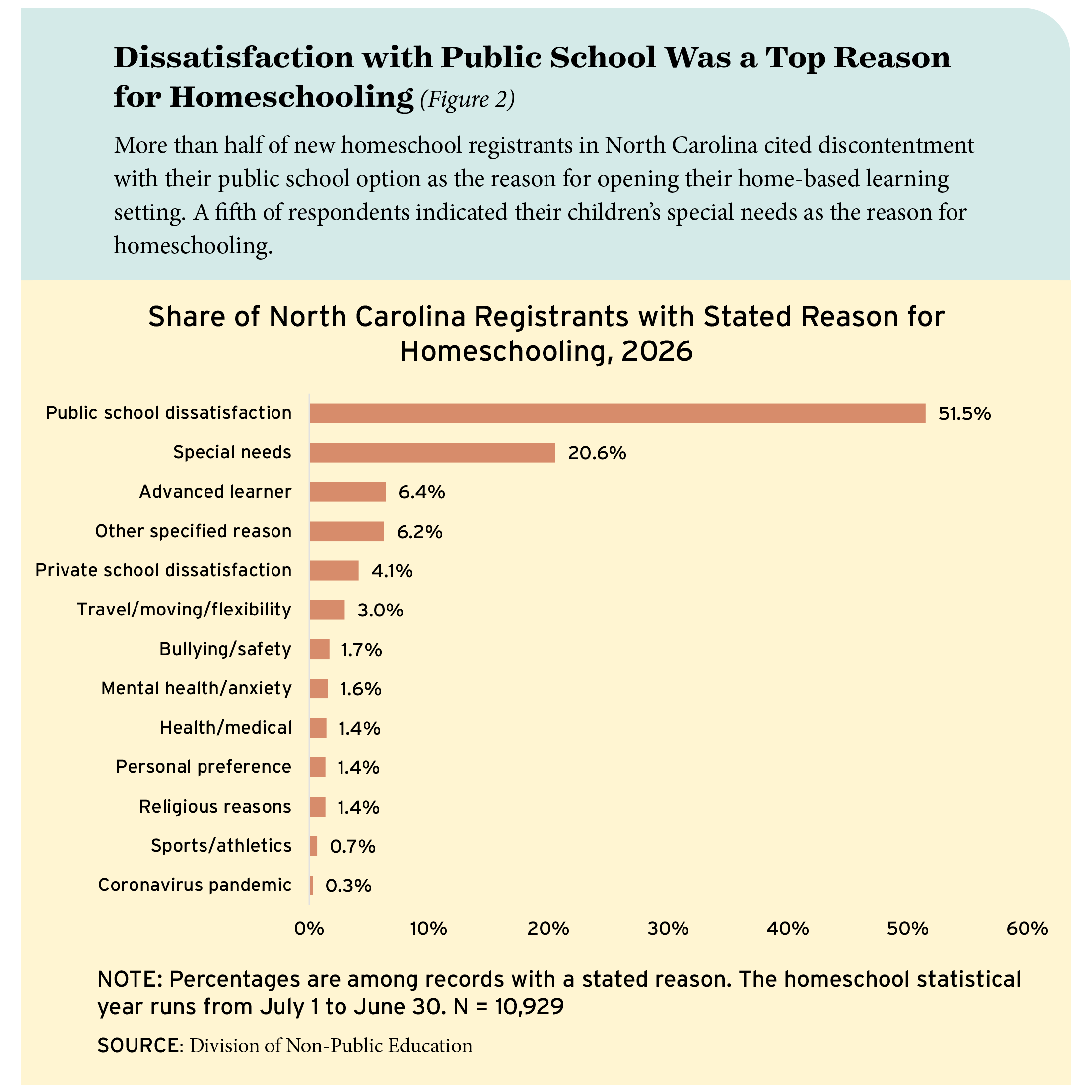
To compete effectively, districts must first understand why families are leaving. North Carolina’s homeschool registration process provides a rare window into these motivations by asking parents to select a primary reason for their departure from traditional systems. The evolution of these responses between 2020 and 2026 highlights a significant trend: the "COVID effect" has been replaced by systemic dissatisfaction.
In the 2020–21 school year, 54.1 percent of parents cited the pandemic as their primary reason for homeschooling. By the 2025–26 school year, the pandemic has virtually disappeared from the data. Instead, "dissatisfaction with the public school system" has surged to the forefront, cited by 51.5 percent of new homeschoolers. This is followed by 20.6 percent who cited special needs requirements and 6.4 percent who sought to accommodate advanced learners.
Crucially, dissatisfaction with public schools is now more than 12 times as common as dissatisfaction with private schools among those entering the homeschool sector. This data suggests that the "choice" movement is not merely an ideological preference for private or religious education, but a specific critique of the public system’s inability to provide individualized instruction, safety, or academic rigor.
Strategic Responses from District Leaders
Recognizing this competitive pressure, several states have begun to pivot their rhetoric and policy. West Virginia Board of Education President Paul Hardesty recently signaled this change in tone, stating that public schools are "competing for enrollment, whether we want to believe it or not." Hardesty argued that the only viable response for the public sector is to become "more accommodating, more receptive, and more accessible to parents and students."
This "market-responsive" approach is taking several forms across the country:
- Specialized Career Pathways: In Alabama, Jefferson County Superintendent Walter B. Gonsoulin Jr. has overseen the launch of more than 20 high school career academies. These programs allow students to earn industry-recognized certifications alongside their diplomas, directly addressing the concern that traditional high schools do not sufficiently prepare students for the modern workforce.
- Microschooling and Flexibility: Districts in Indiana and North Carolina are experimenting with smaller, "boutique" learning environments. By creating microschools within the public system, districts can offer the small-class sizes and specialized curriculum (such as nature-based or AI-focused learning) that families typically seek in the private or homeschool sectors.
- Data-Driven Outreach: In Des Moines, Iowa, district leaders have implemented sophisticated enrollment tracking and parent outreach programs. By analyzing exactly when and why families withdraw, the district can tailor its marketing and program development to plug "leaks" in its enrollment.
- Branding and Communication: North Carolina’s Department of Public Instruction has launched the "Find Your Fit, Build Your Future" initiative. This campaign aims to rebrand public education as a portfolio of choices—including early college high schools, Career and Technical Education (CTE) credentials, magnet programs, and virtual learning—rather than a one-size-fits-all mandate.
The Role of Parent Voice in Systemic Reform
A central component of this new strategy is the formalization of parent feedback. North Carolina State Superintendent Maurice “Mo” Green recently established a statewide Parent Advisory Council. This follows a similar initiative by his predecessor, Catherine Truitt, who reserved seats on her commission for parents of students in traditional public, charter, private, and homeschool environments.
The logic behind including non-public school parents is pragmatic: if the public system intends to win back families, it must listen to the people who chose to leave. As Truitt noted during her tenure, "If we’re going to be the first choice for families, then we need to understand why some families are choosing not to send their kids to us."
Educational policy experts, including Anna J. Egalite of North Carolina State University, suggest that states should go further by refining the questions asked during homeschool registration. By asking parents to specify whether their "dissatisfaction" stems from safety concerns, lack of academic challenge, or school culture, districts could gain the granular data needed to make surgical improvements to their local schools.
Implications for the Future of American Education
The long-term implication of this trend is the potential "blurring" of the lines between public and private education. As public districts adopt the traits of the "choice" sector—such as specialized curricula, flexible scheduling, and smaller learning communities—the distinction between a "public school" and a "charter" or "microschool" becomes less about the pedagogical approach and more about the funding mechanism.
However, this shift also presents challenges. Critics of the competitive model argue that it may lead to "educational inequity," where districts with more resources can innovate more rapidly than those in impoverished areas. There is also the concern that by trying to be "everything to everyone," public schools may dilute their core mission or struggle with the logistical complexities of managing dozens of disparate programs.
Despite these concerns, the data from the mid-2020s suggests that the era of the public school monopoly is over. The states and districts that are thriving are those that have stopped viewing school choice as an enemy to be defeated and started viewing it as a roadmap for reform.
Chronology of the School Choice Evolution
- 2010–2019: The "Charter Era." Public districts largely focus on legislative efforts to cap charter school growth and protect traditional funding formulas.
- March 2020: COVID-19 triggers nationwide school closures. Parents gain an unprecedented look at public school curricula via remote learning.
- 2020–2021: Homeschooling spikes. North Carolina sees a 100% increase in new homeschool filings.
- 2022–2023: "The Great Expansion." States like Arizona, Florida, and West Virginia pass "universal" school choice laws, expanding Education Savings Accounts (ESAs) to all students regardless of income.
- 2024–2026: The "Public Pivot." District leaders begin launching microschools and career academies specifically designed to compete with the private sector. Public school dissatisfaction officially overtakes pandemic concerns as the primary driver for alternative education.
The shift toward a competitive educational model appears to be permanent. For the public school system to remain relevant, it must continue to evolve from a mandatory service into a preferred destination. The experiments currently underway in rural North Carolina and Indiana are not just novelties; they are the first iterations of a more responsive, diverse, and accessible public education system. By leaning into the competition, public schools are finding that the very "choice" they once feared may be the catalyst they needed to innovate for the 21st century.

