
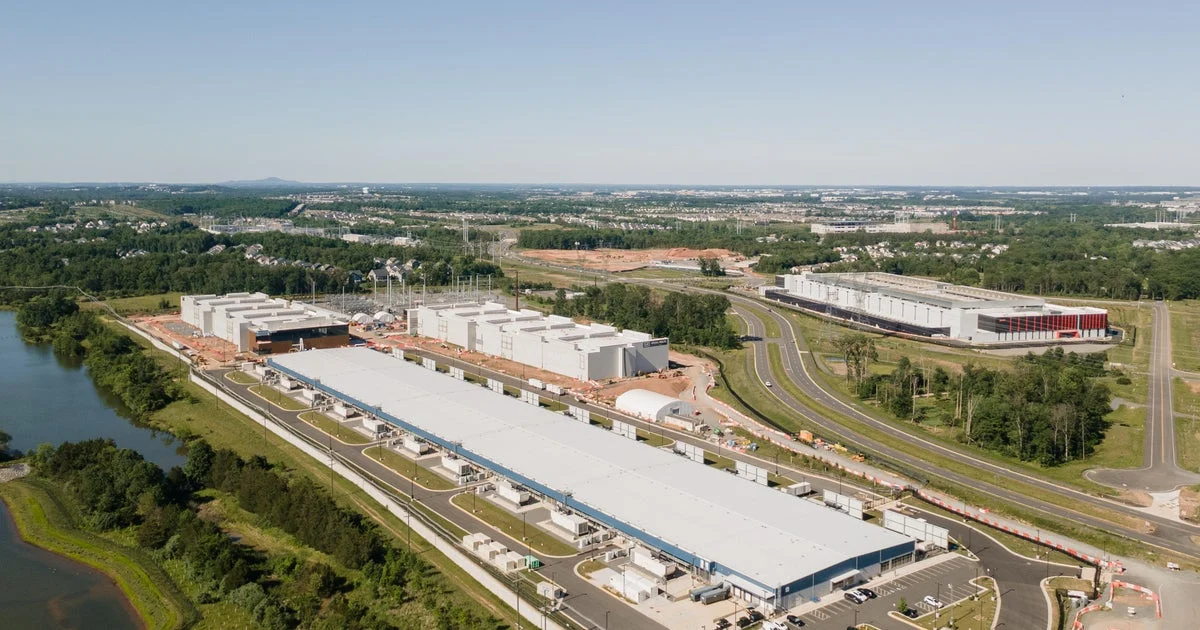
Virginia environmental regulators have levied a record-breaking $2.49 million civil penalty against Microsoft Corporation, marking the largest enforcement action of its kind against a data center in the history of the commonwealth. The fine stems from a severe regulatory violation that occurred in June 2025, when a major electrical failure at a corporate facility in Leesburg forced the prolonged and heavy use of dozens of emergency diesel generators.
The penalty highlights the mounting regulatory and environmental pressures facing the data center industry in Northern Virginia. Often referred to as "Data Center Alley," Loudoun County and the surrounding region host the highest concentration of digital infrastructure in the world. As the demand for artificial intelligence, cloud computing, and digital storage accelerates at an unprecedented pace, the physical infrastructure supporting these technologies has increasingly collided with local environmental protection limits, public health concerns, and infrastructure capacity constraints.
The Anatomy of the June 2025 Violation
According to official documents published by the Virginia Department of Environmental Quality (VDEQ), the enforcement action traces back to a catastrophic electrical substation failure that struck the Microsoft data center campus in Leesburg in mid-June 2025. Deprived of its primary commercial power source to maintain continuous operations for critical cloud infrastructure, the facility was forced to activate its backup power generation systems.
Rather than relying on a handful of backup units, the facility brought an extraordinary 62 emergency diesel generators online simultaneously. These massive combustion engines were run continuously for a full seven-day period while utility providers worked to repair the downed substation and restore stable grid power.
Under the facility’s state-issued air quality operating permits, emergency generators are strictly restricted in terms of runtime and emissions output, intended primarily for short-term testing and unexpected power outages of brief duration. Running 62 heavy-duty diesel engines continuously for a week resulted in massive cumulative emissions that vastly exceeded permitted thresholds. VDEQ testing and reporting confirmed that the facility breached statutory limits for several hazardous air pollutants and greenhouse gas precursors, including carbon monoxide (CO), volatile organic compounds (VOCs), and particulate matter (PM10 and PM2.5).
Fine Structure and the Air Quality Monitoring Initiative
Rather than requiring the entire penalty sum to be paid directly into the state treasury as a standard civil fine, VDEQ negotiated a settlement structure that directly addresses local environmental transparency. Under the terms of the consent order, Microsoft has agreed to redirect $2.4 million of the total financial penalty toward a specialized, high-density environmental monitoring project focused on Loudoun County and neighboring Northern Virginia communities.
The funding will be utilized by state environmental agencies to deploy dozens of advanced air quality sensors strategically positioned throughout geographic zones characterized by dense clusters of data centers. These monitors are designed to track real-time particulate matter, nitrogen oxides, and other industrial pollutants, providing regulators, scientists, and the public with granular data regarding the cumulative atmospheric impact of operating hundreds of diesel generators and massive HVAC cooling systems in close proximity.
"As part of our continued commitment to the communities where we operate, Microsoft will support VDEQ’s expansion of air-quality monitoring in Northern Virginia, as they work to deliver additional data and insight into regional air quality," Microsoft representatives stated in an official communication to news outlets following the announcement of the settlement.
The Epicenter of the Digital Age: Loudoun County’s Rapid Expansion
The enforcement action against Microsoft arrives at a critical cultural and political inflection point for Loudoun County. Located just outside Washington, D.C., the county is globally recognized as the undisputed capital of the internet. According to local economic development figures, more than 250 operational data centers are housed within Loudoun County alone, processing an estimated staggering percentage of the world’s daily internet traffic.
While the region has historically welcomed the digital infrastructure boom due to the immense commercial tax base it generates, the physical reality of hosting hundreds of industrial-scale facilities has sparked an intense backlash from local residents. Communities situated adjacent to massive server farms have increasingly raised alarms regarding constant low-frequency noise pollution from industrial cooling fans, massive water consumption required to cool server racks, and the localized air pollution generated during routine generator testing and emergency grid failures.
Local Political Shockwaves: The One-Year Development Pause
The friction between rapid technological expansion and local livability culminated in a historic legislative maneuver by the Loudoun County Board of Supervisors. In a decisive 7-1 vote, with one abstention, the nine-member board moved forward with a controversial measure to implement a one-year pause on the approval of new data center zoning applications, effective mid-September 2026.
Under the provisions utilized by the board, the policy stops short of an outright legal moratorium, which county attorneys argued would violate state Dillon Rule constraints and expose the municipality to legal challenges. Instead, the action creates a twelve-month window during which the county will not take final action on new zoning proposals or permit approvals for upcoming facilities. Developers are technically permitted to submit initial proposals, but the county review board will freeze all advancement while a comprehensive, months-long study of land-use policies, zoning guardrails, and environmental standards is conducted.
The pause applies strictly to future developments and unapproved applications; it has no legal or operational impact on existing data centers or projects currently under active construction, such as the Microsoft campus involved in the VDEQ violation.
Community Voices and Environmental Justice Concerns
During the lengthy public comment sessions preceding the Board of Supervisors’ vote, residents voiced deep-seated anxieties regarding the long-term degradation of their neighborhoods. Greg Pirio, a resident of Sterling, Virginia, who lives directly across the street from a sprawling data center complex featuring its own dedicated power generation infrastructure, encapsulated the frustrations of many local property owners.
"The community must be involved in setting up the new standards and guardrails to guide data center development and to mitigate the damage that has already been done to the environment and well-being of our community," Pirio testified during the public hearing. For years, residents like Pirio have campaigned against the creeping industrialization of suburban and residential corridors, citing plummeting property values, relentless acoustic disturbances, and fears over long-term respiratory health risks tied to elevated local emissions.
Economic Realities and the Counter-Arguments from Industry Advocates
Conversely, the push to curb or slow data center growth has faced fierce opposition from industry representatives, trade organizations, and local fiscal conservatives who point to the irreplaceable economic engine that the sector represents for Virginia.
Data centers have long served as the primary financial bedrock for Loudoun County’s public services. Industry advocates emphasize that commercial tax revenues generated by server facilities—projected to reach approximately $1.3 billion locally—subsidize a massive share of the county’s public school system, park maintenance, emergency response infrastructure, and public safety budgets. Without this revenue stream, proponents argue, local residential property taxes would need to skyrocket to maintain current service levels.
Nicole Riley, speaking on behalf of the Data Center Coalition, delivered a stern warning to the Board of Supervisors regarding the economic signals sent by regulatory slowdowns.
"Moratoriums and other anti-competitive policies send a signal that an area is closed for business, for data centers, for the many local businesses that provide goods and services that support the data center industry, for the trade unions and schools that are training and growing the construction and operational workforce, and for other significant economic development projects," Riley stated in her written submission to the panel.
Broader Implications for the Future of Cloud Infrastructure
The intersection of the record-setting VDEQ fine against Microsoft and Loudoun County’s administrative pause signals a broader national reckoning for the data center industry. As artificial intelligence models demand exponentially greater computing power, the scale of individual data center campuses is expanding rapidly from multi-megawatt facilities to gigawatt-scale behemoths. This hyper-scaling places unprecedented strain on local electrical grids, water supplies, and air basins.
Environmental analysts note that the Virginia case establishes a critical precedent. As tech giants race to secure uninterrupted power for mission-critical operations, relying on massive fleets of diesel backup generators during grid failures is no longer a localized operational secret; it is an environmental event subject to severe legal scrutiny and multi-million-dollar penalties.
For Northern Virginia, the coming year under the development pause will serve as a crucial testing ground. How the county rewrites its zoning ordinances, regulates backup power emissions, and balances multibillion-dollar corporate investments against the health and quality of life of local residents will likely serve as a blueprint—or a cautionary tale—for municipal governments nationwide facing the relentless physical expansion of the digital age.

