
President Donald Trump announced on Friday that his administration is barring CNN, MS NOW, and Politico from the White House, marking a significant escalation in ongoing tensions between the executive branch and major news organizations. The decision, revealed through a post on Truth Social, targets outlets that the administration has frequently accused of publishing biased or inaccurate coverage. The move has immediately sparked intense national debate, drawing swift condemnation from media organizations, constitutional law scholars, and press freedom advocates who warn of severe legal and democratic ramifications.
The sudden announcement arrives at a time of heightened scrutiny over executive transparency, the boundaries of presidential authority, and the role of the free press in American governance. While administration defenders argue that the executive branch possesses the inherent authority to manage access to its physical workspace, legal experts contend that the selective banning of journalists based on viewpoint constitutes a direct violation of the First Amendment.
The Announcement and Oval Office Defense
The directive was made public on Friday afternoon when President Trump published a statement on Truth Social. In the post, the president declared that the ban would take effect immediately, explicitly naming CNN, MS NOW, and Politico.
"I am proud to announce that, effective immediately, I am banning Fake News CNN, MSNOW … and Politico … from the White House as a result of their constant ‘reporting’ FAKE NEWS!" Trump wrote on the platform. "Media Outlets shouldn’t be able to constantly write or report FICTION and LIES when they’re covering the President of the United States, the Trump Administration, or the United States of America. Other Fake News Media Outlets to follow."
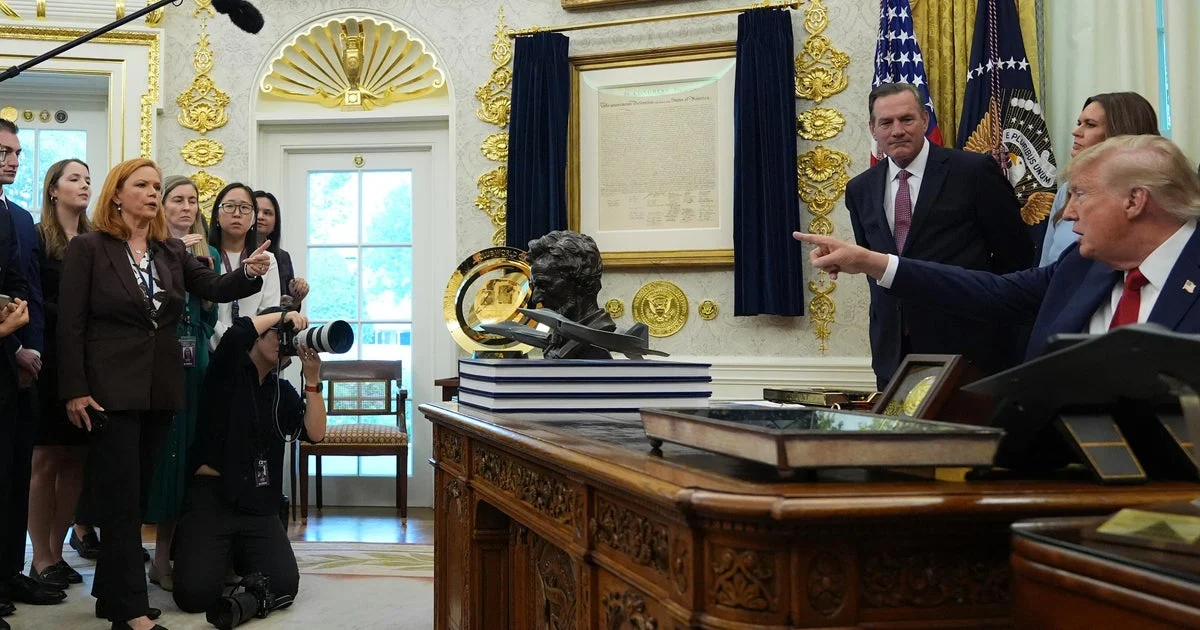
Shortly after the social media post, President Trump fielded questions from reporters during a scheduled healthcare event in the Oval Office. When pressed by journalists regarding how he could reconcile the ban with his constitutional oath, the president offered a direct justification.
"Because they’re fake news," Trump responded. "I get so tired of reading and seeing fake news."
Asked why the administration was implementing the ban at this particular moment, the president indicated that there was no singular catalyst. Instead, he described the decision as the result of a prolonged buildup of grievances.
"It’s really just cumulative stories of the last two years," the president said. "You get sick of it."
When another reporter questioned whether the directive was intended to intimidate the press and deter journalists from fulfilling their professional duties, the president rejected the premise. "No, no, no, no," he said. "I dislike dishonest press, like you. I think you’re terrible."
While the president’s initial statements signaled a broad exclusion, the practical mechanics of the ban remained ambiguous in the immediate aftermath of the announcement. The administration clarified that it does not wish for representatives of the targeted outlets to be present within the Oval Office, though the precise scope regarding wider press pool access, workspaces within the White House complex, and briefing room credentials left legal and media observers seeking definitive guidance. As of late Friday afternoon, journalists representing the affected organizations remained on White House grounds.
Historical Context and Legal Precedents
This latest restriction on media access does not occur in a vacuum; rather, it represents a continuation of contentious interactions between Donald Trump and the mainstream press that span both of his presidential terms. The relationship between the administration and various news organizations has frequently been characterized by public criticism, revocations of credentials, and subsequent litigation.
A notable precedent occurred last year when the White House moved to bar the Associated Press (AP) from presidential coverage. That restriction was enacted after the AP declined to adopt the administration’s preferred nomenclature, specifically refusing to refer to the Gulf of Mexico as the "Gulf of America." In response to the exclusion, the AP filed a federal lawsuit asserting that the administration’s actions violated First Amendment protections against viewpoint-based discrimination.
The legal battle yielded a mixed judicial outcome in the spring of 2025. A federal district judge ruled that the White House was required to restore the AP’s access to primary presidential spaces. However, a federal appeals court subsequently granted a temporary stay, allowing the administration to restrict the AP from smaller, specialized areas while the broader litigation proceeded through the courts. That legal dispute remains active and unresolved.
The dynamic recalls conflicts from President Trump’s first term in office, most notably a high-profile dispute involving then-CNN chief White House correspondent Jim Acosta. In November 2018, following a contentious exchange between the president and Acosta during a televised news conference, the White House revoked the reporter’s press credentials. CNN subsequently filed a federal lawsuit challenging the revocation.
A federal judge ruled in favor of CNN, ordering the immediate restoration of Acosta’s press pass on the grounds that the administration had violated the network’s due process rights under the Fifth Amendment. Complying with the judicial order, the White House restored the credential and subsequently established formal protocols governing the suspension or revocation of press passes, effectively bringing a close to that specific chapter of litigation.
Reactions from the Media and Legal Scholars
The announcement provoked immediate and forceful pushback from the targeted news organizations, as well as from press freedom groups and constitutional law experts who view the ban as an unprecedented threat to institutional norms.
CNN released an official statement defending its journalists and condemning the administration’s directive as an overreach of executive authority.
"CNN stands fully behind our White House team and their fair and accurate reporting," the network stated. "We have a right under the U.S. Constitution to do that reporting without hindrance or interference from the government. Should the ban which President Trump threatened go ahead, it would be an illegal assault on that fundamental and constitutionally-protected right."
Legal scholars similarly argued that the directive stands on precarious constitutional ground. Jameel Jaffer, executive director of the Knight First Amendment Institute at Columbia University, issued a statement labeling the president’s action unconstitutional.
"The First Amendment prohibits the president from punishing journalists because he doesn’t like their coverage, just as it prohibits him from punishing universities because he doesn’t like the courses they offer, or from punishing law firms because he doesn’t like the clients they represent," Jaffer stated. He added that if the administration intends to permanently expel the affected news organizations from the White House press pool, the action would be doubly unconstitutional, noting that the press pool functions as a designated public forum where viewpoint-based exclusions are legally prohibited.
Representatives for Politico and MS NOW also engaged legal counsel to review the administration’s actions, signaling that a coordinated or multi-pronged legal challenge is virtually certain to materialize in federal court.
Broader Implications and Future Outlook
The decision to ban specific media outlets from the White House carries significant implications for the practice of political journalism, government accountability, and the interpretation of First Amendment protections in the digital age.
From a practical standpoint, restricting access to the White House complicates the ability of reporters to provide real-time, on-the-ground reporting of executive branch activities. While modern communications technology allows for remote coverage and digital dissemination of news, physical access to the White House press briefing room, the West Wing, and traveling press pools remains critical for questioning administration officials directly and holding executive power accountable.
From a legal perspective, the anticipated court battles are expected to test the boundaries of executive discretion regarding property management versus the constitutional rights of the press. While the executive branch historically holds broad authority to control access to its physical facilities for security and operational reasons, federal jurisprudence has consistently established that government officials cannot selectively bar journalists from public forums purely on the basis of political viewpoint or editorial content.
As legal teams prepare filings and the administration defends its directives, the standoff between the White House and major media organizations sets the stage for a landmark legal confrontation. The ultimate resolution of these disputes by the federal judiciary will likely establish enduring precedents regarding the constitutional parameters of presidential power and the protections afforded to the press in modern American democracy.

