
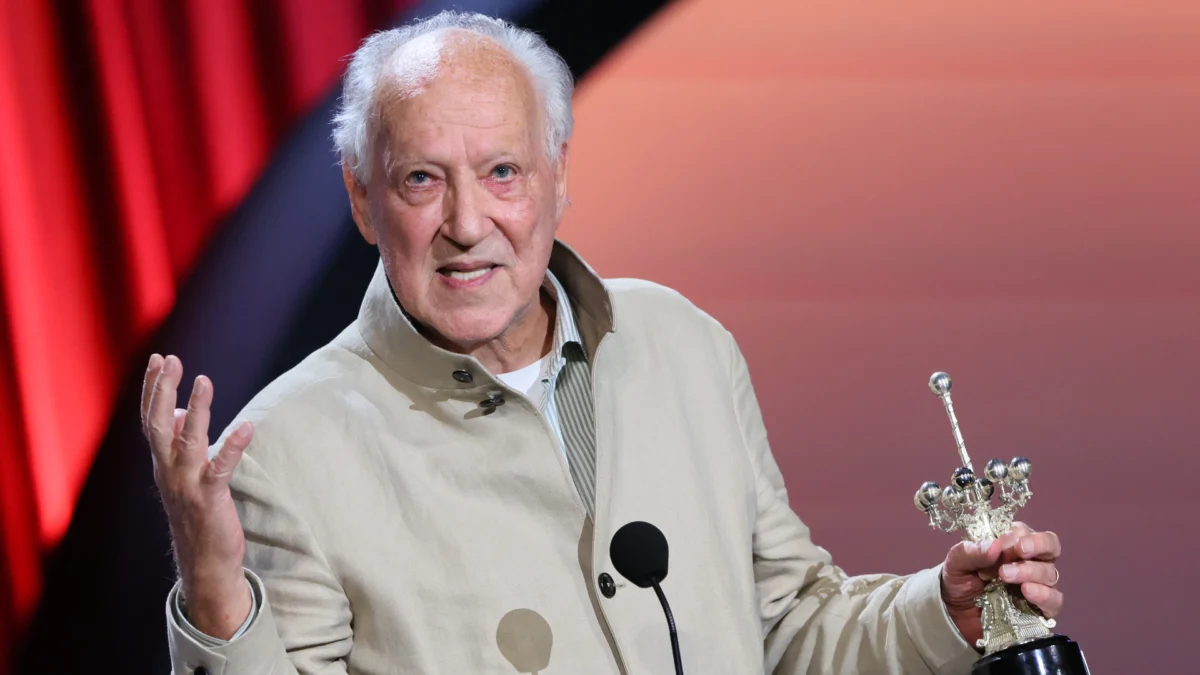
The 74th edition of the San Sebastian International Film Festival commenced on Friday evening with a potent blend of cinematic celebration and urgent geopolitical commentary. Held at the iconic Kursaal Theatre in northern Spain, the opening night was anchored by the presentation of the prestigious Donostia Award to legendary German director, screenwriter, and producer Werner Herzog. While the evening celebrated a titan of world cinema whose career spans more than six decades, the ceremony quickly widened its aperture to address global conflicts, freedom of expression, and international human rights.
The event set a deeply engaged tone for the nine-day festival, which runs from September 18 to September 26. Alongside honoring Herzog’s monumental contributions to the film industry, the evening’s hosts used the global stage to condemn ongoing conflicts, voice solidarity with persecuted filmmakers, and call for strict adherence to international law.
A Tribute to a Cinematic Maverick
The focal point of the celebratory portion of the evening was the bestowal of the Donostia Award upon Werner Herzog, recognized as the San Sebastian Film Festival’s highest accolade. The honor was presented to the 83-year-old auteur by British actor Orlando Bloom, prompting a raucous, prolonged standing ovation from the assembly of European creatives, critics, and industry professionals packed into the Kursaal Theatre.
Bloom, who stars in Herzog’s latest feature Bucking Fastards—a star-studded production that also features Kate and Rooney Mara alongside Domhnall Gleeson—praised the director’s visionary contributions to storytelling. In response, Herzog offered characteristic humility and wit.
“What an honor to receive it from the very hands of Orlando Bloom,” Herzog told the audience from the stage. “He’s a living legend at his young age already. He is a treasure of cinema.”
Herzog’s connection to the region proved to be a central emotional thread of his acceptance speech. Rather than addressing the audience as an outsider, the veteran filmmaker reflected on a grueling personal journey he undertook decades ago. He recalled traveling on foot—covering more than 1,000 kilometers—from the Cannes Film Festival up into the rugged Pyrenees mountain range during the early 1970s, around the time of his landmark production Aguirre, the Wrath of God (1972).
“I’m here standing in front of you, not as a foreigner,” Herzog said. “I’ve had a connection to you, the Basque people, through an early film of mine… But I must confess, I ended up in Biarritz,” he added with a laugh, “not San Sebastian.”
Despite missing his original coastal destination, Herzog emphasized that his interactions with the Basque people left an indelible impression on him. Noting his close attention to Spain’s national poetry competitions, the director of cinematic masterpieces such as Fitzcarraldo (1982), Grizzly Man (2005), and Cave of Forgotten Dreams (2010) concluded, “I feel like as if I belong here. It is a country of poetry. It’s a country of poets, and I receive this here from the poets. Thank you very much.”
The Political Undercurrents of the Opening Night
While Herzog’s lifetime achievement recognition provided a triumphant cinematic high point, the opening ceremony was heavily defined by its overt political declarations. Ceremony hosts Fariba Sheikhan and Mariona Terés delivered remarks that directly addressed humanitarian crises and the precarious safety of documentary filmmakers working in conflict zones.
“We join the myriad of voices calling for an end to genocide, like the one happening in Gaza,” Sheikhan and Terés told the crowd, eliciting thunderous applause from the auditorium. “And we stand in solidarity with the directors of the film NAZA, Yuval Abraham and Rachel Szor, who have been threatened by the Israeli government.”
The hosts’ reference to NAZA highlighted a tense flashpoint connecting the current festival circuit with broader geopolitical debates. The documentary, which recently made waves at the Venice Film Festival, features harrowing testimony from 24 Israeli military officers. These whistleblowers outline the systematic protocols and operational mechanisms they allege the Israeli military utilizes to target and eliminate civilians in the Gaza Strip.
The film emerged as one of the breakout critical successes of the recent Lido showcase, setting a new modern record for the longest standing ovation during its premiere. Following this acclaim, Abraham and Szor were awarded the Special Jury Prize at the Venice Film Festival awards ceremony. However, their triumph has been severely overshadowed by intense political backlash.
Following the film’s release, Israeli Culture Minister Miki Zohar publicly targeted the co-directors, threatening to revoke their Israeli citizenship in retaliation for their cinematic exposure of military protocols. The threats have sparked widespread alarm among international human rights organizations, free-speech advocates, and film industry guilds worldwide, transforming NAZA into a vital test case for artistic freedom and state censorship.
The stance taken by the San Sebastian Film Festival builds upon an institutional precedent established during previous editions. Last year, festival organizers made international headlines by formally calling for an “immediate ceasefire” in the Middle East, explicitly condemning the actions of Israeli Prime Minister Benjamin Netanyahu’s government and describing the humanitarian catastrophe in Gaza using strong language regarding civilian casualties.
Expanding the Scope of International Advocacy
Beyond the situation in Gaza and the threats leveled against the creators of NAZA, the opening night comperes broadened their geopolitical critique to encompass systemic global injustices. Sheikhan and Terés emphasized the urgent necessity of putting an end to the “unilateral breaking of international law, to colonialist looting, to sexual violence and to the cruel wars that systematically violate human rights.”
This uncompromising rhetoric reflects a growing trend among European film festivals, which increasingly view themselves not merely as marketplaces for commercial distribution and artistic celebration, but as vital civic forums where urgent global crises can be spotlighted before international press corps.
Festival Lineup and Opening Film: Ghost Song
Following the politically charged opening ceremony and the celebration of Werner Herzog’s career, the 74th San Sebastian Film Festival officially kicked off its competitive and non-competitive screenings with Ghost Song, the haunting new feature by acclaimed director Fatih Akin.
The film, heavily informed by Akin’s deep appreciation and aesthetic engagement with Japanese anime and manga traditions, centers on two university students whose sudden, love-at-first-sight connection is abruptly shattered by an unexpected tragedy resulting in the untimely death of one of the partners. Critics have praised the film for its atmospheric visual language and emotional resonance, continuing Akin’s track record of exploring complex cultural and emotional landscapes.
As the festival progresses through its nine-day schedule—culminating in the announcement of the Concha de Oro (Golden Shell) winner on September 26—industry analysts will be watching closely to see how the intersection of high-profile cinema and outspoken political discourse continues to shape the cultural dialogue in San Sebastian. With major international projects screening daily and global industry leaders gathered in northern Spain, the 2026 edition has firmly established itself as a platform where cinematic excellence and political conscience are inextricably linked.

